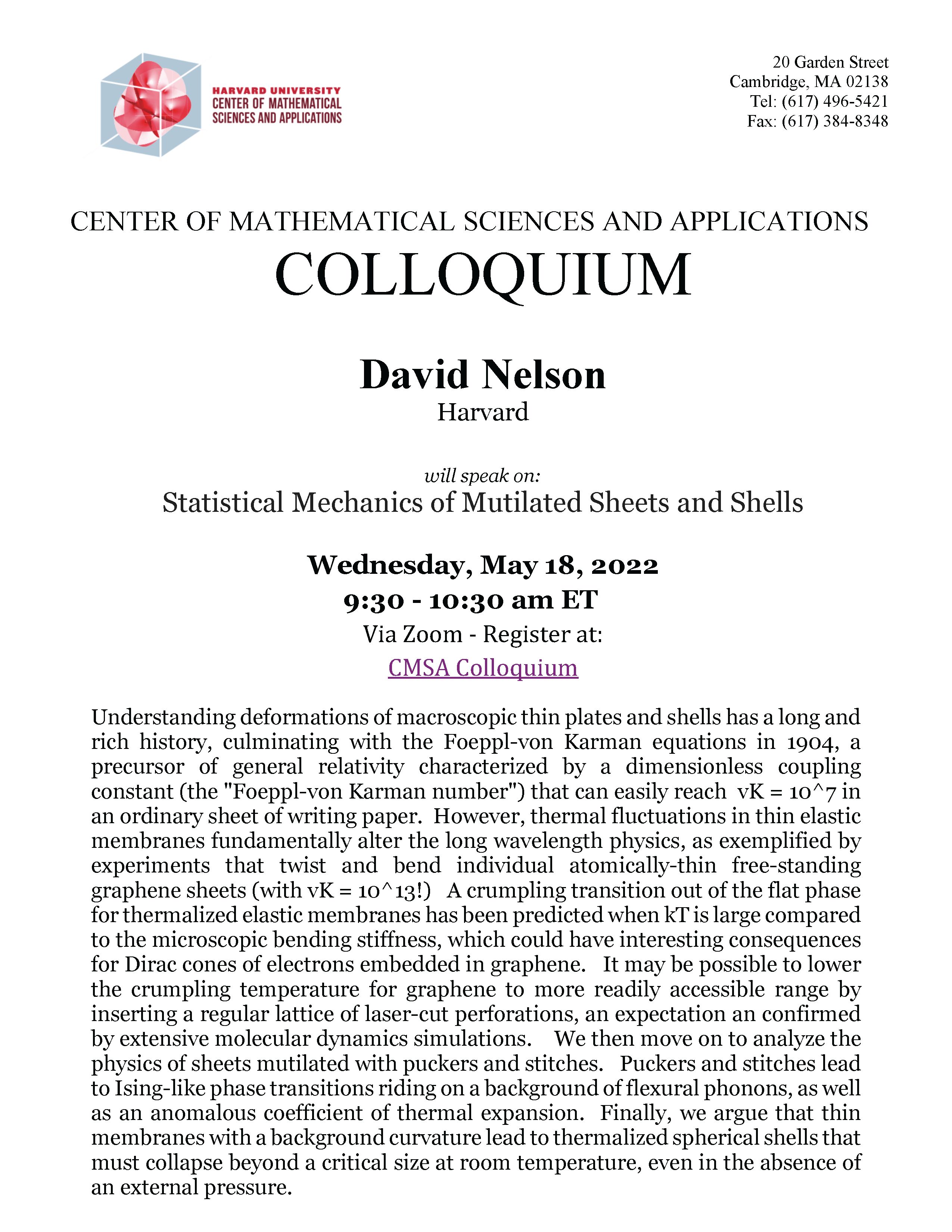
• Statistical Mechanics of Mutilated Sheets and Shells

    Speaker: David Nelson, Harvard University Title: Statistical Mechanics of Mutilated Sheets and Shells Abstract:  Understanding deformations of macroscopic thin plates and shells has a long and rich history, culminating with the Foeppl-von Karman equations in 1904, a precursor of general relativity characterized by a dimensionless coupling constant (the “Foeppl-von Karman number”) that can easily reach  vK […]
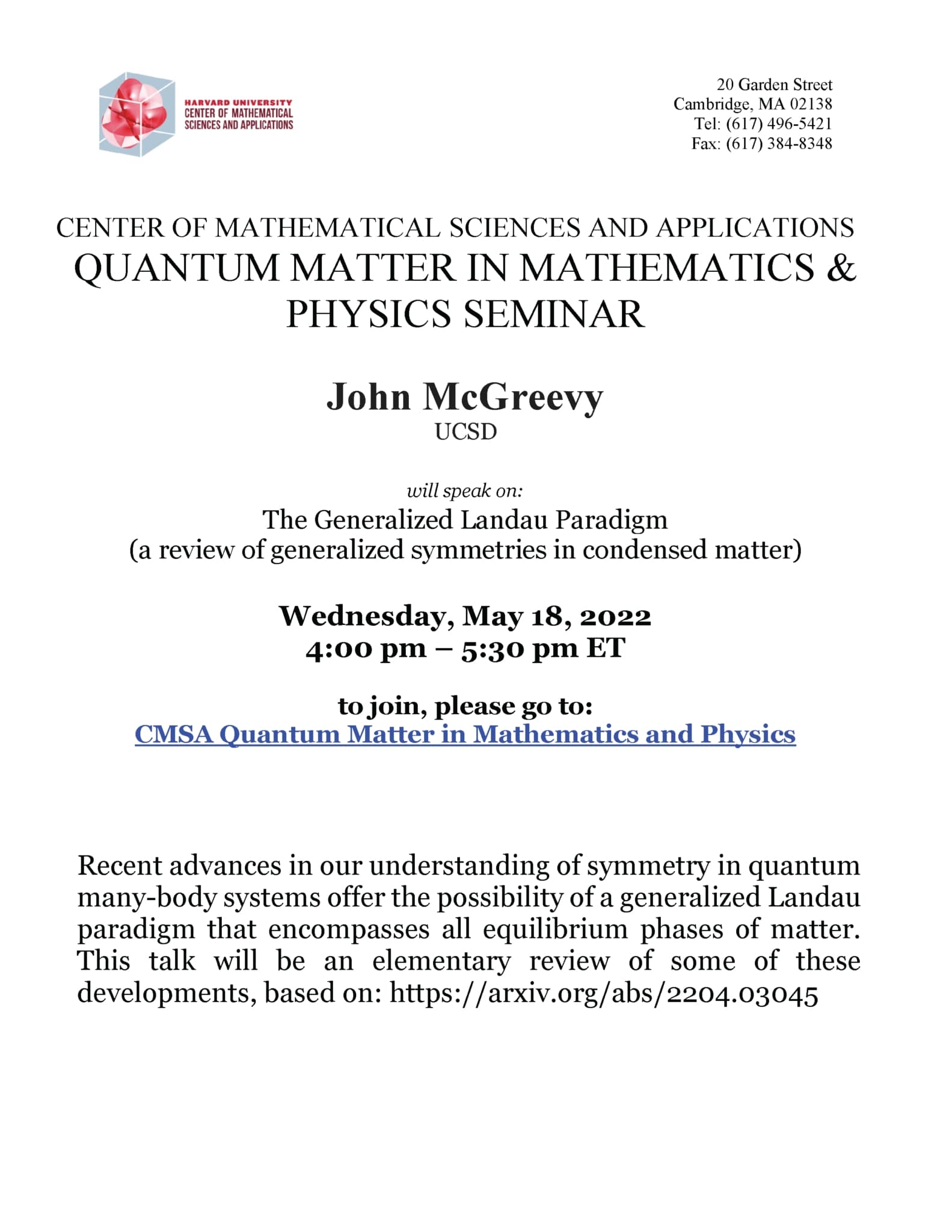
  • The Generalized Landau Paradigm (a review of generalized symmetries in condensed matter)

    Virtual

    https://www.youtube.com/watch?v=orT7vWJiCeo&list=PL0NRmB0fnLJQAnYwkpt9PN2PBKx4rvdup&index=10&t=15s Abstract: Recent advances in our understanding of symmetry in quantum many-body systems offer the possibility of a generalized Landau paradigm that encompasses all equilibrium phases of matter. This talk will be an elementary review of some of these developments, based on: https://arxiv.org/abs/2204.03045

  • Boundary conditions and LSM anomalies of conformal field theories in 1+1 dimensions

    Virtual

    Speaker: Linhao Li (ISSP, U Tokyo) Title: Boundary conditions and LSM anomalies of conformal field theories in 1+1 dimensions Abstract: In this talk, we will study a relationship between conformally invariant boundary conditions and anomalies of conformal field theories (CFTs) in 1+1 dimensions. For a given CFT with a global symmetry, we consider symmetric gapping […]

  • The geometry of conditional independence models with hidden variables

    Abstract: Conditional independence (CI) is an important tool instatistical modeling, as, for example, it gives a statistical interpretation to graphical models. In general, given a list of dependencies among random variables, it is difficult to say which constraints are implied by them. Moreover, it is important to know what constraints on the random variables are caused […]

  • 2022 Summer Introduction to Mathematical Research

    Virtual

    The Math Department and Harvard’s Center of Mathematical Sciences and Applications (CMSA) will be running a math program/course for mathematically minded undergraduates this summer. The course will be run by Dr. Yingying Wu from CMSA. Here is a description: Summer Introduction to Mathematical Research (sponsored by CMSA and the Harvard Math Department) In this course, we will start […]

  • Oblique Lessons from the W Mass Measurement at CDF II

    Hybrid

    Speaker: Seth Koren (University of Chicago) Title: Baryon Minus Lepton Number BF Theory for the Cosmological Lithium Problem Abstract: The cosmological lithium problem—that the observed primordial abundance is lower than theoretical expectations by order one—is perhaps the most statistically significant anomaly of SM+ ΛCDM, and has resisted decades of attempts by cosmologists, nuclear physicists, and […]

  • Extinction and coexistence for reaction-diffusion systems on metric graphs

    Abstract: In spatial population genetics, it is important to understand the probability of extinction in multi-species interactions such as growing bacterial colonies, cancer tumor evolution and human migration. This is because extinction probabilities are instrumental in determining the probability of coexistence and the genealogies of populations. A key challenge is the complication due to spatial effect […]

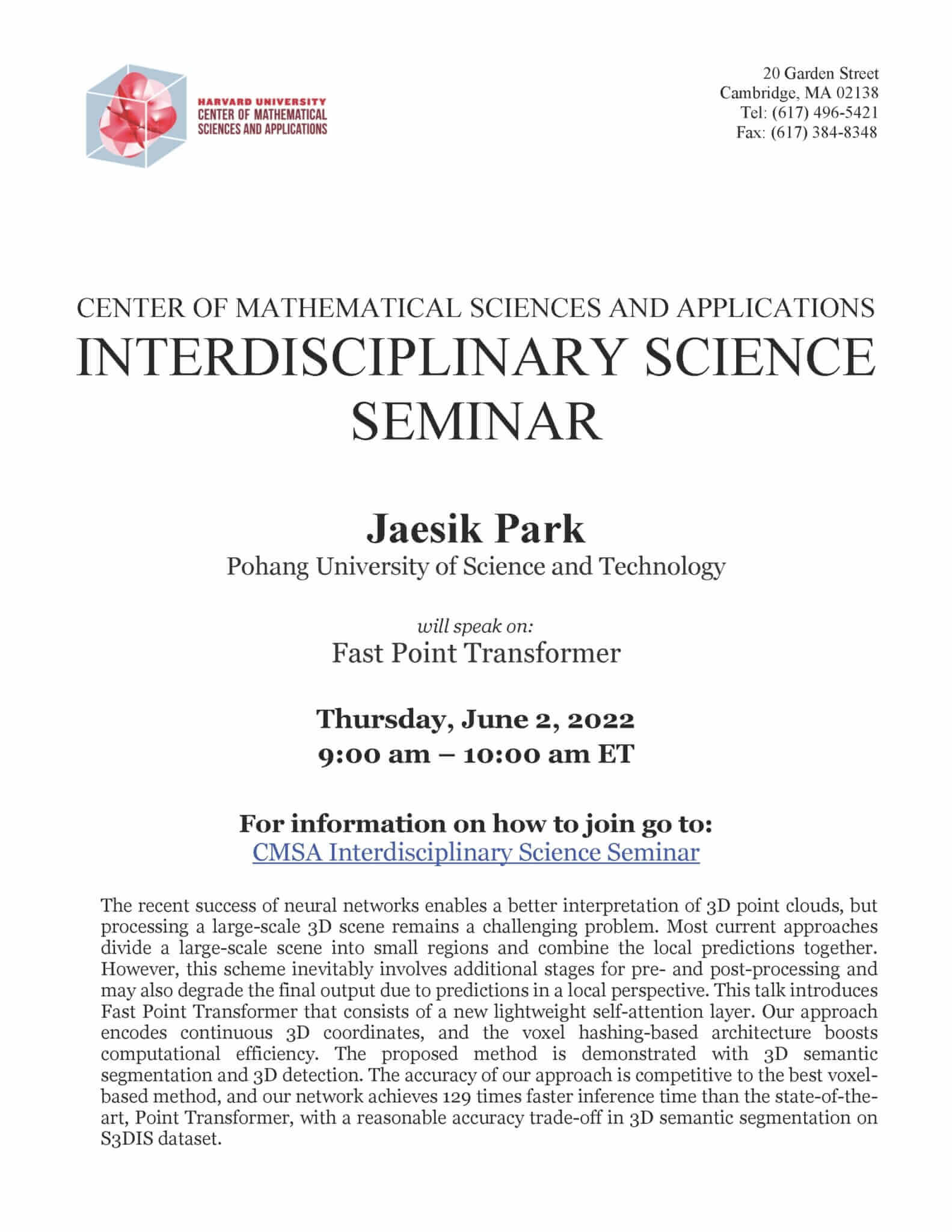
  • Fast Point Transformer

    Abstract: The recent success of neural networks enables a better interpretation of 3D point clouds, but processing a large-scale 3D scene remains a challenging problem. Most current approaches divide a large-scale scene into small regions and combine the local predictions together. However, this scheme inevitably involves additional stages for pre- and post-processing and may also degrade […]

  • Symposium on Foundations of Responsible Computing (FORC)

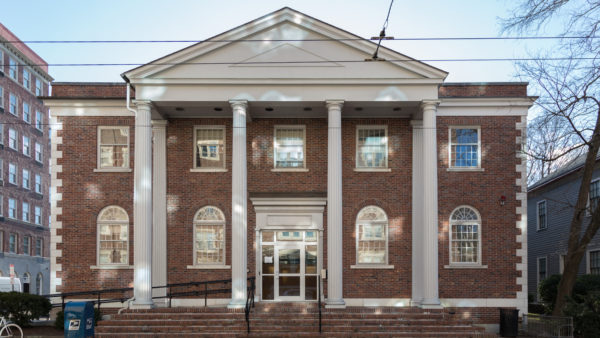
    CMSA Room G10 CMSA, 20 Garden Street, Cambridge, MA, United States

    On June 6-8, 2022, the CMSA hosted the 3rd annual Symposium on Foundations of Responsible Computing (FORC). The Symposium on Foundations of Responsible Computing (FORC) is a forum for mathematical research in computation and society writ large.  The Symposium aims to catalyze the formation of a community supportive of the application of theoretical computer science, statistics, […]

  • Surface hopping algorithms for non-adiabatic quantum systems

    CMSA Room G10 CMSA, 20 Garden Street, Cambridge, MA, United States

    Interdisciplinary Science Seminar Speaker: Jianfeng Lu, Duke UniversityTitle: Surface hopping algorithms for non-adiabatic quantum systems Abstract: Surface hopping algorithm is widely used in chemistry for mixed quantum-classical dynamics. In this talk, we will discuss some of our recent works in mathematical understanding and algorithm development for surface hopping methods. These methods are based on stochastic approximations […]

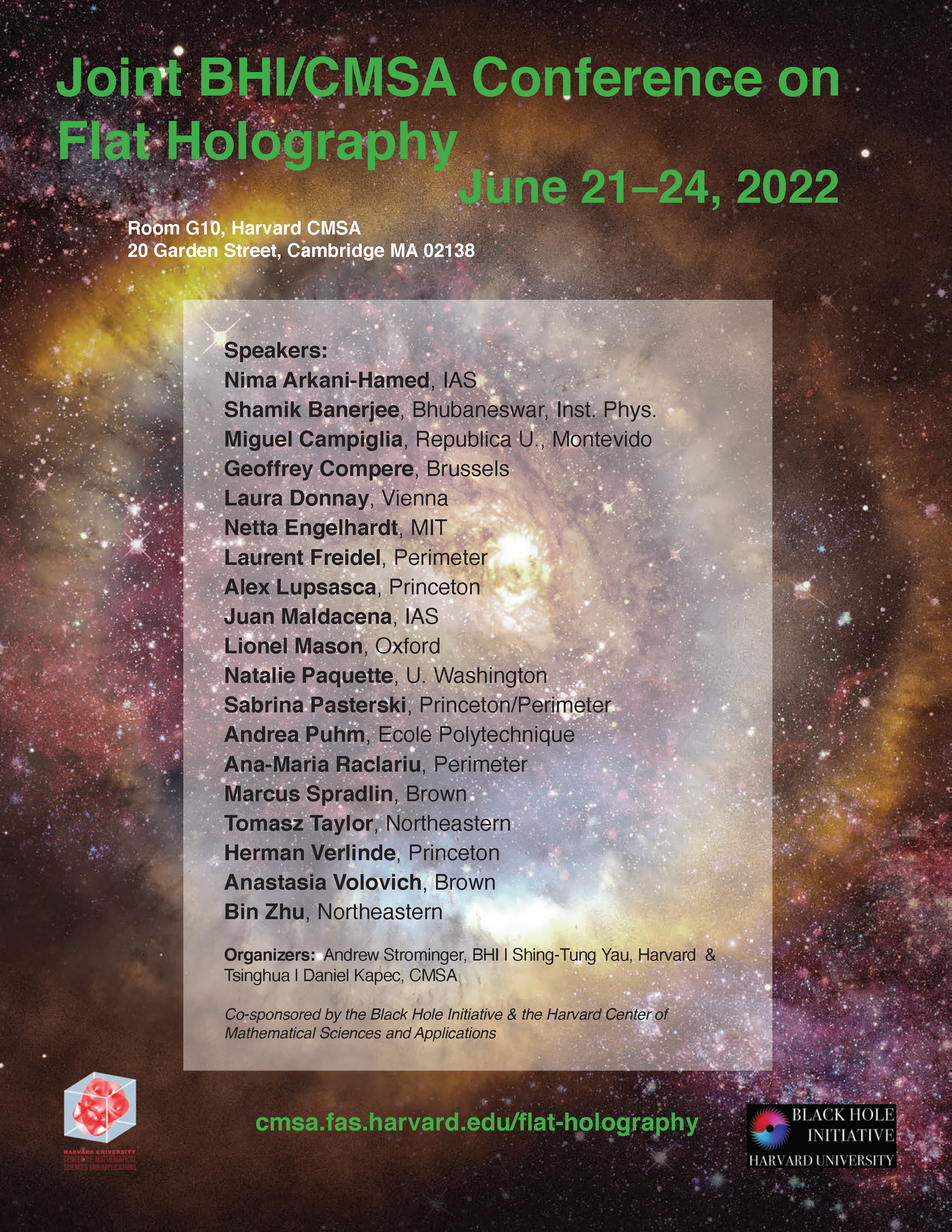
  • Joint BHI/CMSA Conference on Flat Holography

    CMSA Room G10 CMSA, 20 Garden Street, Cambridge, MA, United States

    On June 21–24, 2022, the Harvard Black Hole Initiative and the CMSA hosted the Joint BHI/CMSA Conference on Flat Holography (and related topics). The recent discovery of infinitely-many soft symmetries for all quantum theories of gravity in asymptotically flat space has provided a promising starting point for a bottom-up construction of a holographic dual for […]

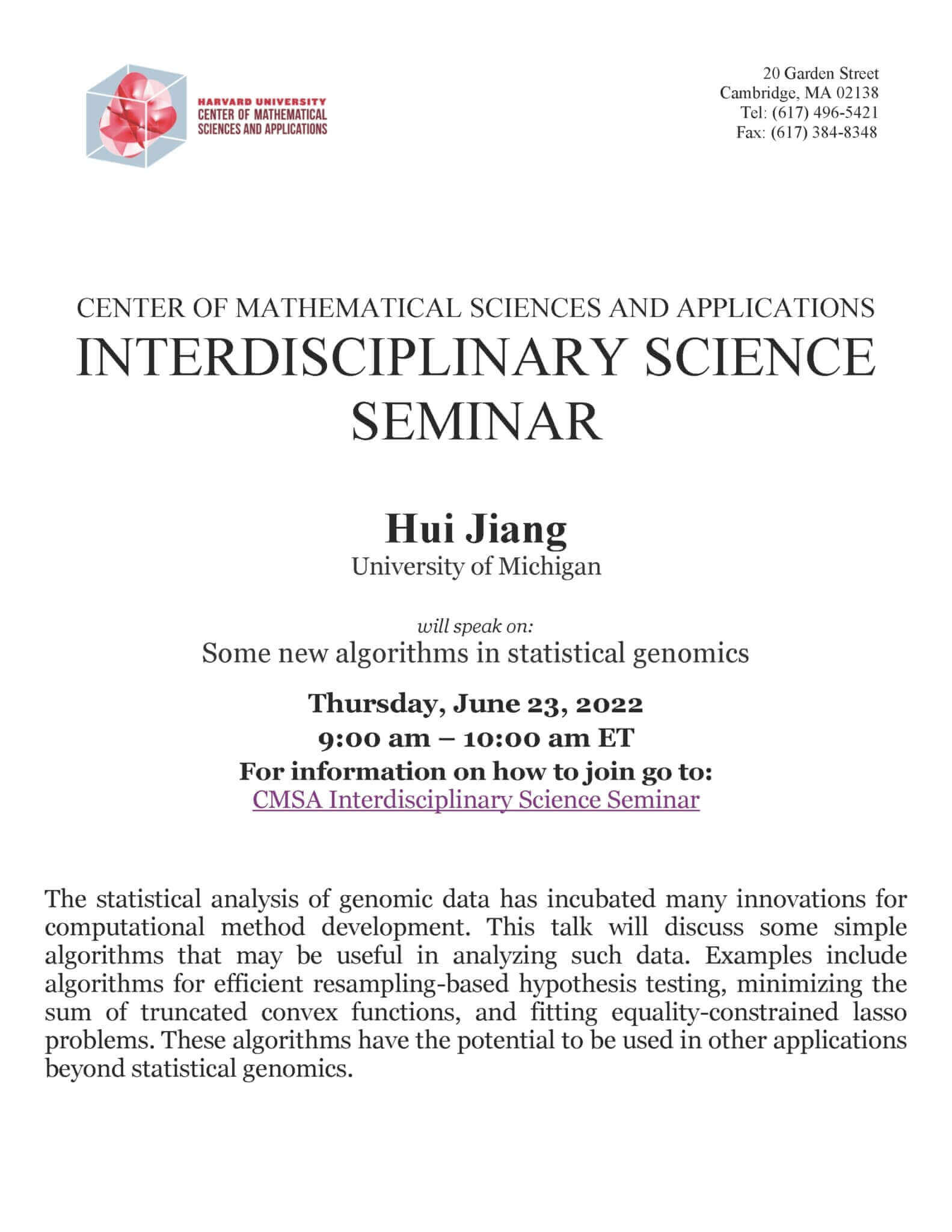
  • Some new algorithms in statistical genomics

    Abstract: The statistical analysis of genomic data has incubated many innovations for computational method development. This talk will discuss some simple algorithms that may be useful in analyzing such data. Examples include algorithms for efficient resampling-based hypothesis testing, minimizing the sum of truncated convex functions, and fitting equality-constrained lasso problems. These algorithms have the potential to […]