• Swampland Program

    CMSA 20 Garden Street, Cambridge, MA, United States

    During the 2021–2022 academic year, the CMSA will host a program on the so-called “Swampland.” The Swampland program aims to determine which low-energy effective field theories are consistent with nonperturbative quantum gravity considerations. Not […]

  • CMSA Colloquium 9/15/2021 – 5/25/2022

    CMSA 20 Garden Street, Cambridge, MA, United States

    During the 2021–22 academic year, the CMSA will be hosting a Colloquium, organized by Du Pei, Changji Xu, and Michael Simkin. It will take place on Wednesdays at 9:30am – 10:30am (Boston time). The […]

  • General Relativity Program

    CMSA Room G10 CMSA, 20 Garden Street, Cambridge, MA, United States

    During the Spring 2022 semester, the CMSA hosted a program on General Relativity. This semester-long program included four minicourses,  a conference, and a workshop. General Relativity Mincourses: March–May, 2022 General […]

  • 1/27/2022 – Interdisciplinary Science Seminar

    Title: Polynomials vanishing at lattice points in convex sets Abstract: Let P be a convex subset of R^2. For large d, what is the smallest degree r_d of a polynomial vanishing at […]

  • Singular Calabi-Yau mirror symmetry

    Speaker: Bong Lian Title: Singular Calabi-Yau mirror symmetry Abstract: We will consider a class of Calabi-Yau varieties given by cyclic branched covers of a fixed semi Fano manifold. The first […]

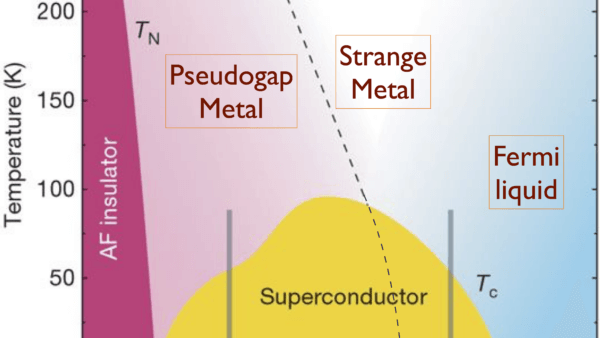
  • Maximal quantum chaos of the critical Fermi surface

    Speaker: Maria Tikhanovskaya (Harvard) Title: Maximal quantum chaos of the critical Fermi surface Abstract: In this talk, I will describe many-body quantum chaos in a recently proposed large-N theory for critical Fermi […]

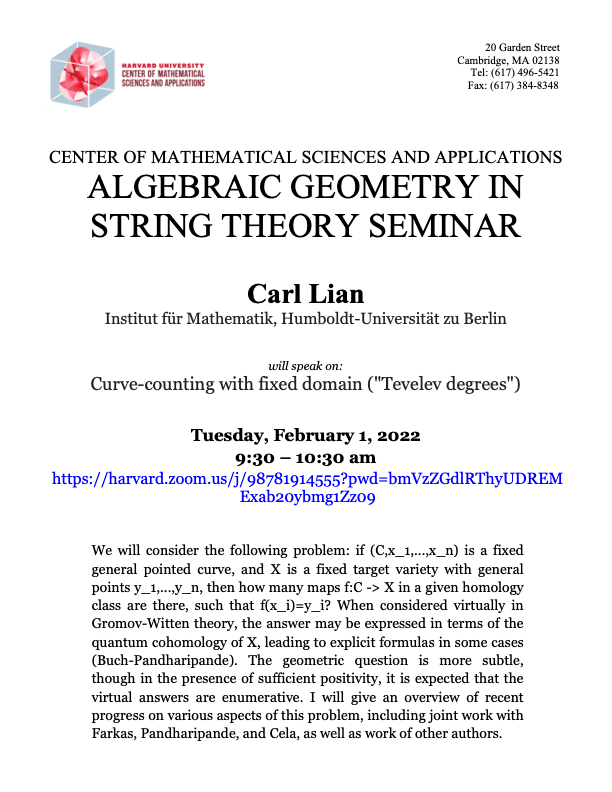
  • Curve-counting with fixed domain (“Tevelev degrees”)

    Virtual

    Abstract: We will consider the following problem: if (C,x_1,…,x_n) is a fixed general pointed curve, and X is a fixed target variety with general points y_1,…,y_n, then how many maps f:C -> […]

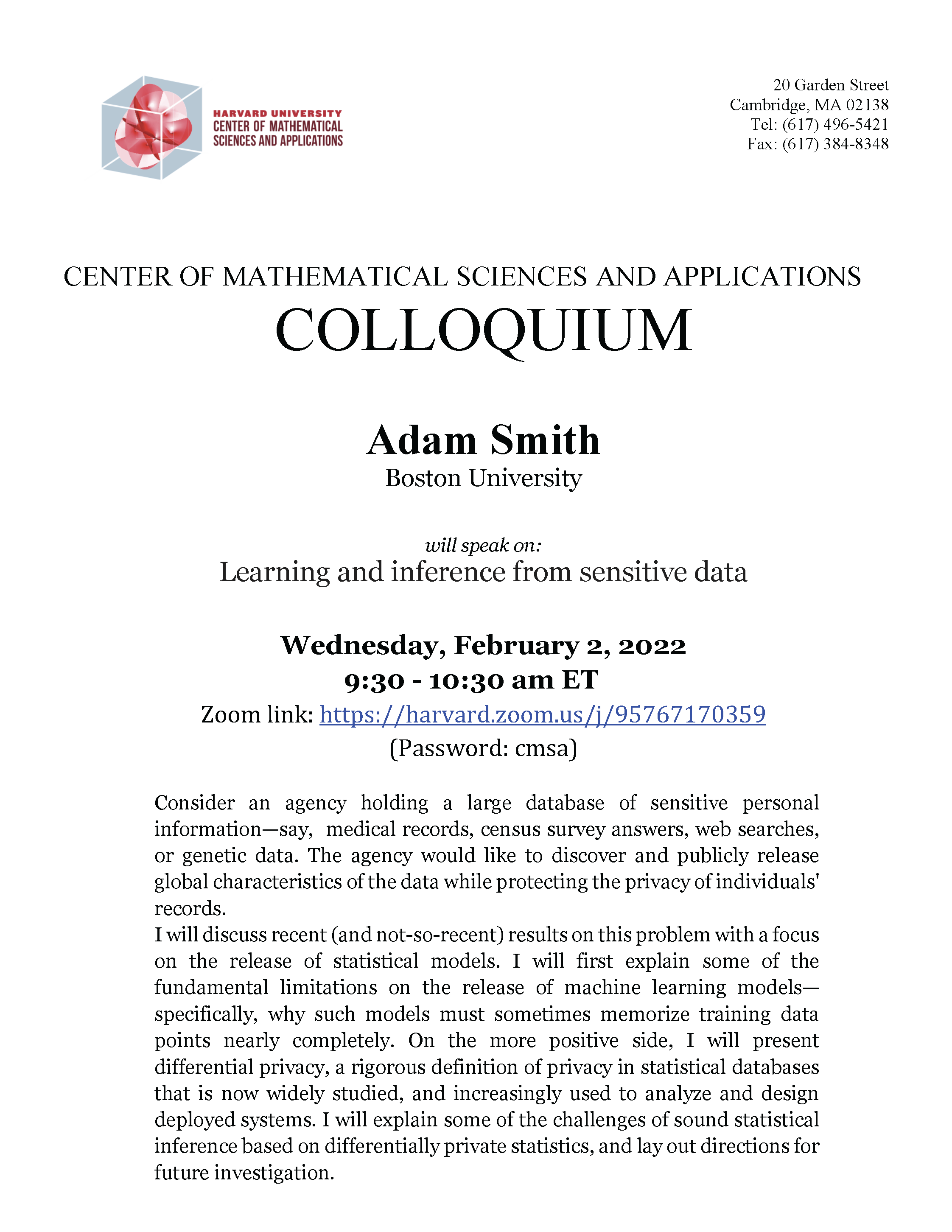
  • Learning and inference from sensitive data

    Virtual

    Speaker: Adam Smith (Boston University) Title: Learning and inference from sensitive data Abstract: Consider an agency holding a large database of sensitive personal information—say,  medical records, census survey answers, web searches, or genetic data. The agency would […]