• Theories of branching morphogenesis

    Abstract: The morphogenesis of branched tissues has been a subject of long-standing debate. Although much is known about the molecular pathways that control cell fate decisions, it remains unclear how macroscopic features of branched organs, including their size, network topology and spatial pattern are encoded. Based on large-scale reconstructions of the mouse mammary gland and […]
  • The space of vector bundles on spheres: algebra, geometry, topology

    Abstract: Bott periodicity relates vector bundles on a topological space X to vector bundles on X “times a sphere”.   I’m not a topologist, so I will try to explain an algebraic or geometric incarnation, in terms of vector bundles on the Riemann sphere.   I will attempt to make the talk introductory, and (for the most part) […]

  • Synthetic Regression Discontinuity: Estimating Treatment Effects using Machine Learning

    Virtual

    Speaker: Jörn Boehnke Title: Synthetic Regression Discontinuity: Estimating Treatment Effects using Machine Learning Abstract:  In the standard regression discontinuity setting, treatment assignment is based on whether a unit’s observable score (running variable) crosses a known threshold.  We propose a two-stage method to estimate the treatment effect when the score is unobservable to the econometrician while the […]

  • Type IIB flux compactifications with $h^{1,1}=0$

    Virtual

    Abstract: We revisit type IIB flux compactification that are mirror dual to type IIA on rigid Calabi-Yau manifolds. We find a variety of interesting new solutions, like fully stabilized Minkowski vacua and infinite families of AdS$_4$ solutions with arbitrarily large numbers of spacetime filling D3 branes. We discuss how these solutions fit into the web of […]

  • BCFW recursion relations and non-planar positive geometry

    Abstract: There is a close connection between the scattering amplitudes in planar N=4 SYM theory and the cells in the positive Grassmannian. In the context of BCFW recursion relations the tree-level S-matrix is represented as a sum of planar on-shell diagrams (aka plabic graphs) and associated with logarithmic forms on the Grassmannian cells of certain dimensionality. […]

  • Applications of Higher Determinant Map

    Virtual

    Abstract: In this talk I will explain the construction of a determinant map for Tate objects and two applications: (i) to construct central extensions of iterated loop groups and (ii) to produce a determinant theory on certain ind-schemes. For that I will introduce some aspects of the theory of Tate objects in a couple of contexts.

  • Quantisation in monoidal categories and quantum operads

    Abstract: The standard definition of symmetries of a structure given on a set S (in the sense of Bourbaki) is the group of bijective maps S to S, compatible with this structure. But in fact, symmetries of various structures related to storing and transmitting information (such as information spaces) are naturally embodied in various classes of loops […]

  • Why is the mission impossible? Decoupling the mirror Ginsparg-Wilson fermions in the lattice models for two-dimensional abelian chiral gauge theories

    Virtual

    Youtube Video Abstract: It has been known that the four-dimensional abelian chiral gauge theories of an anomaly-free set of Wely fermions can be formulated on the lattice preserving the exact gauge invariance and the required locality property in the framework of the Ginsparg- Wilson relation. This holds true in two dimensions. However, in the related formulation […]

  • SIMPLEs: a single-cell RNA sequencing imputation strategy preserving gene modules and cell clusters variation

    Abstract: A main challenge in analyzing single-cell RNA sequencing (scRNA-seq) data is to reduce technical variations yet retain cell heterogeneity. Due to low mRNAs content per cell and molecule losses during the experiment (called ‘dropout’), the gene expression matrix has a substantial amount of zero read counts. Existing imputation methods treat either each cell or each […]

  • Global existence and stability of de Sitter-like solutions to the Einstein-Yang-Mills equations in spacetime dimensions n≥4

    Virtual

    Abstract: In this talk, we briefly introduce our recent work on establishing the global existence and stability to the future of non-linear perturbation of de Sitter-like solutions to the Einstein-Yang-Mills system in n≥4 spacetime dimension. This generalizes Friedrich’s (1991) Einstein-Yang-Mills stability results in dimension n=4 to all higher dimensions. This is a joint work with […]

  • Cancellation of the vacuum energy and Weyl anomaly in the standard model, and a two-sheeted, CPT-symmetric universe

    Virtual

    Youtube video   Abstract: I will explain a mechanism to cancel the vacuum energy and both terms in the Weyl anomaly in the standard model of particle physics, using conformally-coupled dimension-zero scalar fields.  Remarkably, given the standard model gauge group SU(3)xSU(2)xU(1), the cancellation requires precisely 48 Weyl spinors — i.e. three generations of standard model fermions, […]

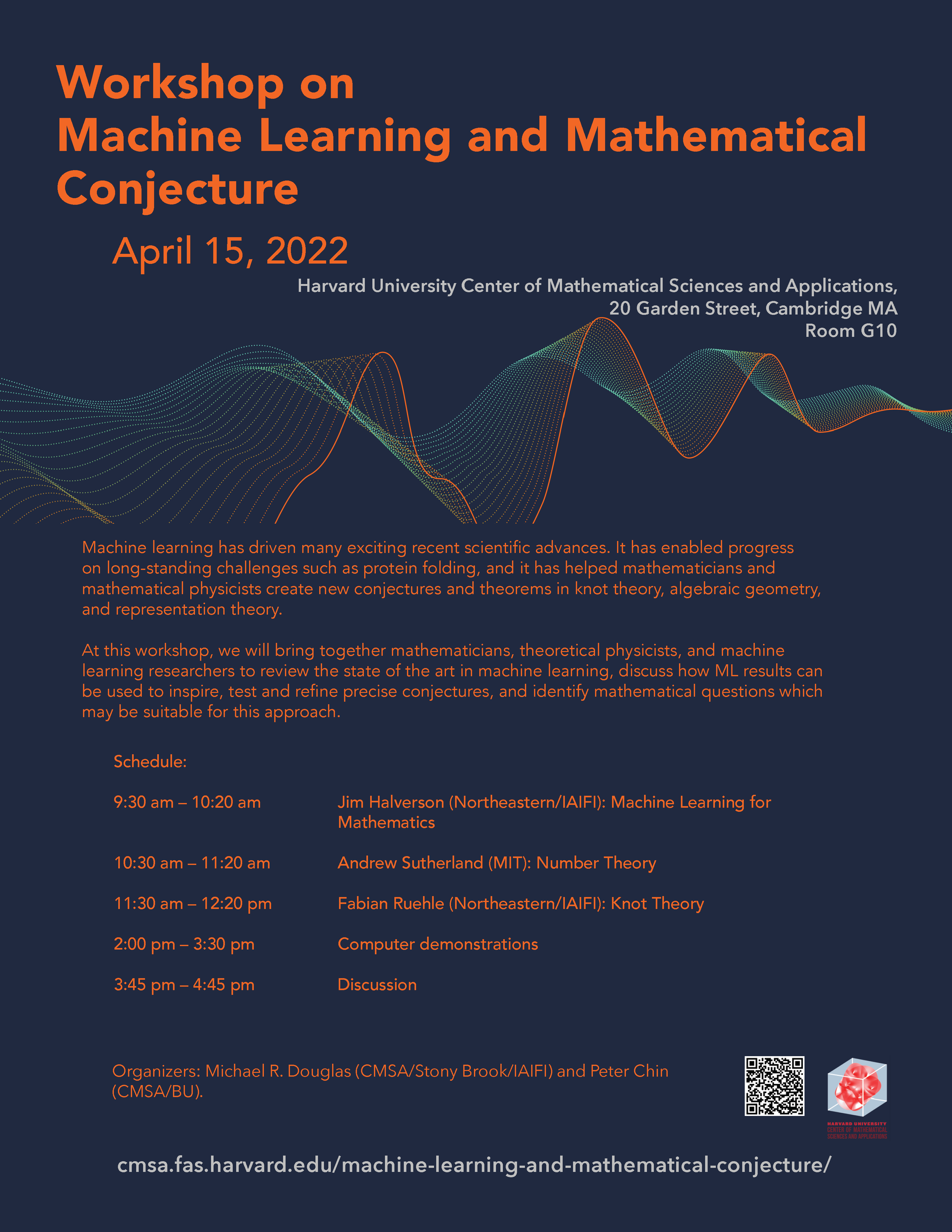
  • Workshop on Machine Learning and Mathematical Conjecture

    CMSA Room G10 CMSA, 20 Garden Street, Cambridge, MA, United States

    On April 15, 2022, the CMSA will hold a one-day workshop, Machine Learning and Mathematical Conjecture, related to the New Technologies in Mathematics Seminar Series. Location: Room G10, 20 Garden Street, Cambridge, MA 02138. Organizers: Michael R. Douglas (CMSA/Stony Brook/IAIFI) and Peter Chin (CMSA/BU). Machine learning has driven many exciting recent scientific advances. It has enabled […]