

Gentle Measurement of Quantum States and Differential Privacy
Speaker: Scott Aaronson (University of Texas at Austin) Title: Gentle Measurement of Quantum States and Differential Privacy Abstract: I'll discuss a recent connection between two seemingly unrelated problems: how to measure a collection of quantum states without damaging them too much ("gentle measurement"), and how to provide statistical data without leaking too much about individuals ("differential privacy," an area of classical […]
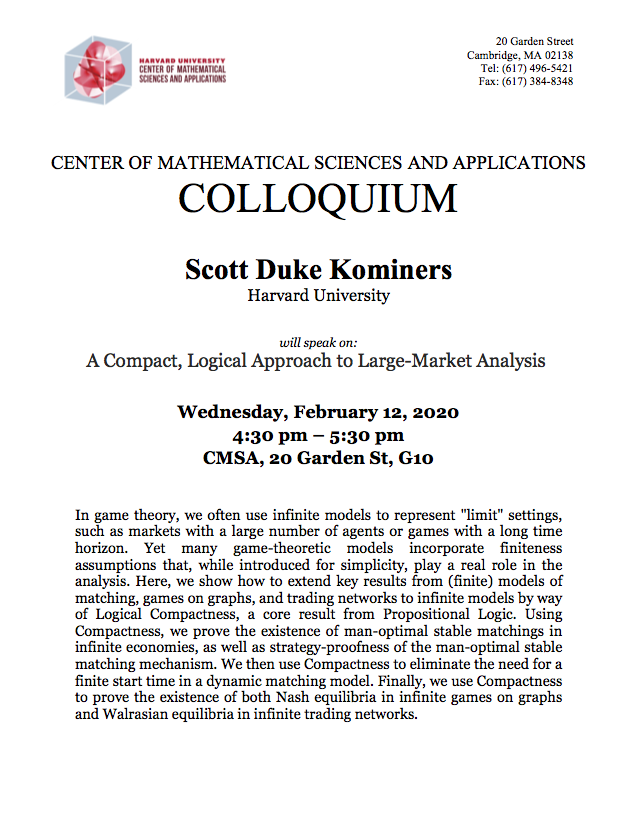
A Compact, Logical Approach to Large-Market Analysis
Speaker: Scott Duke Kominers (Harvard) Title: A Compact, Logical Approach to Large-Market Analysis Abstract: In game theory, we often use infinite models to represent "limit" settings, such as markets with a large number of agents or games with a long time horizon. Yet many game-theoretic models incorporate finiteness assumptions that, while introduced for simplicity, play a real role in the analysis. Here, we show […]

The Cubical Route to Understanding Groups
Speaker: Daniel Wise (McGill University) Title: The Cubical Route to Understanding Groups Abstract: Cube complexes have come to play an increasingly central role within geometric group theory, as their connection to right-angled Artin groups provides a powerful combinatorial bridge between geometry and algebra. This talk will introduce nonpositively curved cube complexes, and then describe the developments that culminated in the resolution of the virtual […]

Quantum Money from Lattices
Speaker: Peter Shor (MIT) Title: Quantum Money from Lattices Abstract: Quantum money is a cryptographic protocol for quantum computers. A quantum money protocol consists of a quantum state which can be created (by the mint) and verified (by anybody with a quantum computer who knows what the "serial number" of the money is), but which cannot be duplicated, even by somebody with a copy of the quantum state who knows the verification protocol. Several previous proposals have […]