• Synthetic Regression Discontinuity: Estimating Treatment Effects using Machine Learning

    Virtual

    Speaker: Jörn Boehnke Title: Synthetic Regression Discontinuity: Estimating Treatment Effects using Machine Learning Abstract:  In the standard regression discontinuity setting, treatment assignment is based on whether a unit’s observable score (running variable) crosses a known threshold.  We propose a two-stage method to estimate the treatment effect when the score is unobservable to the econometrician while the […]

  • Type IIB flux compactifications with $h^{1,1}=0$

    Virtual

    Abstract: We revisit type IIB flux compactification that are mirror dual to type IIA on rigid Calabi-Yau manifolds. We find a variety of interesting new solutions, like fully stabilized Minkowski vacua and infinite families of AdS$_4$ solutions with arbitrarily large numbers of spacetime filling D3 branes. We discuss how these solutions fit into the web of […]

  • BCFW recursion relations and non-planar positive geometry

    Abstract: There is a close connection between the scattering amplitudes in planar N=4 SYM theory and the cells in the positive Grassmannian. In the context of BCFW recursion relations the tree-level S-matrix is represented as a sum of planar on-shell diagrams (aka plabic graphs) and associated with logarithmic forms on the Grassmannian cells of certain dimensionality. […]

  • Applications of Higher Determinant Map

    Virtual

    Abstract: In this talk I will explain the construction of a determinant map for Tate objects and two applications: (i) to construct central extensions of iterated loop groups and (ii) to produce a determinant theory on certain ind-schemes. For that I will introduce some aspects of the theory of Tate objects in a couple of contexts.

  • Quantisation in monoidal categories and quantum operads

    Abstract: The standard definition of symmetries of a structure given on a set S (in the sense of Bourbaki) is the group of bijective maps S to S, compatible with this structure. But in fact, symmetries of various structures related to storing and transmitting information (such as information spaces) are naturally embodied in various classes of loops […]

  • Why is the mission impossible? Decoupling the mirror Ginsparg-Wilson fermions in the lattice models for two-dimensional abelian chiral gauge theories

    Virtual

    Youtube Video Abstract: It has been known that the four-dimensional abelian chiral gauge theories of an anomaly-free set of Wely fermions can be formulated on the lattice preserving the exact gauge invariance and the required locality property in the framework of the Ginsparg- Wilson relation. This holds true in two dimensions. However, in the related formulation […]

  • SIMPLEs: a single-cell RNA sequencing imputation strategy preserving gene modules and cell clusters variation

    Abstract: A main challenge in analyzing single-cell RNA sequencing (scRNA-seq) data is to reduce technical variations yet retain cell heterogeneity. Due to low mRNAs content per cell and molecule losses during the experiment (called ‘dropout’), the gene expression matrix has a substantial amount of zero read counts. Existing imputation methods treat either each cell or each […]

  • Global existence and stability of de Sitter-like solutions to the Einstein-Yang-Mills equations in spacetime dimensions n≥4

    Virtual

    Abstract: In this talk, we briefly introduce our recent work on establishing the global existence and stability to the future of non-linear perturbation of de Sitter-like solutions to the Einstein-Yang-Mills system in n≥4 spacetime dimension. This generalizes Friedrich’s (1991) Einstein-Yang-Mills stability results in dimension n=4 to all higher dimensions. This is a joint work with […]

  • Cancellation of the vacuum energy and Weyl anomaly in the standard model, and a two-sheeted, CPT-symmetric universe

    Virtual

    Youtube video   Abstract: I will explain a mechanism to cancel the vacuum energy and both terms in the Weyl anomaly in the standard model of particle physics, using conformally-coupled dimension-zero scalar fields.  Remarkably, given the standard model gauge group SU(3)xSU(2)xU(1), the cancellation requires precisely 48 Weyl spinors — i.e. three generations of standard model fermions, […]

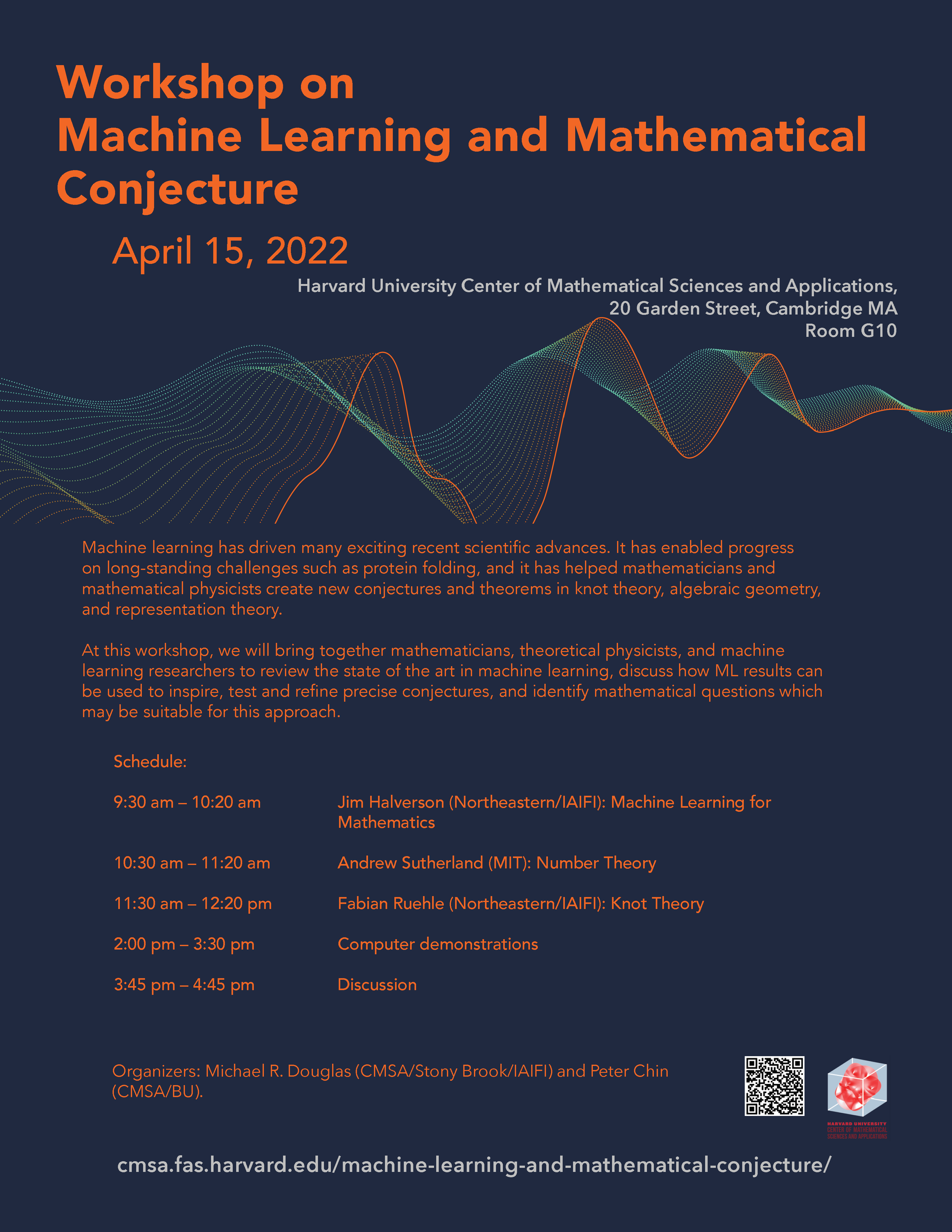
  • Workshop on Machine Learning and Mathematical Conjecture

    CMSA Room G10 CMSA, 20 Garden Street, Cambridge, MA, United States

    On April 15, 2022, the CMSA will hold a one-day workshop, Machine Learning and Mathematical Conjecture, related to the New Technologies in Mathematics Seminar Series. Location: Room G10, 20 Garden Street, Cambridge, MA 02138. Organizers: Michael R. Douglas (CMSA/Stony Brook/IAIFI) and Peter Chin (CMSA/BU). Machine learning has driven many exciting recent scientific advances. It has enabled […]

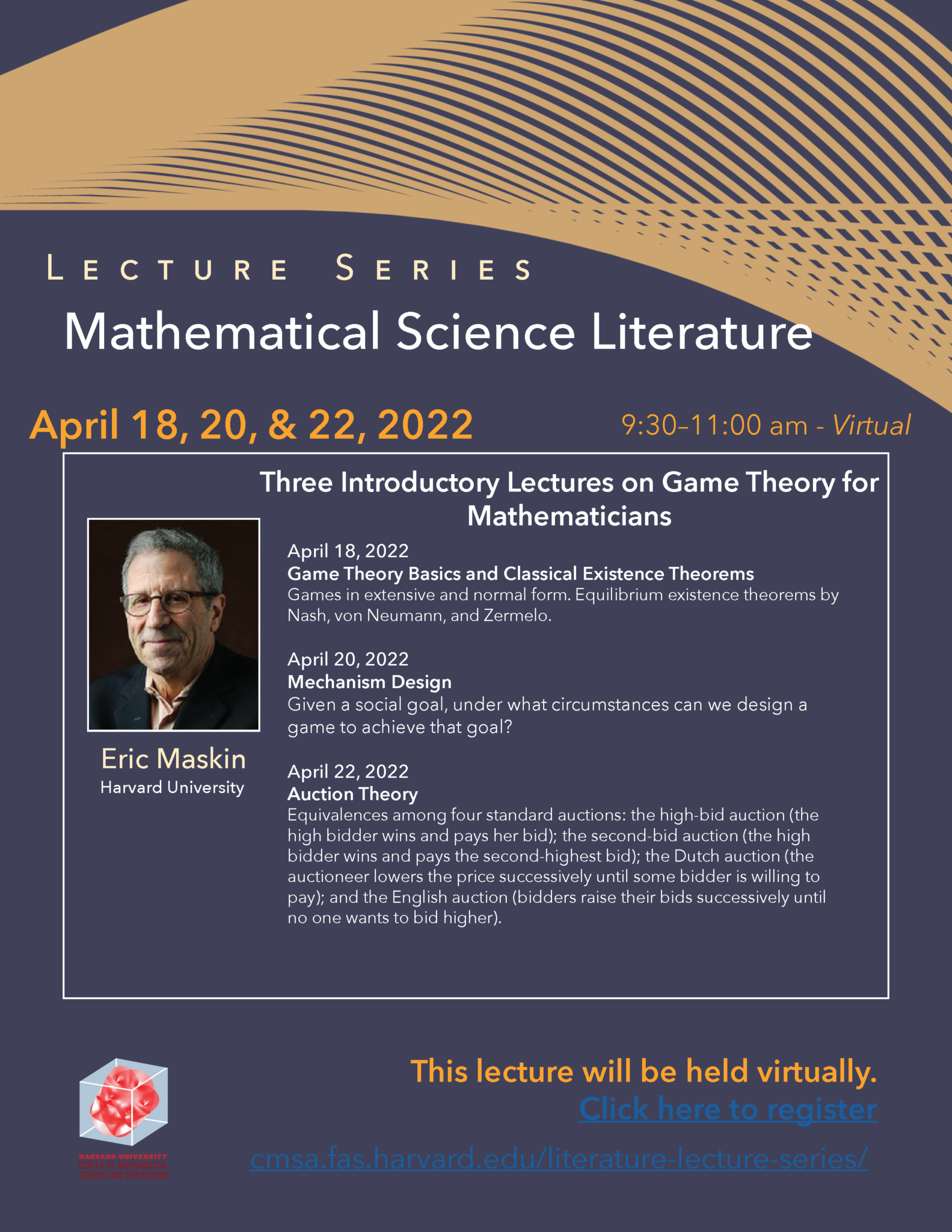
  • CMSA/Tsinghua Math-Science Literature Lecture: Three Introductory Lectures on Game Theory for Mathematicians: Game Theory Basics and Classical Existence Theorems

    Virtual

    Eric Maskin (Harvard University) Three Introductory Lectures on Game Theory for Mathematicians April 18, 2022 | 9:30 – 11:00 am ET Title: Game Theory Basics and Classical Existence Theorems Abstract: Games in extensive and normal form. Equilibrium existence theorems by Nash, von Neumann, and Zermelo Talk chairs: Scott Kominers, Sergiy Verstyuk SLIDES | VIDEO