
Adventures in Perturbation Theory
Abstract: Recent years have seen tremendous advances in our understanding of perturbative quantum field theory—fueled largely by discoveries (and eventual explanations and exploitation) of shocking simplicity in the mathematical form of the predictions made for experiment. Among the most important frontiers in this progress is the understanding of loop amplitudes—their mathematical form, underlying geometric structure, and […]
CMSA Colloquium
During the 2021–22 academic year, the CMSA will be hosting a Colloquium, organized by Du Pei, Changji Xu, and Michael Simkin. It will take place on Wednesdays at 9:30am – 10:30am (Boston time). The meetings will take place virtually on Zoom. All CMSA postdocs/members are required to attend the weekly CMSA Members’ Seminars, as well as the weekly CMSA […]
The black hole information paradox
Speaker: Samir Mathur (Ohio State University) Title: The black hole information paradox Abstract: In 1975, Stephen Hawking showed that black holes radiate away in a manner that violates quantum theory. Starting in 1997, it was observed that black holes in string theory did not have the form expected from general relativity: in place of “empty space will […]
Cohomology of the moduli of Higgs bundles via positive characteristic
Abstract: In this talk, I will survey the P=W conjecture, which describes certain structures of the cohomology of the moduli space of Higgs bundles on a curve in terms of the character variety of the curve. I will then explain how certain symmetries of this cohomology, which are predictions of this conjecture, can be constructed […]
Machine learning with mathematicians
https://youtu.be/DMvmcTQuofE Speaker: Alex Davies, DeepMind Title: Machine learning with mathematicians Abstract: Can machine learning be a useful tool for research mathematicians? There are many examples of mathematicians pioneering new technologies to aid our understanding of the mathematical world: using very early computers to help formulate the Birch and Swinnerton-Dyer conjecture and using computer aid to […]
Learning to School in the presence of hydrodynamic interactions
Abstract: Fluids pervade complex systems, ranging from fish schools, to bacterial colonies and nanoparticles in drug delivery. Despite its importance, little is known about the role of fluid mechanics in such applications. Is schooling the result of vortex dynamics synthesized by individual fish wakes or the result of behavioral traits? Is fish schooling energetically favorable? I […]
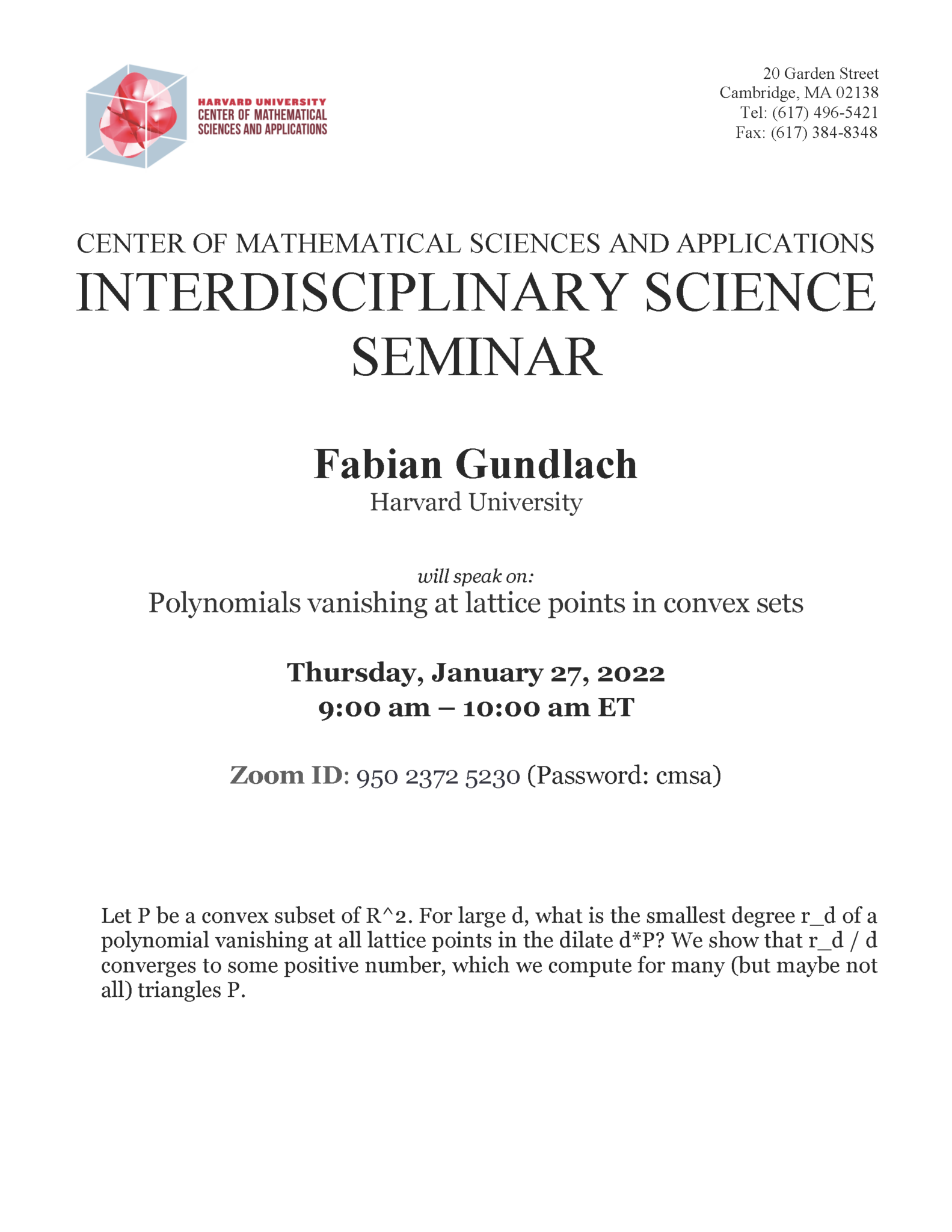
1/27/2022 – Interdisciplinary Science Seminar
Title: Polynomials vanishing at lattice points in convex sets Abstract: Let P be a convex subset of R^2. For large d, what is the smallest degree r_d of a polynomial vanishing at all lattice points in the dilate d*P? We show that r_d / d converges to some positive number, which we compute for many (but maybe not […]
Singular Calabi-Yau mirror symmetry
Speaker: Bong Lian Title: Singular Calabi-Yau mirror symmetry Abstract: We will consider a class of Calabi-Yau varieties given by cyclic branched covers of a fixed semi Fano manifold. The first prototype example goes back to Euler, Gauss and Legendre, who considered 2-fold covers of P1 branched over 4 points. Two-fold covers of P2 branched over […]
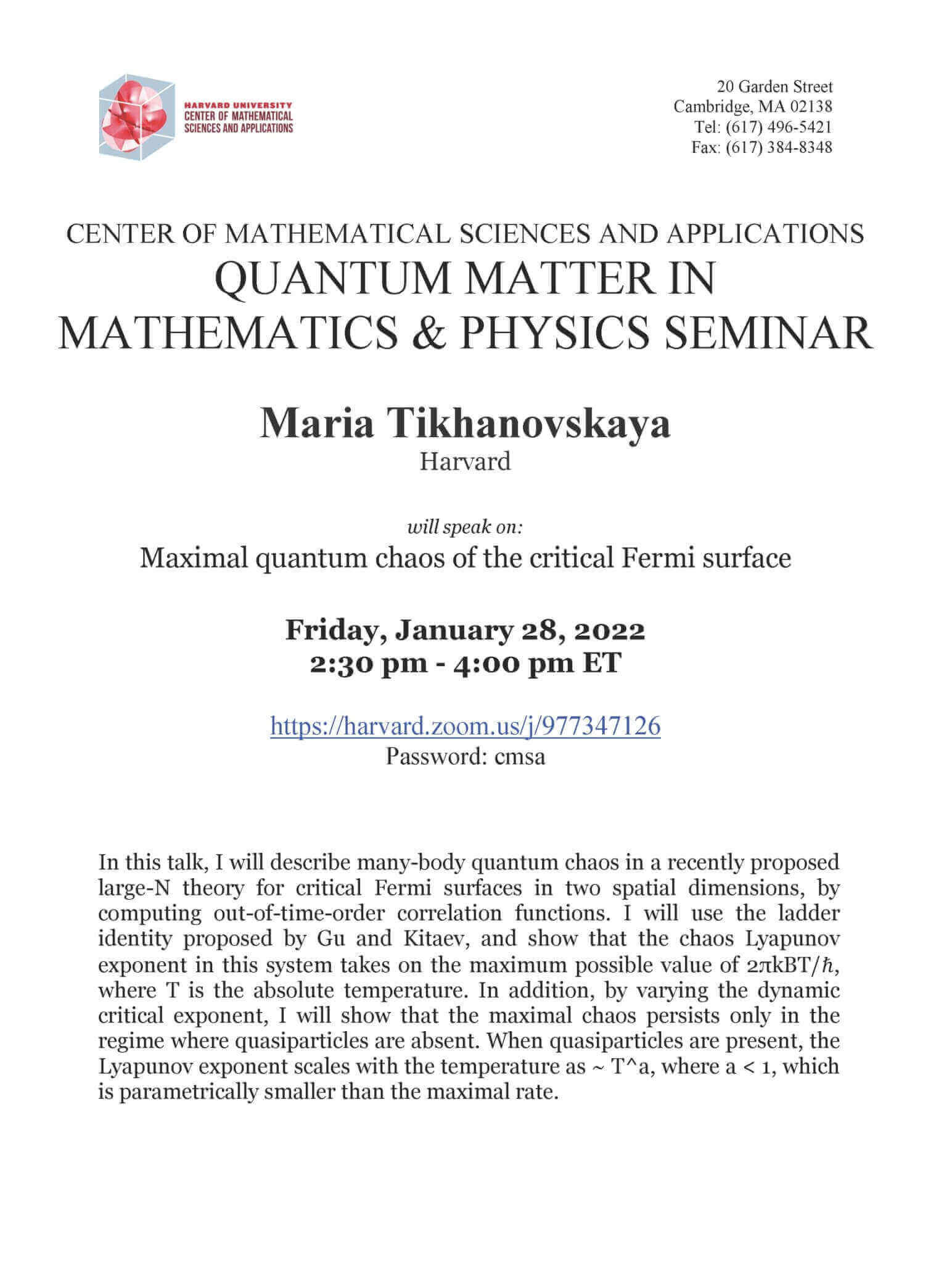
Maximal quantum chaos of the critical Fermi surface
Speaker: Maria Tikhanovskaya (Harvard) Title: Maximal quantum chaos of the critical Fermi surface Abstract: In this talk, I will describe many-body quantum chaos in a recently proposed large-N theory for critical Fermi surfaces in two spatial dimensions, by computing out-of-time-order correlation functions. I will use the ladder identity proposed by Gu and Kitaev, and show that the […]
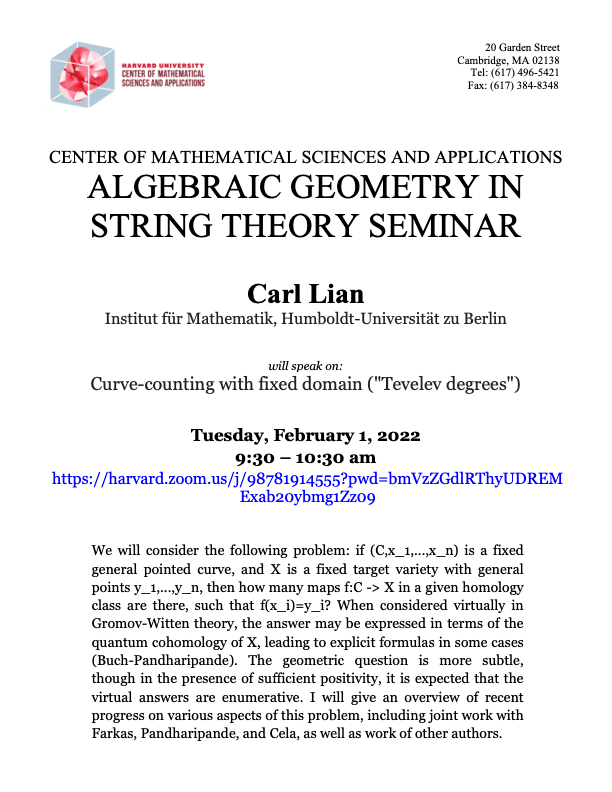
Curve-counting with fixed domain (“Tevelev degrees”)
VirtualAbstract: We will consider the following problem: if (C,x_1,…,x_n) is a fixed general pointed curve, and X is a fixed target variety with general points y_1,…,y_n, then how many maps f:C -> X in a given homology class are there, such that f(x_i)=y_i? When considered virtually in Gromov-Witten theory, the answer may be expressed in terms of […]