Factorization Homology
Geometry and Quantum Theory Seminar Speakers: Sunghyuk Park and Vasily Krylov, Harvard CMSA Title: Factorization Homology

Geometry and Quantum Theory Seminar Speakers: Sunghyuk Park and Vasily Krylov, Harvard CMSA Title: Factorization Homology

Geometry and Quantum Theory Seminar Speaker: Keyou Zeng, Harvard CMSA Title: Review of the excision property in factorization homology
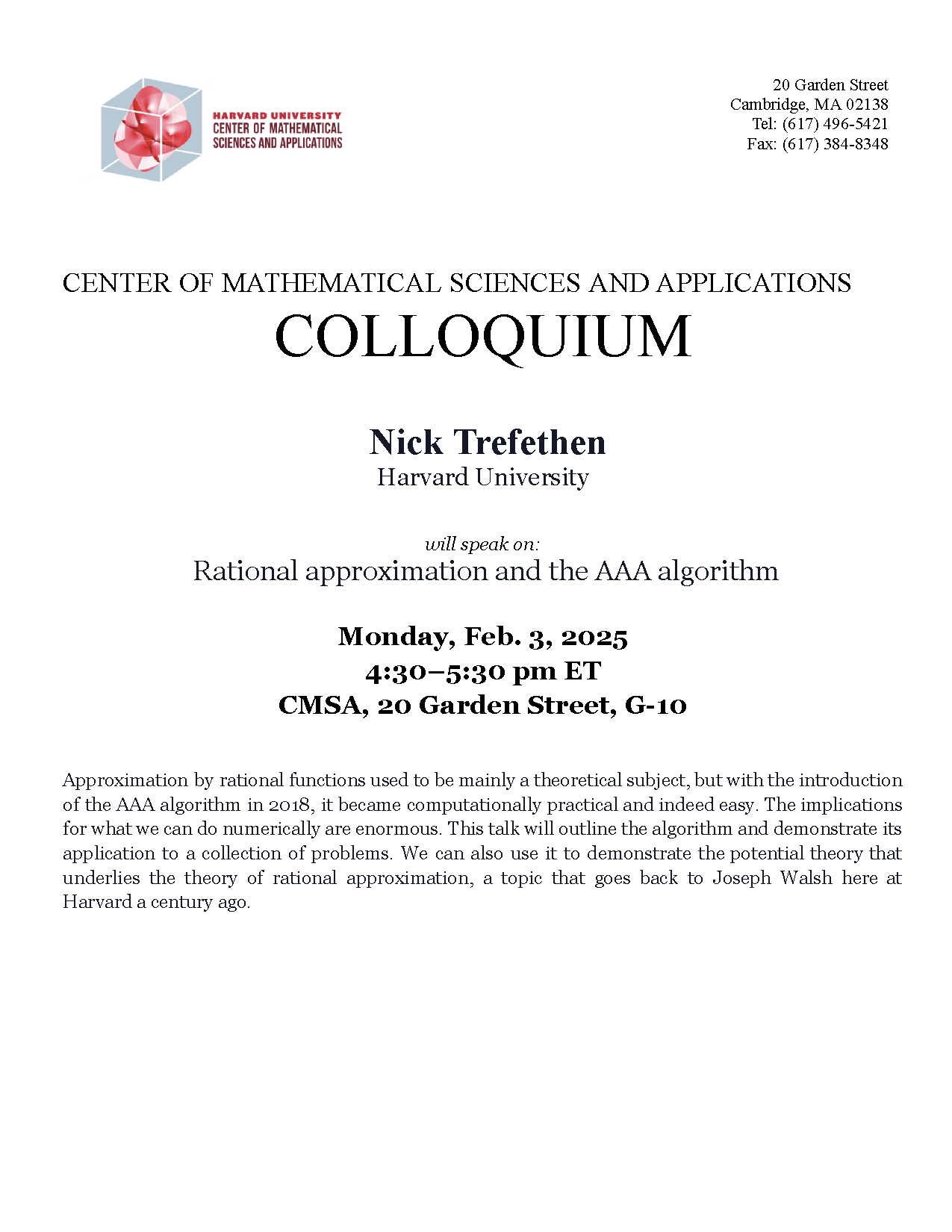
Colloquium Speaker: Nick Trefethen, Harvard University Title: Rational approximation and the AAA algorithm Approximation by rational functions used to be mainly a theoretical subject, but with the introduction of the AAA algorithm in 2018, it became computationally practical and indeed easy. The implications for what we can do numerically are enormous. This talk will outline […]

Geometry and Quantum Theory Seminar Speaker: Sunghyuk Park, Harvard CMSA Title: Blob homology

Colloquium Speaker: Michael Douglas, Harvard CMSA Title: AI in math and theoretical physics: status and prospects Abstract: AI is making great progress and has the potential to change how we work in unprecedented ways. In this talk I will survey a few recent works which illustrate the state of the art, some from my own research, […]

Geometry and Quantum Theory Seminar Speaker: Ben Gammage, Harvard University Title: Discussion of Integrating quantum groups over surfaces https://arxiv.org/abs/1501.04652

Geometry and Quantum Theory Seminar Speaker: Dan Freed, Harvard CMSA and Math Title: Algebras of "symmetries" in QFT and applications to solitons (1) https://arxiv.org/abs/2403.08883

Geometry and Quantum Theory Seminar Speaker: Dan Freed, Harvard CMSA and Math Title: Algebras of "symmetries" in QFT and applications to solitons (2) https://arxiv.org/abs/2403.08883

Colloquium Speaker: Larry Guth, MIT Title: Large value estimates in number theory and computer science Abstract: A large value estimate for a matrix M is a simple type of estimate in quantitative linear algebra. Estimates of this type appear in many parts of math, both pure and applied. One example is the large value problem for […]

Geometry and Quantum Theory Seminar Speaker: Leon Liu, Harvard Title: Introduction to the probabilistic approach to Louville theory Abstract: I will give an introduction to the probabilistic approach to Louville theory, following Hairer's notes.
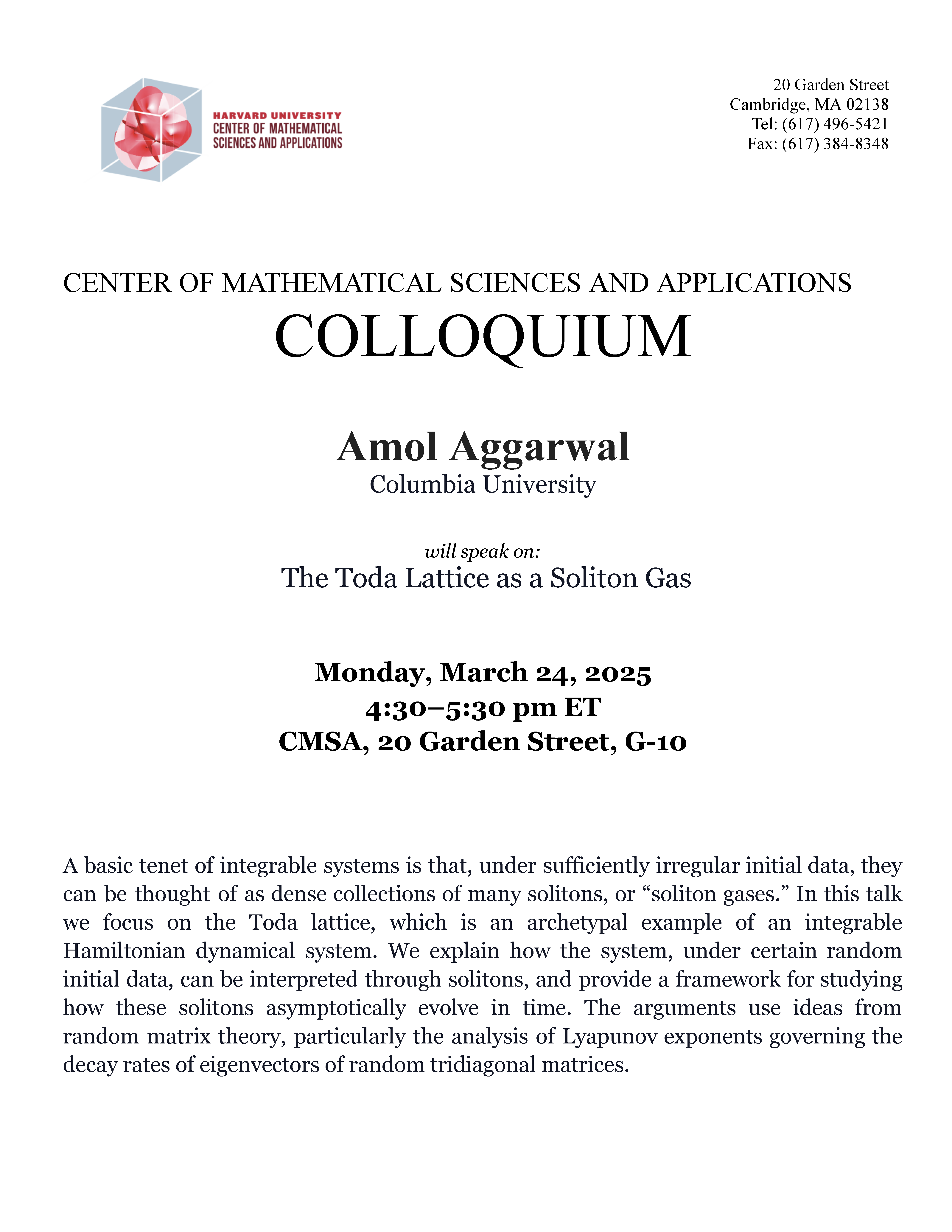
Colloquium Speaker: Amol Aggarwal, Columbia University Title: The Toda Lattice as a Soliton Gas Abstract: A basic tenet of integrable systems is that, under sufficiently irregular initial data, they can be thought of as dense collections of many solitons, or “soliton gases.” In this talk we focus on the Toda lattice, which is an archetypal example of […]
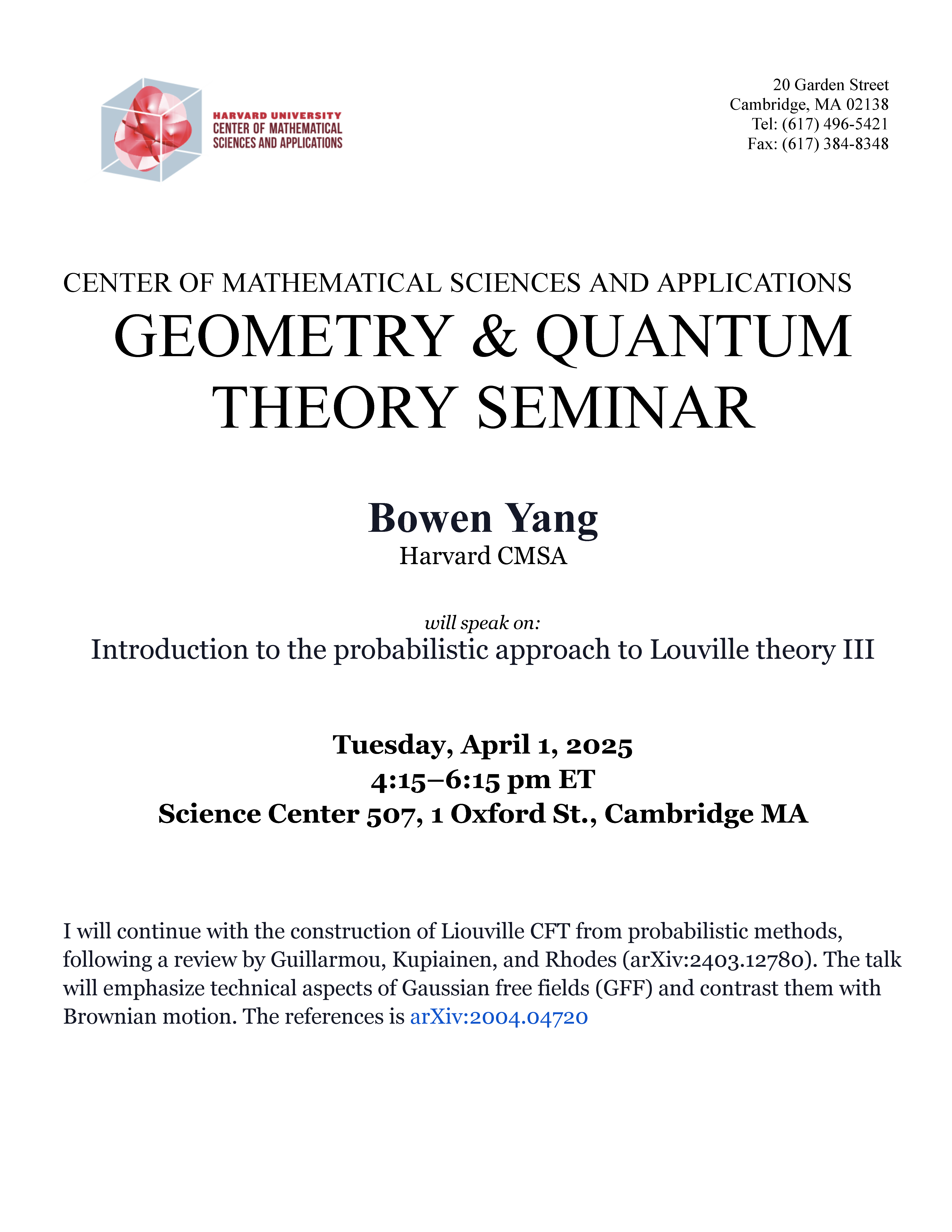
Geometry and Quantum Theory Seminar Speaker: Bowen Yang, CMSA Title: Introduction to the probabilistic approach to Louville theory III Abstract: I will continue with the construction of Liouville CFT from probabilistic methods, following a review by Guillarmou, Kupiainen, and Rhodes (arXiv:2403.12780). The talk will emphasize technical aspects of Gaussian free fields (GFF) and contrast them with Brownian […]