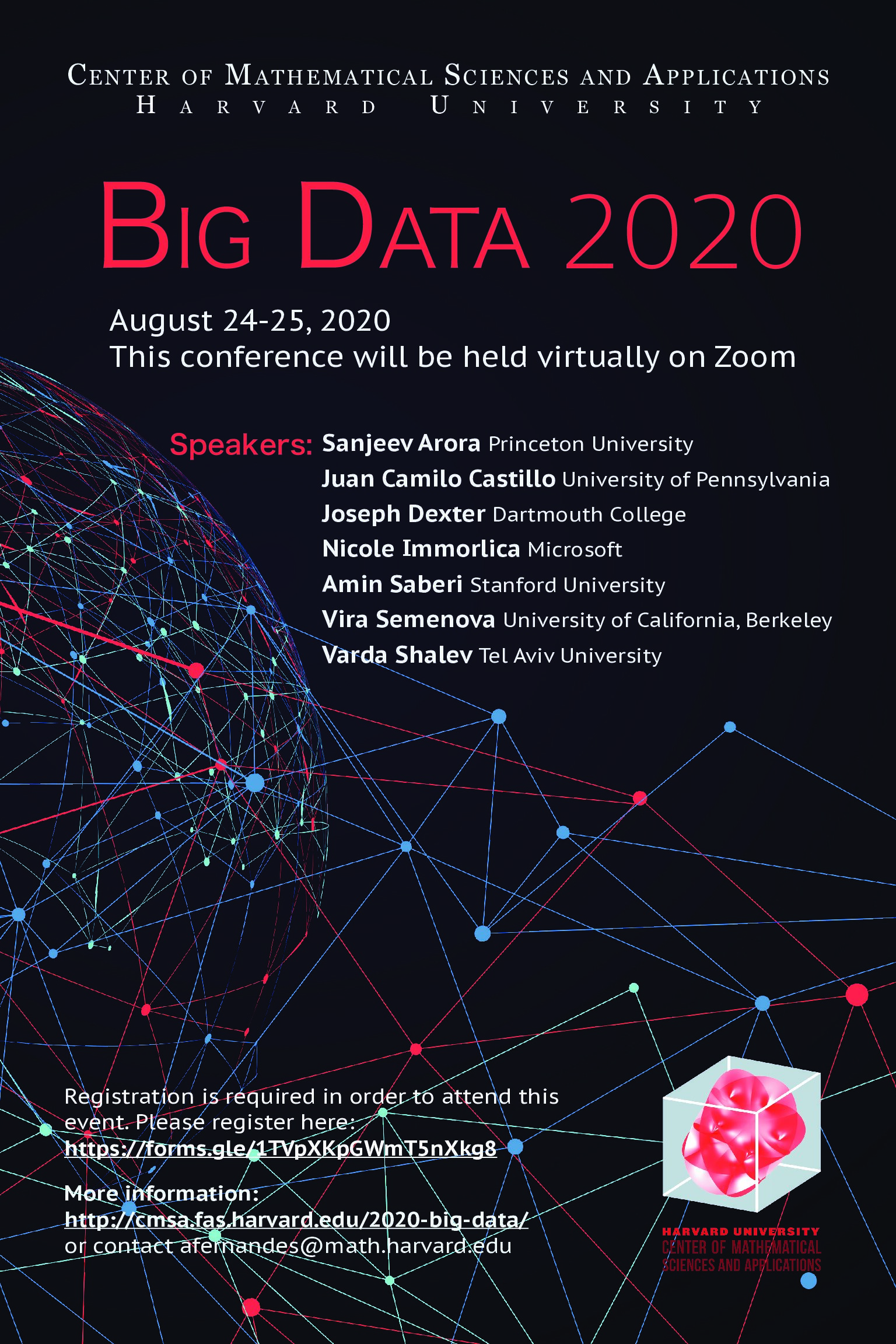
• 2020 Big Data Conference (Virtual)

    CMSA 20 Garden Street, Cambridge, MA, United States

    On August 24-25, 2020 the CMSA hosted our sixth annual Conference on Big Data. The Conference featured many speakers from the Harvard community as well as scholars from across the globe, with talks focusing on computer science, statistics, math and physics, and economics. The 2020 Big Data Conference took place virtually. Videos of the talks are available […]
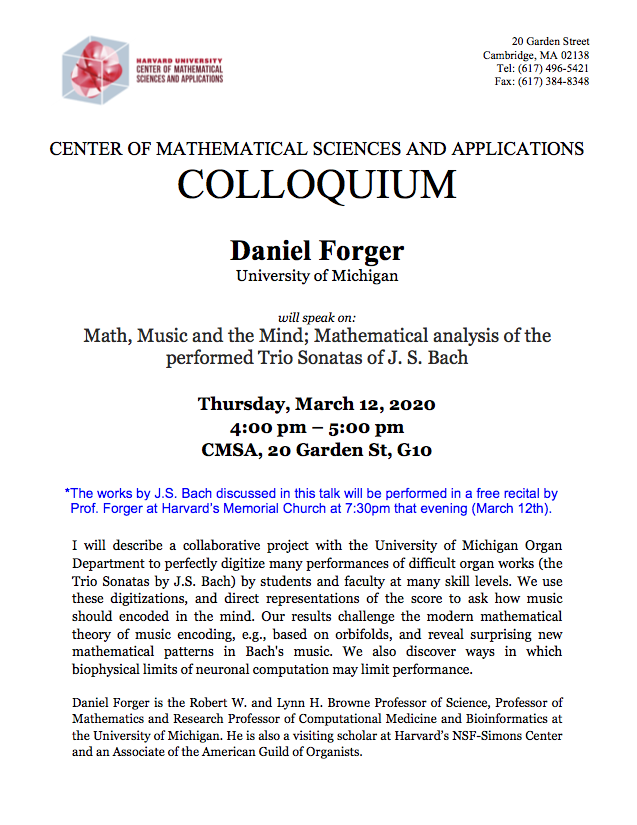
  • Math, Music and the Mind; Mathematical analysis of the performed Trio Sonatas of J. S. Bach

    CMSA 20 Garden Street, Cambridge, MA, United States

    Speaker: Daniel Forger (UMich) Location: CMSA building, 20 Garden Street, Room G10 Title: Math, Music and the Mind; Mathematical analysis of the performed Trio Sonatas of J. S. Bach Abstract: I will describe a collaborative project with the University of Michigan Organ Department to perfectly digitize many performances of difficult organ works (the Trio Sonatas by J.S. Bach) by students and faculty […]

  • Derandomizing Algorithms via Spectral Graph Theory

    CMSA 20 Garden Street, Cambridge, MA, United States

    Speaker: Salil Vadhan (Harvard) Title: Derandomizing Algorithms via Spectral Graph Theory Abstract: Randomization is a powerful tool for algorithms; it is often easier to design efficient algorithms if we allow the algorithms to "toss coins" and output a correct answer with high probability.  However, a longstanding conjecture in theoretical computer science is that every randomized algorithm can be efficiently "derandomized" […]

  • Quantum Money from Lattices

    CMSA 20 Garden Street, Cambridge, MA, United States

    Speaker: Peter Shor (MIT) Title: Quantum Money from Lattices Abstract: Quantum money is a cryptographic protocol for quantum computers. A quantum money protocol consists of a quantum state which can be created (by the mint) and verified (by anybody with a quantum computer who knows what the "serial number" of the money is), but which cannot be duplicated, even by somebody with a copy of the quantum state who knows the verification protocol. Several previous proposals have […]

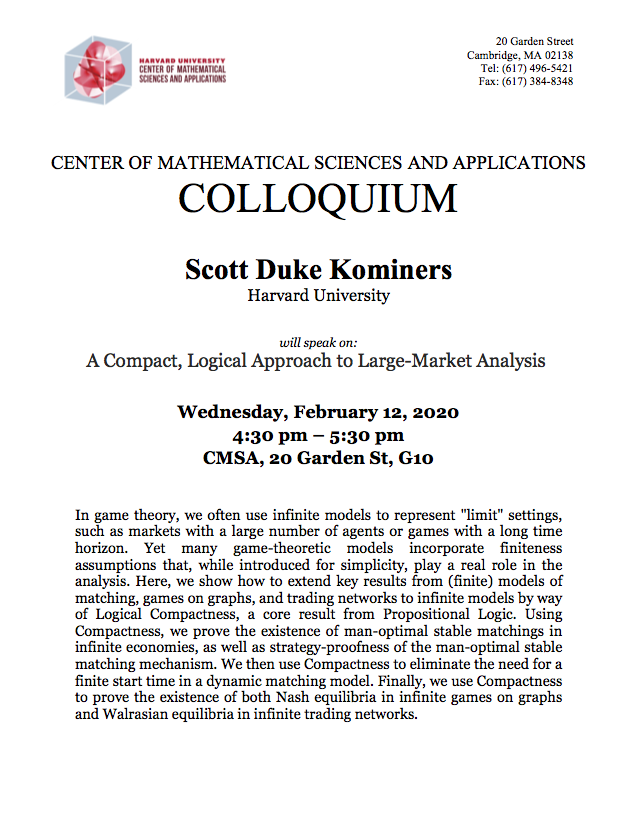
  • A Compact, Logical Approach to Large-Market Analysis

    CMSA 20 Garden Street, Cambridge, MA, United States

    Speaker: Scott Duke Kominers (Harvard) Title: A Compact, Logical Approach to Large-Market Analysis Abstract: In game theory, we often use infinite models to represent "limit" settings, such as markets with a large number of agents or games with a long time horizon. Yet many game-theoretic models incorporate finiteness assumptions that, while introduced for simplicity, play a real role in the analysis. Here, we show […]

  • Gentle Measurement of Quantum States and Differential Privacy

    CMSA 20 Garden Street, Cambridge, MA, United States

    Speaker: Scott Aaronson (University of Texas at Austin) Title: Gentle Measurement of Quantum States and Differential Privacy Abstract: I'll discuss a recent connection between two seemingly unrelated problems: how to measure a collection of quantum states without damaging them too much ("gentle measurement"), and how to provide statistical data without leaking too much about individuals ("differential privacy," an area of classical […]

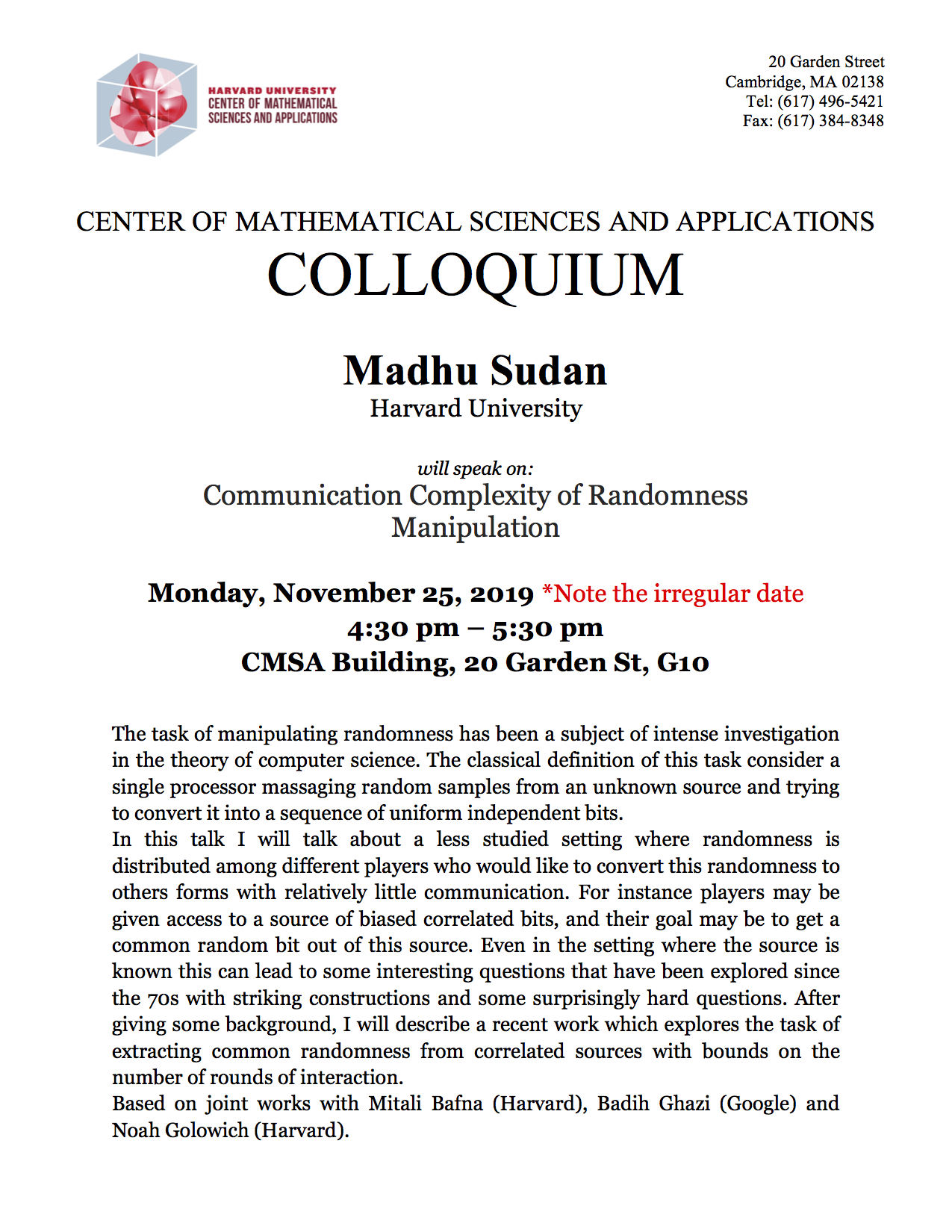
  • Communication Complexity of Randomness Manipulation

    CMSA 20 Garden Street, Cambridge, MA, United States

    Speaker: Madhu Sudan (Harvard) Title: Communication Complexity of Randomness Manipulation Abstract: The task of manipulating randomness has been a subject of intense investigation in the theory of computer science. The classical definition of this task consider a single processor massaging random samples from an unknown source and trying to convert it into a sequence of uniform independent bits.  In […]

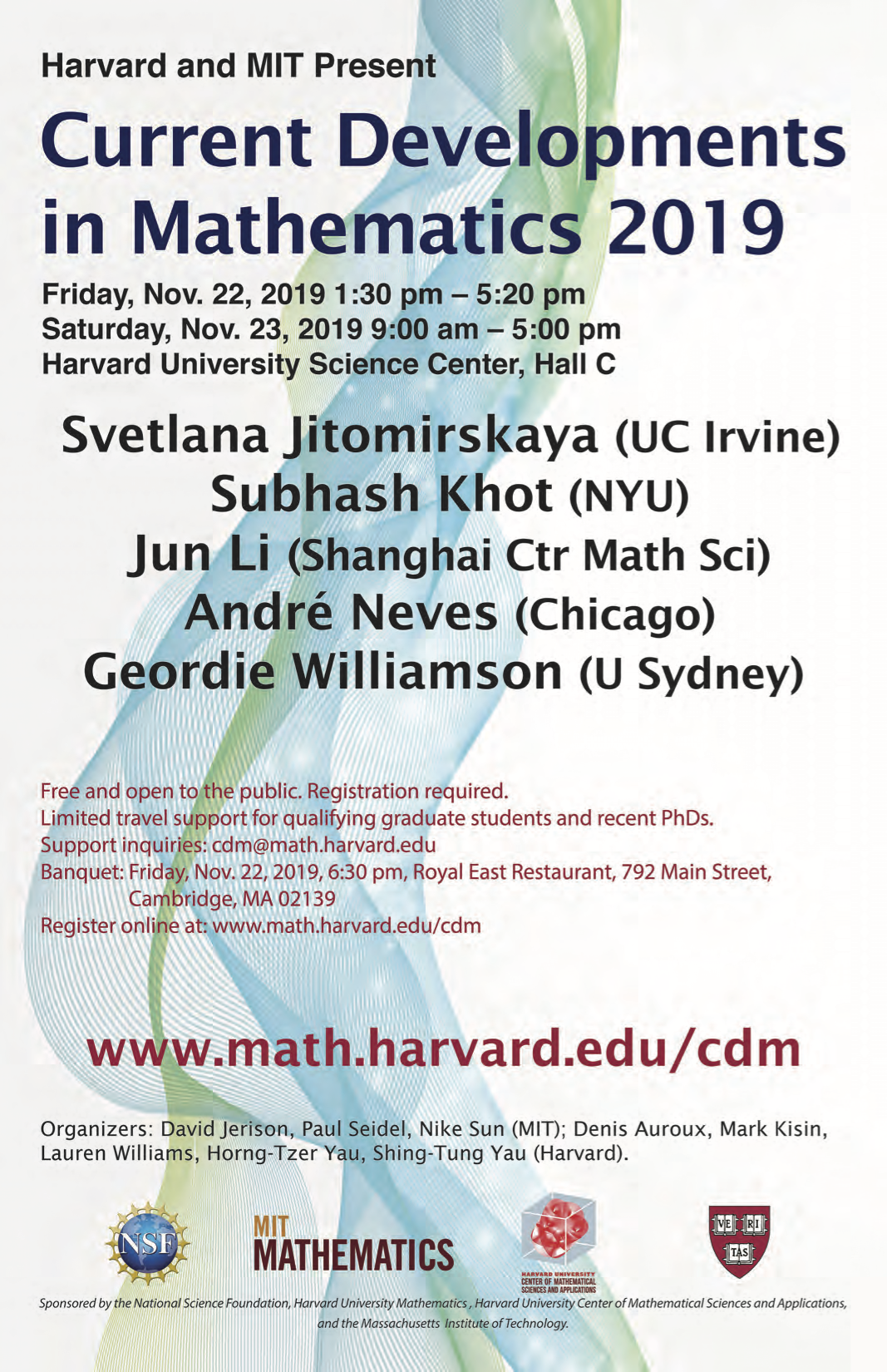
  • Current Developments in Mathematics 2019

    CMSA 20 Garden Street, Cambridge, MA, United States

      Friday, Nov. 22, 2019 1:30 pm – 5:20 pm Saturday, Nov. 23, 2019  9:00 am – 5:00 pm Harvard University Science Center, Hall C Speakers: ·      Svetlana Jitomirskaya (UC Irvine) ·      Subash Khot (NYU) ·      Jun Li (Stanford) ·      André Neves (Chicago) ·      Geordie Williamson (U Sidney) Youtube Playlist  

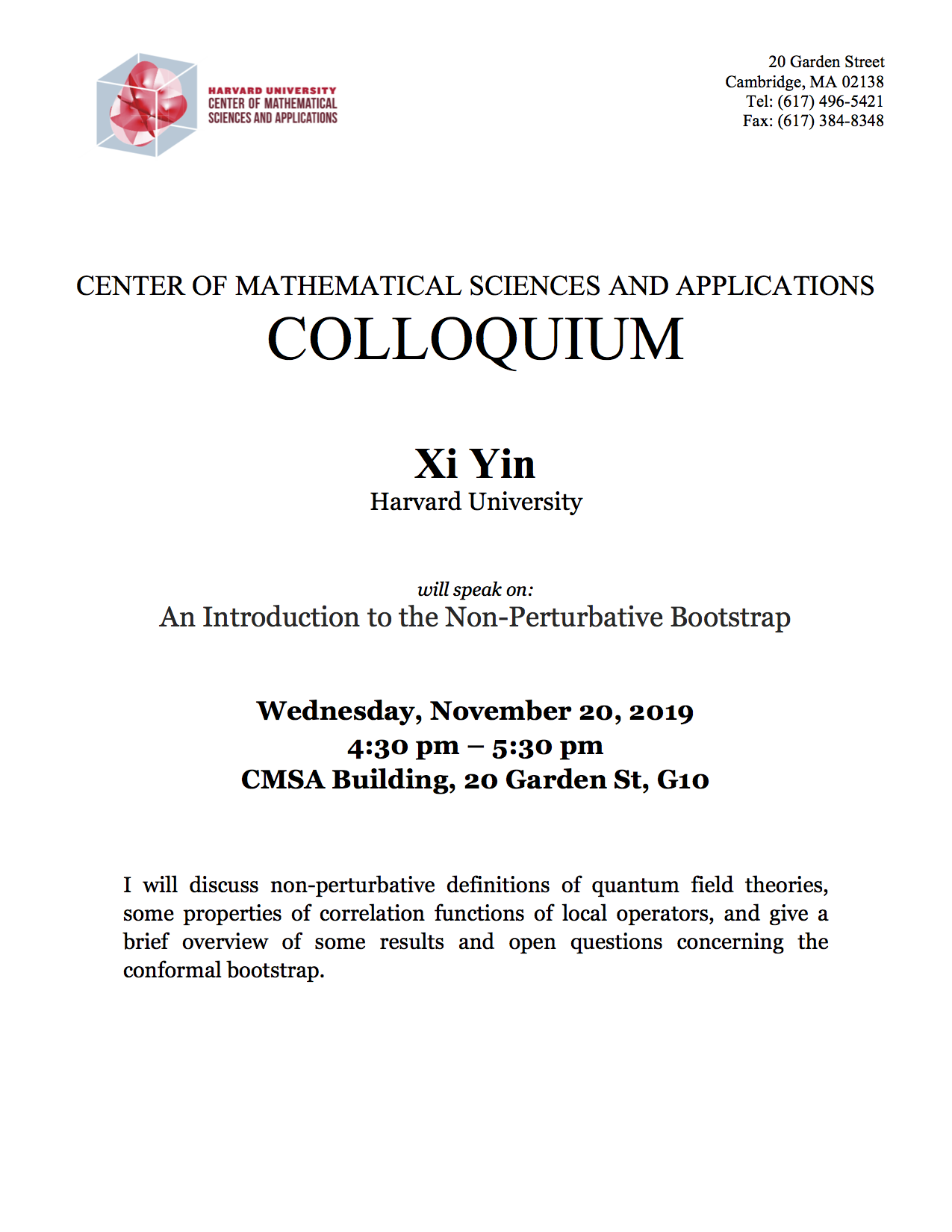
  • An Introduction to the Non-Perturbative Bootstrap

    CMSA 20 Garden Street, Cambridge, MA, United States

    Speaker: Xi Yin (Harvard) Title: An Introduction to the Non-Perturbative Bootstrap Abstract: I will discuss non-perturbative definitions of quantum field theories, some properties of correlation functions of local operators, and give a brief overview of some results and open questions concerning the conformal bootstrap

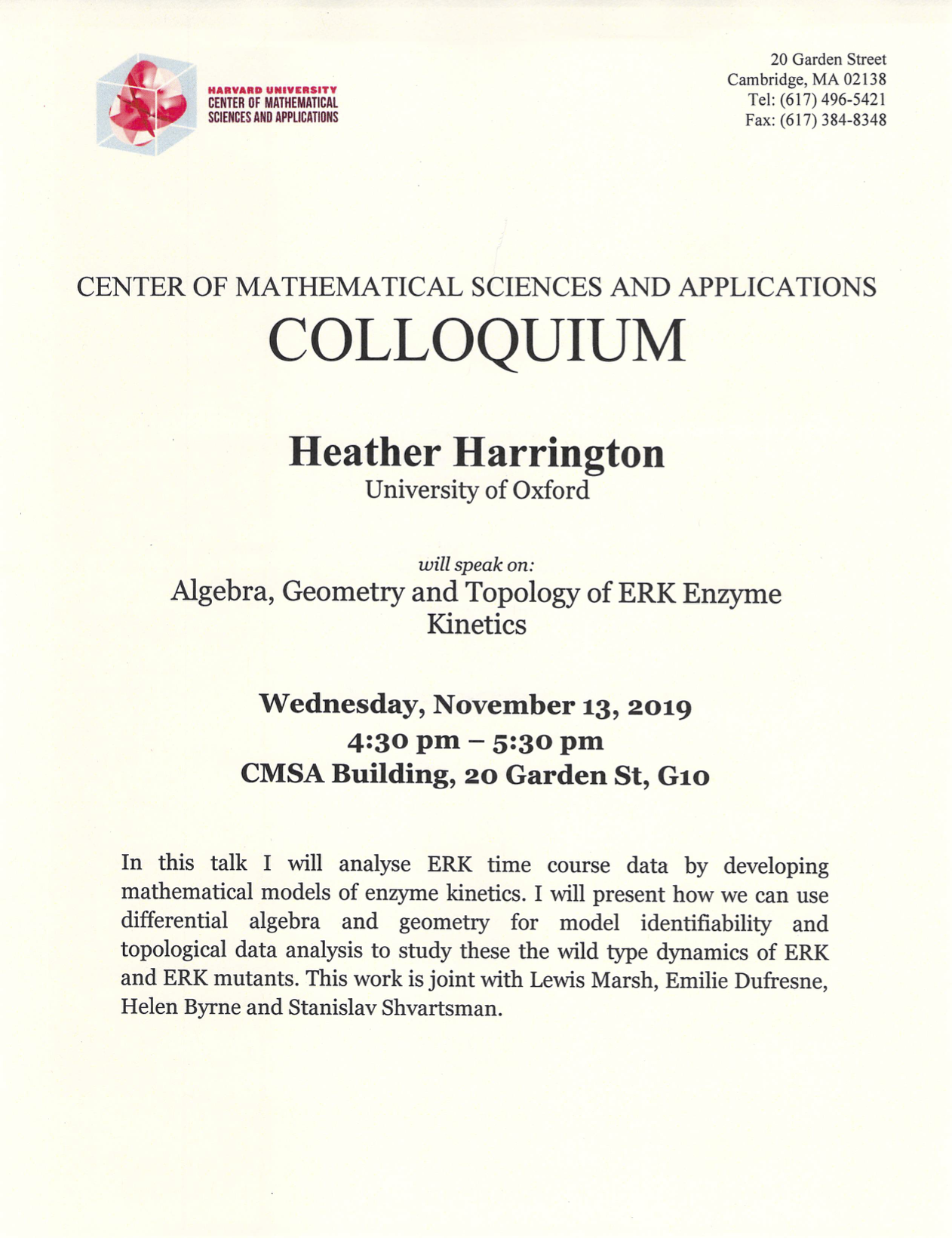
  • Algebra, Geometry and Topology of ERK Enzyme Kinetics

    CMSA 20 Garden Street, Cambridge, MA, United States

    Speaker: Heather Harrington (University of Oxford) Title: Algebra, Geometry and Topology of ERK Enzyme Kinetics Abstract: In this talk I will analyse ERK time course data by developing mathematical models of enzyme kinetics. I will present how we can use differential algebra and geometry for model identifiability and topological data analysis to study these the wild type dynamics of ERK […]

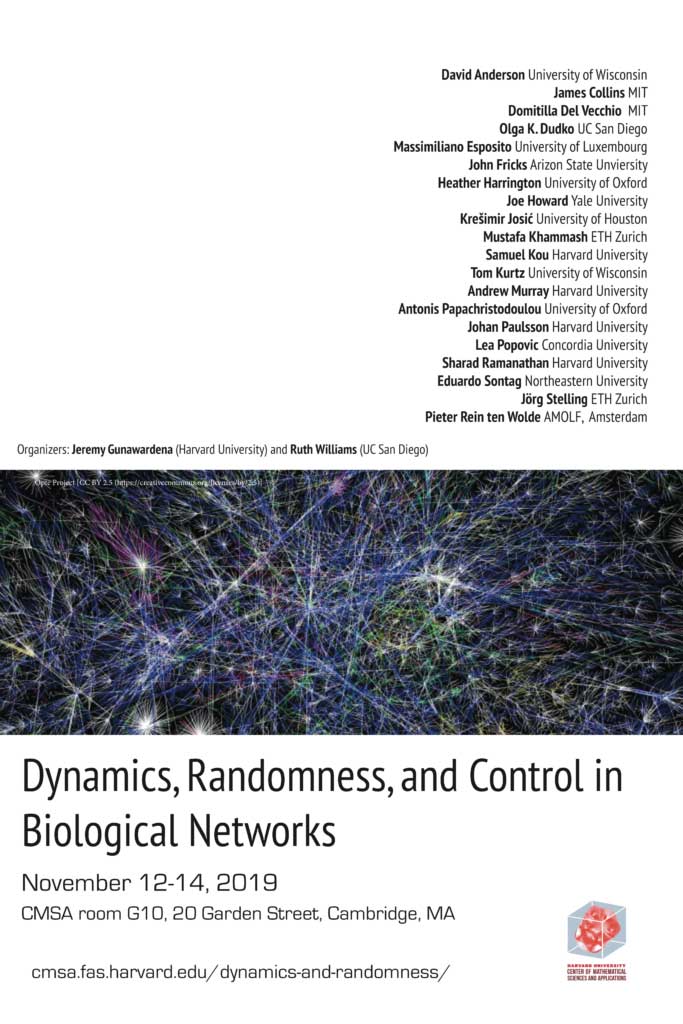
  • Workshop on Dynamics, Randomness, and Control in Molecular and Cellular Networks

    CMSA 20 Garden Street, Cambridge, MA, United States

    On November 12-14, 2019 the CMSA will be hosting a workshop on Dynamics, Randomness, and Control in Molecular and Cellular Networks. The workshop will be held in room G10 of the CMSA, located at 20 Garden Street, Cambridge, MA. Biological cells are the fundamental units of life, and predictive modeling of cellular dynamics is essential for understanding a […]

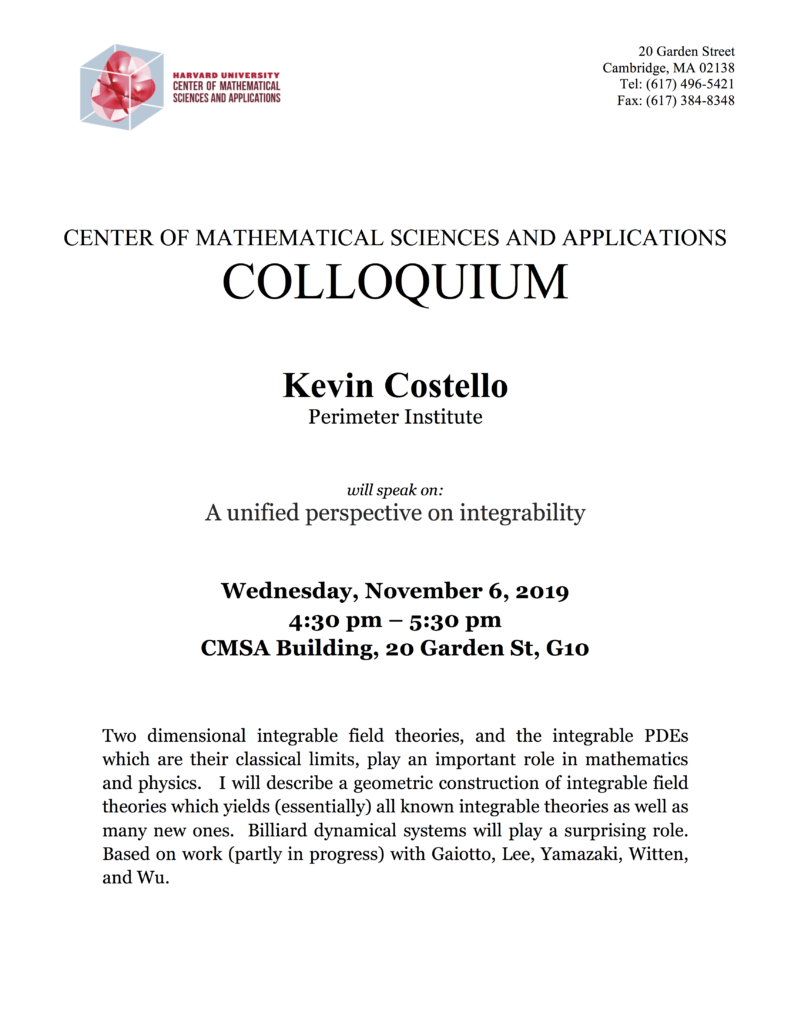
  • A unified perspective on integrability

    CMSA 20 Garden Street, Cambridge, MA, United States

    Speaker: Kevin Costello (Perimeter Institute) Title: A unified perspective on integrability Abstract: Two-dimensional integrable field theories, and the integrable PDEs which are their classical limits, play an important role in mathematics and physics.   I will describe a geometric construction of integrable field theories which yields (essentially) all known integrable theories as well as many new ones.  Billiard dynamical […]