• Swampland Program

    CMSA 20 Garden Street, Cambridge, MA, United States

    During the 2021–2022 academic year, the CMSA will host a program on the so-called “Swampland.” The Swampland program aims to determine which low-energy effective field theories are consistent with nonperturbative quantum gravity considerations. Not […]

  • CMSA Colloquium 9/15/2021 – 5/25/2022

    CMSA 20 Garden Street, Cambridge, MA, United States

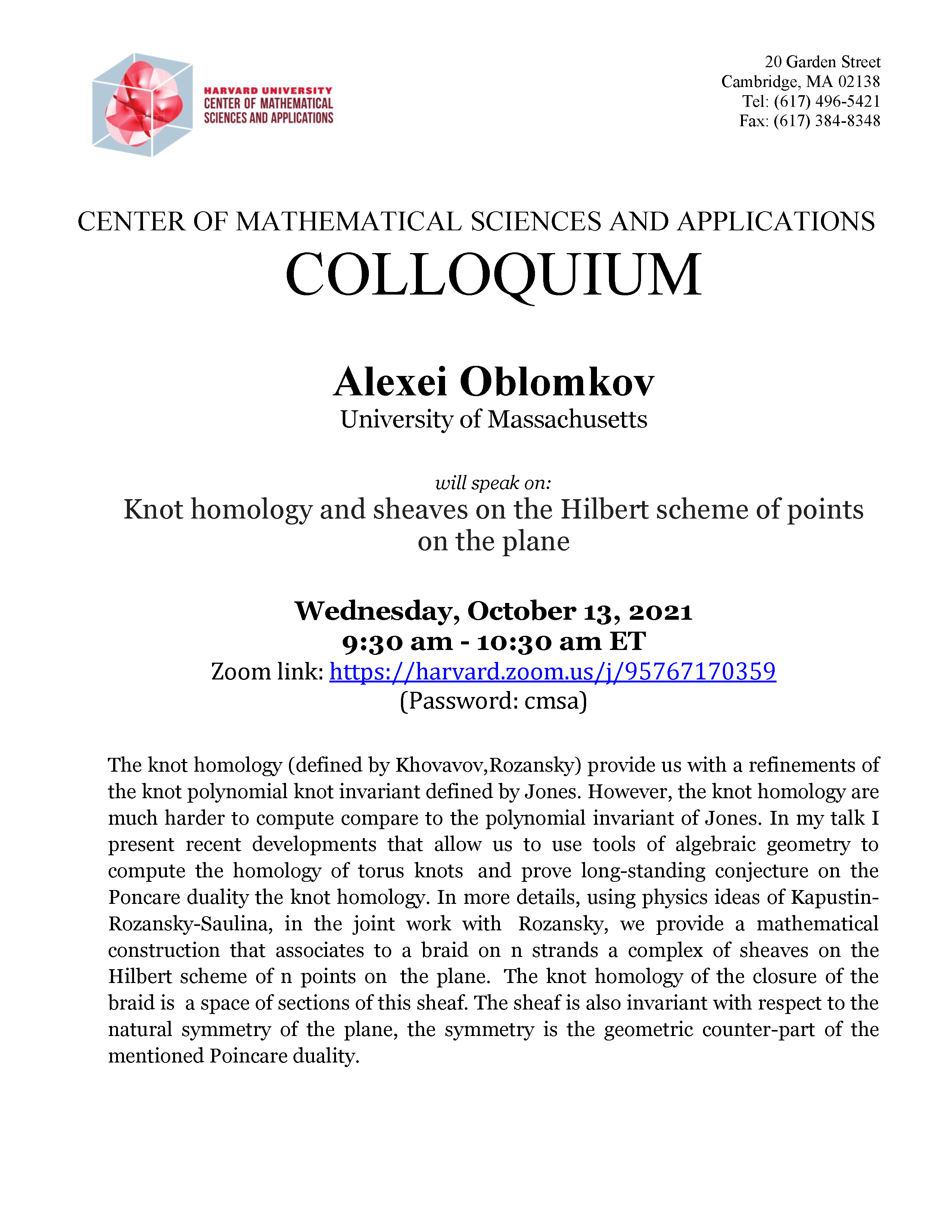
    During the 2021–22 academic year, the CMSA will be hosting a Colloquium, organized by Du Pei, Changji Xu, and Michael Simkin. It will take place on Wednesdays at 9:30am – 10:30am (Boston time). The […]

  • Some remarks on contact Calabi-Yau 7-manifolds

    Abstract: In geometry and physics it has proved useful to relate G2 and Calabi-Yau geometry via circle bundles. Contact Calabi-Yau 7-manifolds are, in the simplest cases, such circle bundles over Calabi-Yau 3-orbifolds. […]

  • Computer-Aided Mathematics and Satisfiability

    https://youtu.be/4wHwqYrCqVQ Speaker: Marijn Heule, Carnegie Mellon University Title: Computer-Aided Mathematics and Satisfiability Abstract: Progress in satisfiability (SAT) solving has made it possible to determine the correctness of complex systems and […]

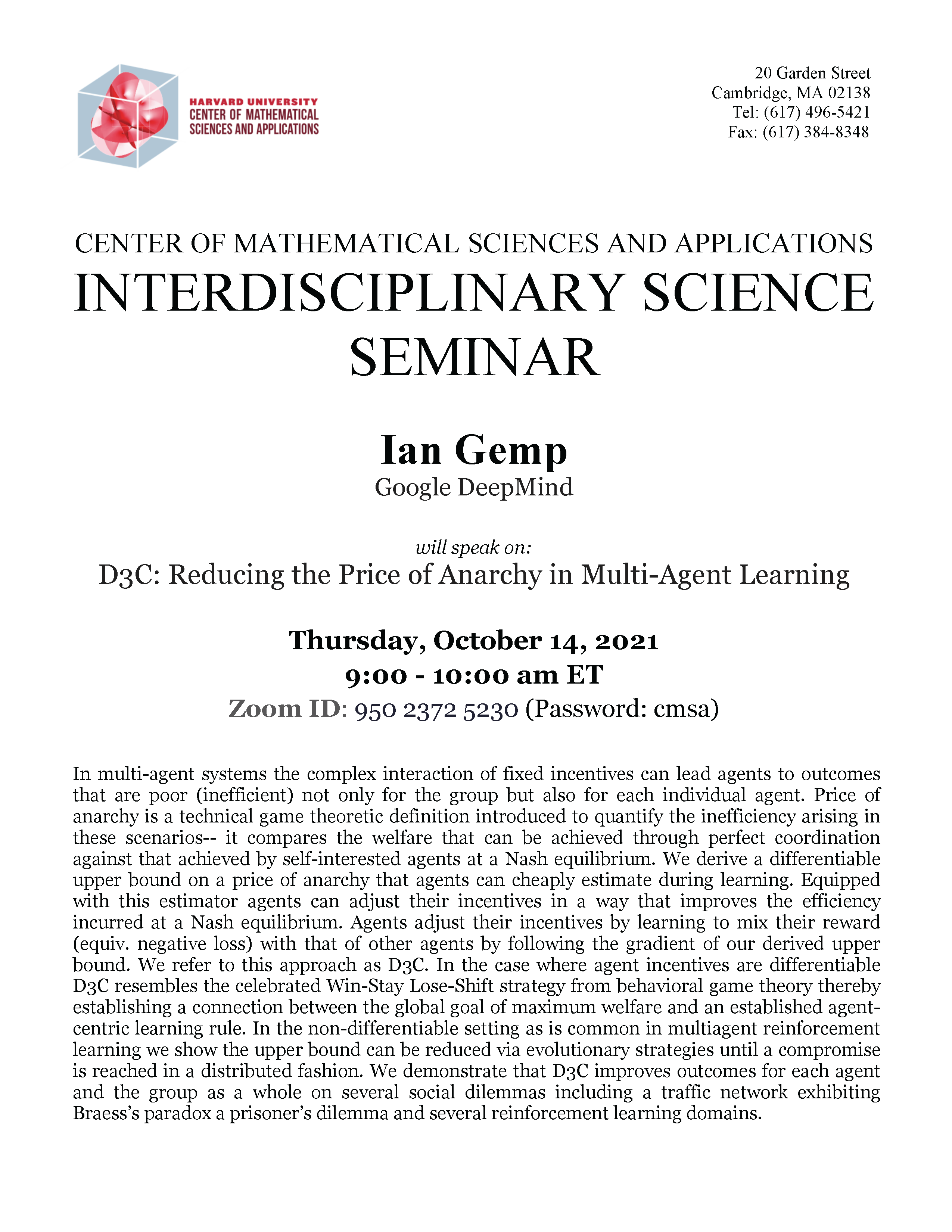
  • D3C: Reducing the Price of Anarchy in Multi-Agent Learning

    Virtual

    Speaker: Ian Gemp, DeepMind Title: D3C: Reducing the Price of Anarchy in Multi-Agent Learning Abstract: In multi-agent systems the complex interaction of fixed incentives can lead agents to outcomes that are poor […]

  • Stochastic PDE as scaling limits of interacting particle systems

    Abstract: Interacting particle models are often employed to gain understanding of the emergence of macroscopic phenomena from microscopic laws of nature. These individual-based models capture fine details, including randomness and […]

  • General Relativity 2021-22

    During the 2021–22 academic year, the CMSA will be hosting a seminar on General Relativity, organized by Aghil Alaee, Jue Liu, Daniel Kapec, and Puskar Mondal. This seminar will take […]

  • The Festina Lente Bound

    Abstract: I will explain what the Festina Lente bound means and where it comes from. Then I discuss its possible implications for phenomenology, both top-down and bottom-up.