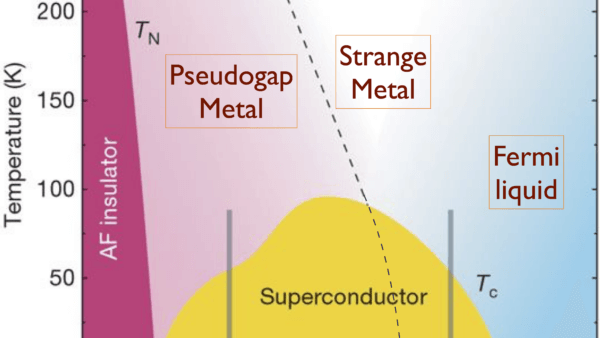
In the 2020-2021 academic year, the CMSA will be hosting a lecture series on Strongly Correlated Materials and High Tc Superconductor. All talks will take place from 10:30-12:00pm ET virtually on Zoom. Cuprate high-temperature superconductors are a classic quantum material system to demonstrate the beauty of “Emergence and Entanglement” in the quantum phases of matter. Merely by […]
During the 2021–2022 academic year, the CMSA will host a program on the so-called “Swampland.” The Swampland program aims to determine which low-energy effective field theories are consistent with nonperturbative quantum gravity considerations. Not everything is possible in String Theory, and finding out what is and what is not strongly constrains the low energy physics. These constraints are naturally […]
During the 2021–22 academic year, the CMSA will be hosting a Colloquium, organized by Du Pei, Changji Xu, and Michael Simkin. It will take place on Wednesdays at 9:30am – 10:30am (Boston time). The meetings will take place virtually on Zoom. All CMSA postdocs/members are required to attend the weekly CMSA Members’ Seminars, as well as the weekly CMSA […]
Abstract: In this talk I will introduce a particular formulation of the Weak Gravity Conjecture in AdS space in terms of the self-binding energy of a particle. The holographic CFT dual of this formulation corresponds to a certain convex-like structure for operators charged under continuous global symmetries. Motivated by this, we propose a conjecture that this […]
Title: The hypersimplex and the m=2 amplituhedron Abstract: I’ll discuss a curious correspondence between the m=2 amplituhedron, a 2k-dimensional subset of Gr(k, k+2), and the hypersimplex, an (n-1)-dimensional polytope in R^n. The amplituhedron and hypersimplex are both images of the totally nonnegative Grassmannian under some map (the amplituhedron map and the moment map, respectively), but […]
Abstract: I will present a four-term exact sequence relating the cohomology of a fibration to the cohomology of an open set obtained by removing the preimage of a general linear section of the base. This exact sequence respects three filtrations, the Hodge, weight, and perverse Leray filtrations, so that it is an exact sequence of mixed […]
Title: Oscillations in the thermal conductivity of a spin liquid* Abstract: The layered honeycomb magnet alpha-RuCl3 orders below 7 K in a zigzag phase in zero field. An in-plane magnetic field H||a suppresses the zigzag order at 7 Tesla, leaving a spin-disordered phase widely believed to be a quantum spin liquid (QSL) that extends to […]
https://youtu.be/ufG0YLj_sik Speaker: Adam Wagner, Tel Aviv University Title: Constructions in combinatorics via neural networks Abstract: Recently, significant progress has been made in the area of machine learning algorithms, and they have quickly become some of the most exciting tools in a scientist’s toolbox. In particular, recent advances in the field of reinforcement learning have led […]
Speaker: David Jordan (U Edinburgh) Title: Langlands duality for 3 manifolds Abstract: Langlands duality began as a deep and still mysterious conjecture in number theory, before branching into a similarly deep and mysterious conjecture of Beilinson and Drinfeld concerning the algebraic geometry of Riemann surfaces. In this guise it was given a physical explanation in the framework of 4-dimensional super […]
Abstract: Life is a nonequilibrium phenomenon. Metabolism provides a continuous flux of energy that dictates the form and function of many subcellular structures. These subcellular structures are active materials, composed of molecules which use chemical energy to perform mechanical work and locally violate detailed balance. One of the most dramatic examples of such a self-organizing […]
Member Seminar Speaker: Jue Liu Title: Instability of naked singularities in general relativity Abstract: One of the fundamental problems in mathematical relativity is the weak cosmic censorship conjecture, proposed by Penrose, which roughly states that for generic physical spacetime, the singularities (if existed) must be hidden behind the black holes. Unfortunately, the singularities visible to faraway observers, […]
Abstract: The study of static vacuum Riemannian metrics arises naturally in differential geometry and general relativity. It plays an important role in scalar curvature deformation, as well as in constructing Einstein spacetimes. Existence of static vacuum Riemannian metrics with prescribed Bartnik data is one of the most fundamental problems in Riemannian geometry related to general relativity. […]
On October 4th and October 5th, 2021, Harvard CMSA will host its annual Math Science Lectures in Honor of Raoul Bott. This year’s speaker will be Michael Freedman (Microsoft). The lectures will take place from 11:00am – 12:15pm (ET) on Zoom. This will be the third annual lecture series held in honor of Raoul Bott. Lecture 1 October 4th, 11:00am (Boston time) Title: […]
On October 4th and October 5th, 2021, Harvard CMSA hosted the annual Math Science Lectures in Honor of Raoul Bott. This year’s speaker was Michael Freedman (Microsoft). The lectures took place on Zoom. This will be the third annual lecture series held in honor of Raoul Bott. Lecture 1 October 4th, 11:00am (Boston time) Title: The Universe from a […]
Abstract: The definition of angular momentum in general relativity has been a subtle issue since the 1960′, due to the discovery of “supertranslation ambiguity”: the angular momentums recorded by two distant observers of the same system may not be the same. In this talk, I shall show how the mathematical theory of optimal isometric embedding and […]
Title: Geodesic Geometry on Graphs Abstract: In a graph G = (V, E) we consider a system of paths S so that for every two vertices u,v in V there is a unique uv path in S connecting them. The path system is said to be consistent if it is closed under taking subpaths, i.e. if P is a path in […]
Speaker: Piotr Sułkowski (University of Warsaw) Title: Strings, knots and quivers Abstract: I will discuss a recently discovered relation between quivers and knots, as well as – more generally – toric Calabi-Yau manifolds. In the context of knots this relation is referred to as the knots-quivers correspondence, and it states that various invariants of a given knot […]
Title: Line defects in CFTs: Renormalization group flows and semiclassical limits Abstract: I will discuss line defects in d-dimensional Conformal Field Theories (CFTs). In the first part of the talk, I will argue that the ambient CFT places nontrivial constraints on Renormalization Group (RG) flows on such line defects. I will show that the flow […]
https://youtu.be/zJOWdZZcitk Speaker: Thomas Fischbacher, Google Title: New results in Supergravity via ML Technology Abstract: The infrastructure built to power the Machine Learning revolution has many other uses beyond Deep Learning. Starting from a general architecture-level overview over the lower levels of Google’s TensorFlow machine learning library, we review how this has recently helped us to […]
Title: A tour of categorical symmetry Abstract: I will discuss some perspectives on symmetry coming from the study of topological defects in quantum field theory. I will argue that we should take topological defects themselves to define the symmetries of QFT. This gives us a view of the “category of QFTs”. I will describe some […]
Abstract: A gauged linear sigma model (GLSM) consists roughly of a complex vector space V, a group G acting on V, a character \theta of G, and a G-invariant function w on V. This data defines a GIT quotient Y = and a function on that quotient. GLSMs arise naturally in a number of contexts, for […]
Title: SiRNA Targeting TCRb: A Proposed Therapy for the Treatment of Autoimmunity Abstract: As of 2018, the United States National Institutes of Health estimate that over half a billion people worldwide are affected by autoimmune disorders. Though these conditions are prevalent, treatment options remain relatively poor, relying primarily on various forms of immunosuppression which carry potentially severe […]
Speaker: Xiaoning Wu, Chinese Academy of Sciences Title: Causality Comparison and Postive Mass Abstract: Penrose et al. investigated the physical incoherence of the space-time with negative mass via the bending of light. Precise estimates of the time-delay of null geodesics were needed and played a pivotal role in their proof. In this paper, we construct […]
Member Seminar Speaker: Michael Douglas Title: Knowledge Graph Embeddings and Inference Abstract: A knowledge graph (KG) is a data structure which represents entities and relations as the vertices and edges of a directed graph. Two examples are Wikidata for general knowledge and SemMedDB for biomedical data. A popular KG representation method is graph embedding, which facilitates […]
Title: On counting algebraically defined graphs Abstract: For many classes of graphs that arise naturally in discrete geometry (for example intersection graphs of segments or disks in the plane), the edges of these graphs can be defined algebraically using the signs of a finite list of fixed polynomials. We investigate the number of n-vertex graphs in such […]
Abstract: For a given two-term complex of vector bundles on a derived scheme (or stack), there are three natural ways to define its “derived projectivizations”: (i) as the derived base-change of the classical projectivization of Grothendieck; (ii) as the derived moduli parametrizing one-dimensional locally free quotients; (iii) as the GIT quotient of the total space by […]
Abstract: In geometry and physics it has proved useful to relate G2 and Calabi-Yau geometry via circle bundles. Contact Calabi-Yau 7-manifolds are, in the simplest cases, such circle bundles over Calabi-Yau 3-orbifolds. These 7-manifolds provide testing grounds for the study of geometric flows which seek to find torsion-free G2-structures (and thus Ricci flat metrics with exceptional holonomy). They […]
Speaker: Alexei Oblomkov (University of Massachusetts) Title: Knot homology and sheaves on the Hilbert scheme of points on the plane Abstract: The knot homology (defined by Khovavov, Rozansky) provide us with a refinement of the knot polynomial knot invariant defined by Jones. However, the knot homology are much harder to compute compared to the polynomial […]
https://youtu.be/4wHwqYrCqVQ Speaker: Marijn Heule, Carnegie Mellon University Title: Computer-Aided Mathematics and Satisfiability Abstract: Progress in satisfiability (SAT) solving has made it possible to determine the correctness of complex systems and answer long-standing open questions in mathematics. The SAT solving approach is completely automatic and can produce clever though potentially gigantic proofs. We can have confidence […]
Speaker: Ian Gemp, DeepMind Title: D3C: Reducing the Price of Anarchy in Multi-Agent Learning Abstract: In multi-agent systems the complex interaction of fixed incentives can lead agents to outcomes that are poor (inefficient) not only for the group but also for each individual agent. Price of anarchy is a technical game theoretic definition introduced to quantify the […]
Abstract: Interacting particle models are often employed to gain understanding of the emergence of macroscopic phenomena from microscopic laws of nature. These individual-based models capture fine details, including randomness and discreteness of individuals, that are not considered in continuum models such as partial differential equations (PDE) and integral-differential equations. The challenge is how to simultaneously […]
Abstract: The Dirac equation is a relativistic equation that describes the spin-1/2 particles. We talk about Dirac equations in Minkowski spacetime. In a geometric viewpoint, we can see that the spinor fields satisfying the Dirac equations enjoy the so-called peeling properties. It means the null components of the solution will decay at different rates along the […]
Member Seminar Speaker: Juven Wang Title: C-P-T Fractionalization, and Quantum Criticality Beyond the Standard Model Abstract: Discrete spacetime symmetries of parity P or reflection R, and time-reversal T, act naively as a Z2-involution on the spacetime coordinates; but together with a charge conjugation C and the fermion parity (−1)^F, these symmetries can be further fractionalized […]
During the 2021–22 academic year, the CMSA will be hosting a seminar on General Relativity, organized by Aghil Alaee, Jue Liu, Daniel Kapec, and Puskar Mondal. This seminar will take place on Thursdays at 9:30am – 10:30am (Eastern time). The meetings will take place virtually on Zoom. To learn how to attend, please fill out this form. The schedule […]
Abstract: I will explain what the Festina Lente bound means and where it comes from. Then I discuss its possible implications for phenomenology, both top-down and bottom-up.
Title: Ising model, total positivity, and criticality Abstract: The Ising model, introduced in 1920, is one of the most well-studied models in statistical mechanics. It is known to undergo a phase transition at critical temperature, and has attracted considerable interest over the last two decades due to special properties of its scaling limit at criticality. The totally nonnegative Grassmannian […]
Abstract: D-critical schemes and Artin stacks were introduced by Joyce in 2015, and play a central role in Donaldson-Thomas theory. They typically occur as truncations of (-1)-shifted symplectic derived schemes, but the problem of constructing the d-critical structure on a “DT moduli space” without passing through derived geometry is wide open. We discuss this problem, and […]
Abstract: (joint with S. Venugopalan) I will describe version of the Fukaya algebra that appears in a tropical degeneration with the Lagrangian being one of the “tropical fibers”. An example is the count of “twenty-one disks in the cubic surface” (suggested by Sheridan) which is an open analog of the twenty-seven lines. As an application, I will explain why the Floer […]
Speaker: Peng Shan (Tsinghua University) Title: Categorification and applications Abstract: I will give a survey of the program of categorification for quantum groups, some of its recent development and applications to representation theory.
Title: Electric-magnetic duality and the Geometric Langlands duality Abstract: I will give a pedagogical review of the connection between electric-magnetic duality and the Geometric Langlands duality.
Title: Mathematical resolution of the Liouville conformal field theory. Abstract: The Liouville conformal field theory is a well-known beautiful quantum field theory in physics describing random surfaces. Only recently a mathematical approach based on a well-defined path integral to this theory has been proposed using probability by David, Kupiainen, Rhodes, Vargas. Many works since the […]
Abstract: Taking the large dimension limit of Einstein’s equations is a useful strategy for solving and understanding the dynamics that these equations encode. I will introduce the underlying ideas and the progress that has resulted in recent years from this line of research. Most of the discussion will be classical in nature and will concern situations […]
Speaker: Du Pei Title: Wall-crossing from Higgs bundles to vortices Abstract: Quantum field theories can often be used to uncover hidden algebraic structures in geometry and hidden geometric structures in algebra. In this talk, I will demonstrate how such “wall-crossing” can relate the moduli space of Higgs bundles with the moduli space of vortices.
Abstract: I describe our work looking at `traditional’ scenarios of moduli stabilisation from a holographic perspective. This reveals some interesting structure that is not apparent from the top-down perspective. For vacua in the extreme regions of moduli space, such as LVS in type IIB or the DGKT flux vacua in type IIA, the dual moduli […]
Abstract: The n-queens problem asks how many ways there are to place n queens on an n x n chessboard so that no two queens can attack one another, and the toroidal n-queens problem asks the same question where the board is considered on the surface of a torus. Let Q(n) denote the number of n-queens […]
Abstract: It is well known that the Hilbert schemes of points on smooth surfaces are smooth. In higher dimensions the Hilbert schemes of points are in general singular. In this talk we will present some examples and conjectures on the local structures of the Hilbert scheme of points on $\mathbb{P}^3$. As an application we study a […]
Speaker: Karim Adiprasito, Hebrew University and University of Copenhagen Title: Anisotropy, biased pairing theory and applications Abstract: Not so long ago, the relations between algebraic geometry and combinatorics were strictly governed by the former party, with results like log-concavity of the coefficients of the characteristic polynomial of matroids shackled by intuitions and techniques from projective algebraic […]
https://youtu.be/rRGh97sOtKE Speaker: Patrick Massot, Laboratoire de Mathématiques d’Orsay and CNRS Title: Why explain mathematics to computers? Abstract: A growing number of mathematicians are having fun explaining mathematics to computers using proof assistant softwares. This process is called formalization. In this talk I’ll describe what formalization looks like, what kind of things it teaches us, and […]
Abstract: The gravitational dual to the grand canonical ensemble of a large N holographic theory is a charged black hole. These spacetimes can have Cauchy horizons that render the classical gravitational dynamics of the black hole interior incomplete. We show that a (spatially uniform) deformation of the CFT by a neutral scalar operator generically leads to […]
Abstract: During development, organisms interact with their natural habitats while undergoing morphological changes, yet we know little about how the interplay between developing systems and their environments impacts animal morphogenesis. Cnidaria, a basal animal lineage that includes sea anemones, corals, hydras, and jellyfish, offers unique insight into the development and evolution of morphological complexity. In my […]
Speaker: Jie Yang, Delft University of Technology Title: ARCH: Know What Your Machine Doesn’t Know Abstract: Despite their impressive performance, machine learning systems remain prohibitively unreliable in safety-, trust-, and ethically sensitive domains. Recent discussions in different sub-fields of AI have reached the consensus of knowledge need in machine learning; few discussions have touched upon the diagnosis […]
Speaker: Freid Tong Title: The complex Monge-Ampere equation in Kahler geometry Abstract: The complex Monge-Ampere equations occupies an central role in K\”ahler geometry, beginning with Yau’s famous solutions of the Calabi conjecture. Later developments has led to many interesting geometric applications and opening of new fields. In this talk, I will introduce the complex Monge-Ampere equation […]
Speaker: Eric Sharpe (Virginia Tech) Title: Anomaly resolution via decomposition Abstract: In this talk we will discuss a method of anomaly resolution due to Wang-Wen-Witten in the special case of (1+1) dimensional theories. Briefly, for our purposes, Wang-Wen-Witten argued that an ill-defined anomalous orbifold could be resolved by extending G to a larger group and […]
Speaker: Biao Lian (Princeton) Title: Integrability and chaos of 1+1d chiral edge states Abstract: I will talk about the integrability and chaos of 1+1d interacting chiral edge states, which may arise on the edge of 2+1d topological phases. We show that integrable chiral Luttinger liquid is not always a good low energy description of the […]