• Light strings, strong coupling, and the Swampland

    Member Seminar Speaker: Max Wiesner Title: Light strings, strong coupling, and the Swampland Abstract: In this talk, I will start by reviewing central ideas of the so-called Swampland Program. The Swampland Program aims to identify criteria that distinguish low-energy effective field theories, that can be consistently coupled to quantum gravity, from those theories that become inconsistent […]
  • Metals with strongly correlated electrons: quantum criticality, disordered interactions, Planckian dissipation, and scale invariance

    Speaker: Aavishkar Patel (UC Berkeley) Title: Metals with strongly correlated electrons: quantum criticality, disordered interactions, Planckian dissipation, and scale invariance Abstract: Metals that do not fit Landau’s famous Fermi liquid paradigm of quasiparticles are plentiful in experiments, but constructing their theoretical description is a major challenge in modern quantum many-body physics. I will describe new […]

  • 1/20/2022 – Interdisciplinary Science Seminar

    Title: Markov chains, optimal control, and reinforcement learning Abstract: Markov decision processes are a model for several artificial intelligence problems, such as games (chess, Go…) or robotics. At each timestep, an agent has to choose an action, then receives a reward, and then the agent’s environment changes (deterministically or stochastically) in response to the agent’s action. […]

  • AdS with Scale Separation

    Member Seminar Speaker: Daniel Junghans Title: AdS with Scale Separation Abstract: I will talk about Anti-de Sitter solutions in string theory with a parametric separation between the AdS curvature scale and the Kaluza-Klein scale. In particular, I will discuss recent progress on computing backreaction corrections in such solutions, and I will explain how to construct solutions without […]

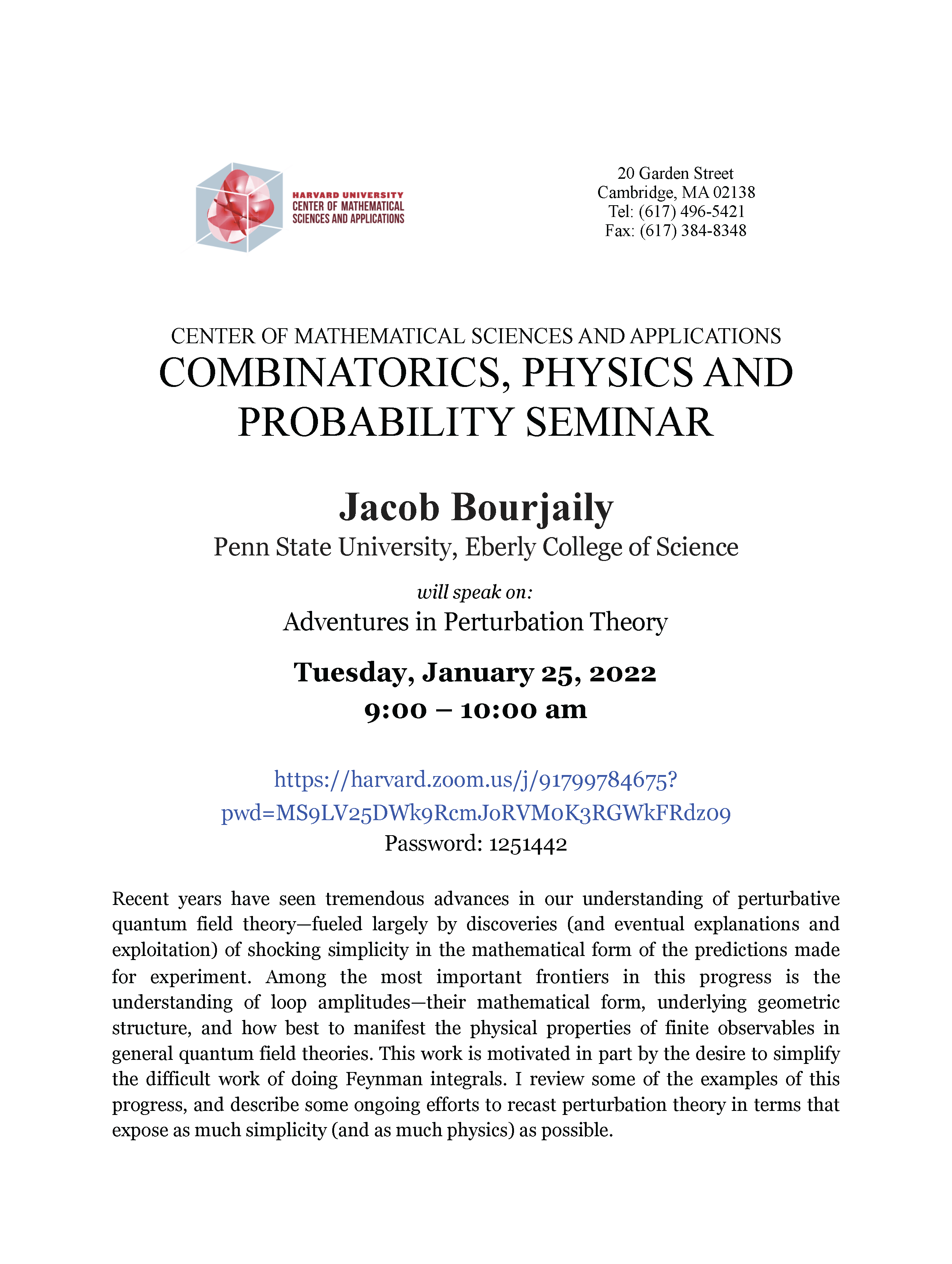
  • Adventures in Perturbation Theory

    Abstract: Recent years have seen tremendous advances in our understanding of perturbative quantum field theory—fueled largely by discoveries (and eventual explanations and exploitation) of shocking simplicity in the mathematical form of the predictions made for experiment. Among the most important frontiers in this progress is the understanding of loop amplitudes—their mathematical form, underlying geometric structure, and […]

  • CMSA Colloquium

    During the 2021–22 academic year, the CMSA will be hosting a Colloquium, organized by Du Pei, Changji Xu, and Michael Simkin. It will take place on Wednesdays at 9:30am – 10:30am (Boston time). The meetings will take place virtually on Zoom. All CMSA postdocs/members are required to attend the weekly CMSA Members’ Seminars, as well as the weekly CMSA […]

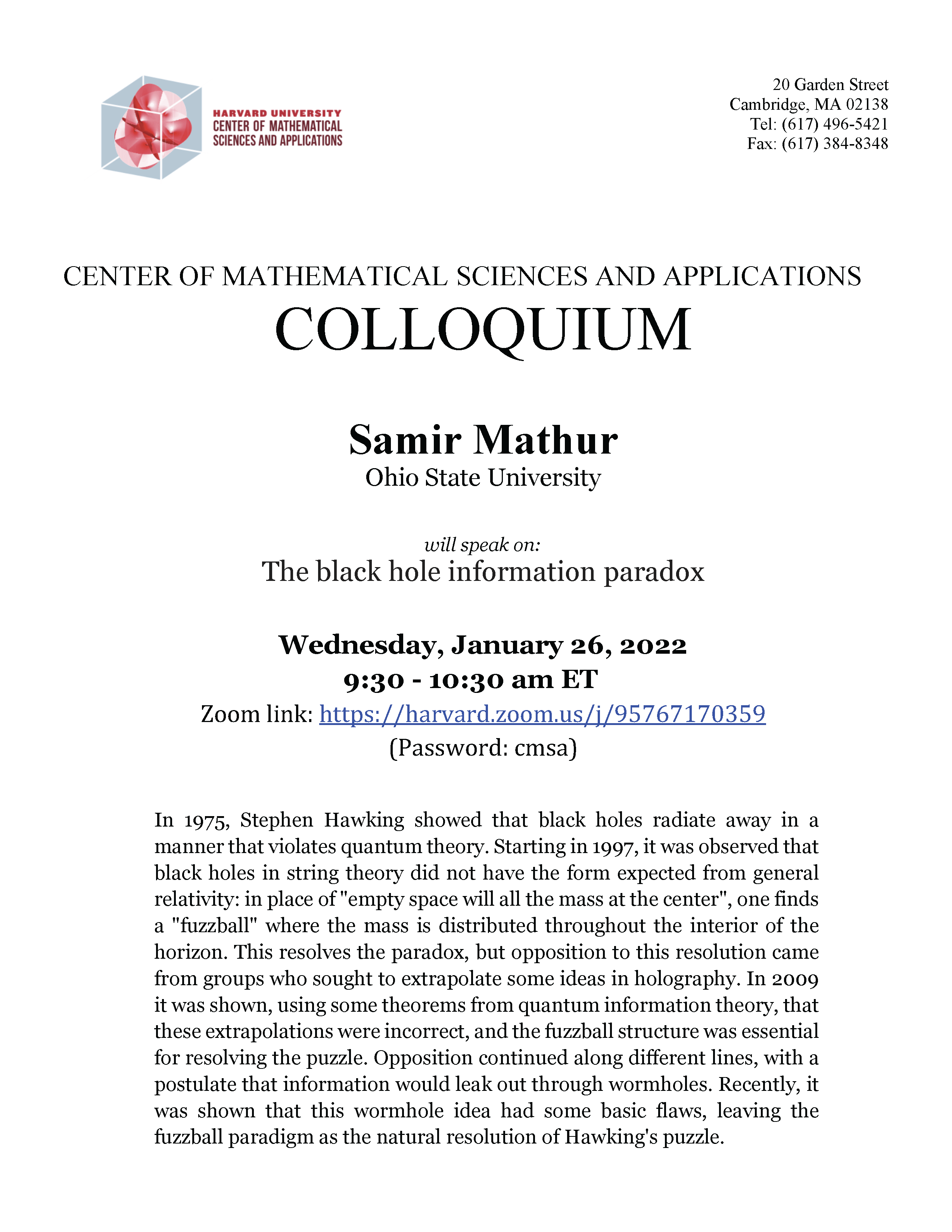
  • The black hole information paradox

    Speaker: Samir Mathur (Ohio State University) Title: The black hole information paradox Abstract: In 1975, Stephen Hawking showed that black holes radiate away in a manner that violates quantum theory. Starting in 1997, it was observed that black holes in string theory did not have the form expected from general relativity: in place of “empty space will […]

  • Cohomology of the moduli of Higgs bundles via positive characteristic

    Abstract: In this talk, I will survey the P=W conjecture, which describes certain structures of the cohomology of the moduli space of Higgs bundles on a curve in terms of the character variety of the curve.  I will then explain how certain symmetries of this cohomology, which are predictions of this conjecture, can be constructed […]

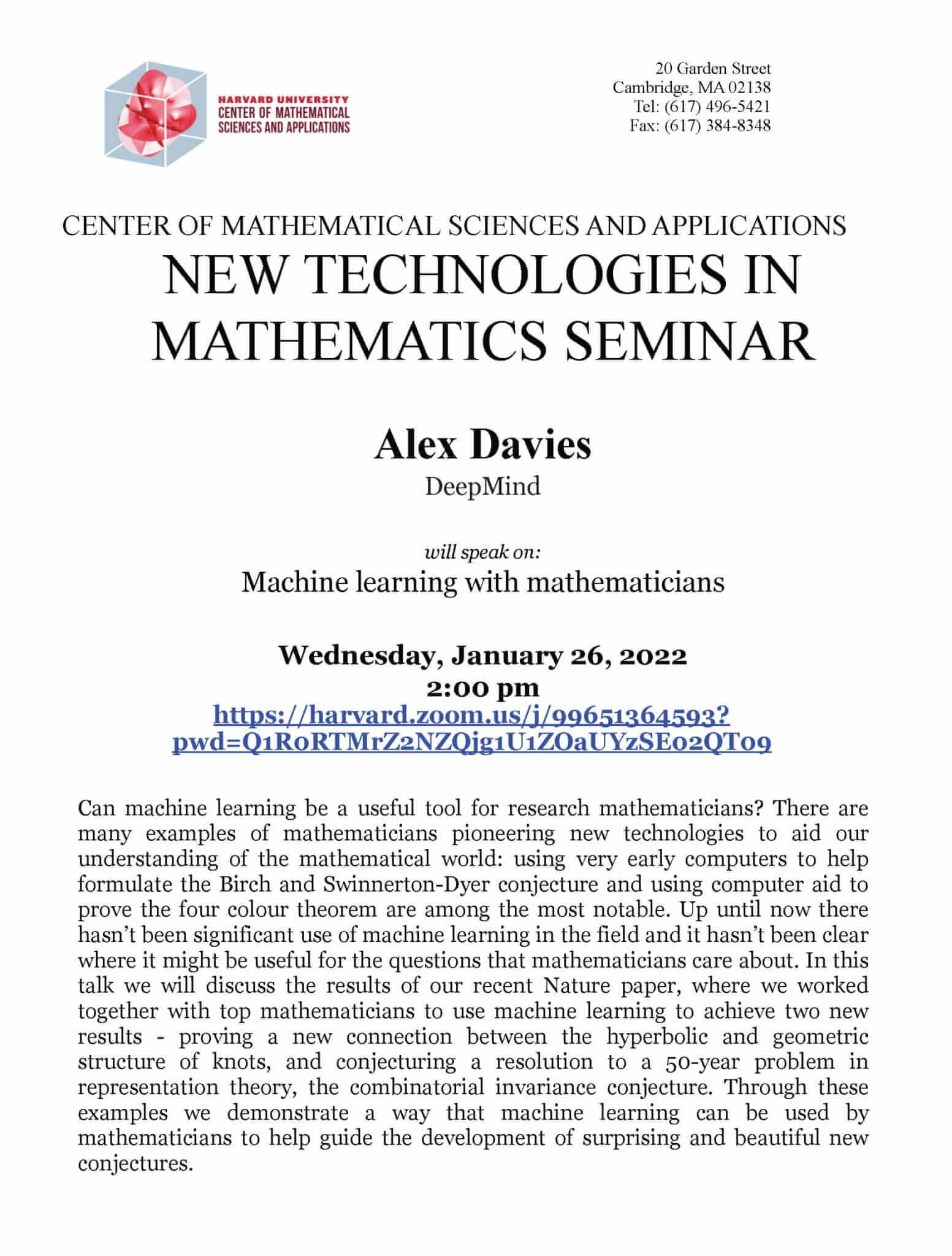
  • Machine learning with mathematicians

    https://youtu.be/DMvmcTQuofE Speaker: Alex Davies, DeepMind Title: Machine learning with mathematicians Abstract: Can machine learning be a useful tool for research mathematicians? There are many examples of mathematicians pioneering new technologies to aid our understanding of the mathematical world: using very early computers to help formulate the Birch and Swinnerton-Dyer conjecture and using computer aid to […]

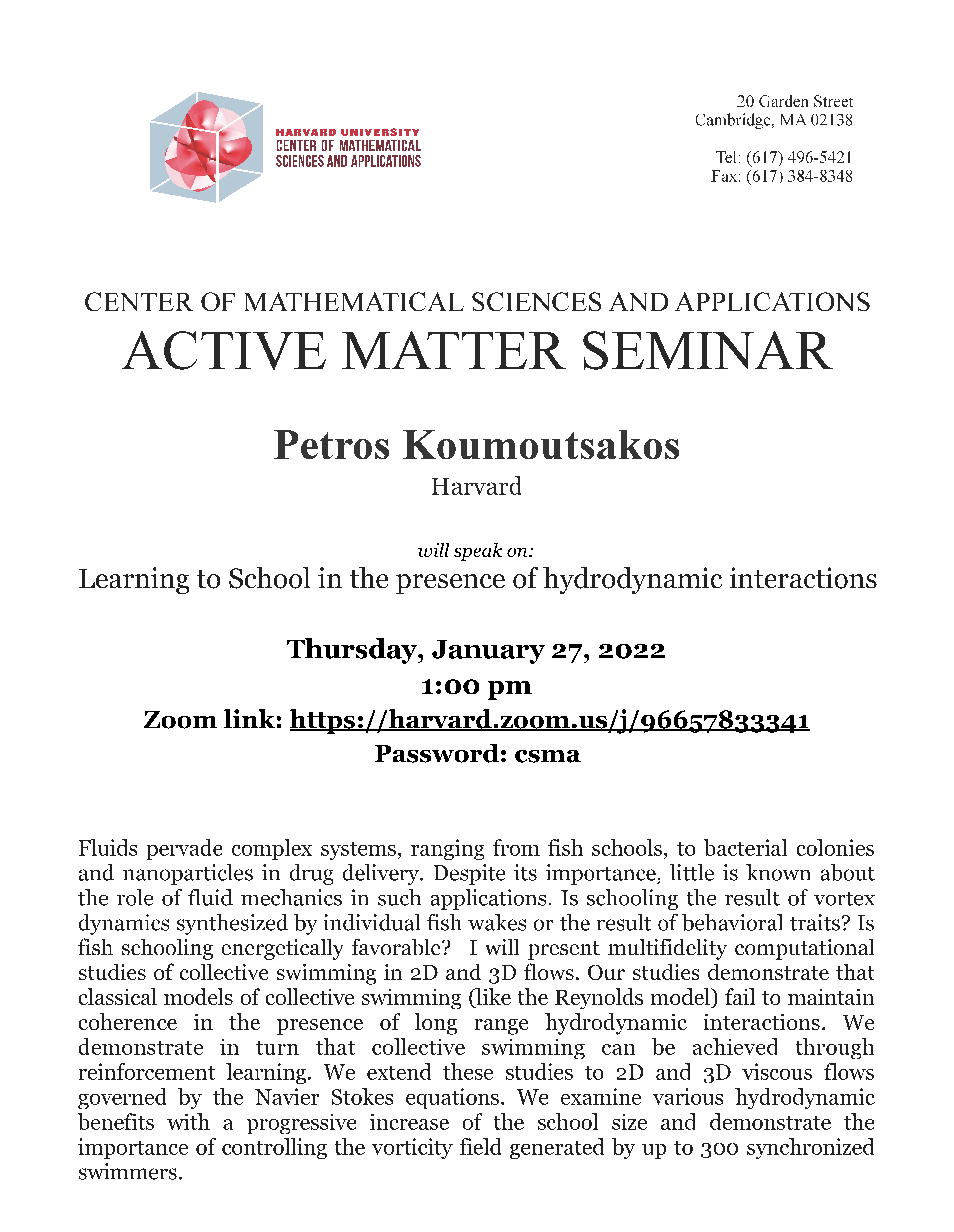
  • Learning to School in the presence of hydrodynamic interactions

    Abstract: Fluids pervade complex systems, ranging from fish schools, to bacterial colonies and nanoparticles in drug delivery. Despite its importance, little is known about the role of fluid mechanics in such applications. Is schooling the result of vortex dynamics synthesized by individual fish wakes or the result of behavioral traits? Is fish schooling energetically favorable?  I […]

  • 1/27/2022 – Interdisciplinary Science Seminar

    Title: Polynomials vanishing at lattice points in convex sets Abstract: Let P be a convex subset of R^2. For large d, what is the smallest degree r_d of a polynomial vanishing at all lattice points in the dilate d*P? We show that r_d / d converges to some positive number, which we compute for many (but maybe not […]