• Interacting Active Matter

    CMSA Room G10 CMSA, 20 Garden Street, Cambridge, MA, United States

    Active Matter Seminar Speaker: Amin Doostmohammadi, Niels Bohr Institute, University of Copenhagen Title: Interacting Active Matter Abstract: I will focus on the interaction between different active matter systems. In particular, I will describe recent experimental and modeling results that reveal how interaction forces between adhesive cells generate activity in the cell layer and lead to a […]
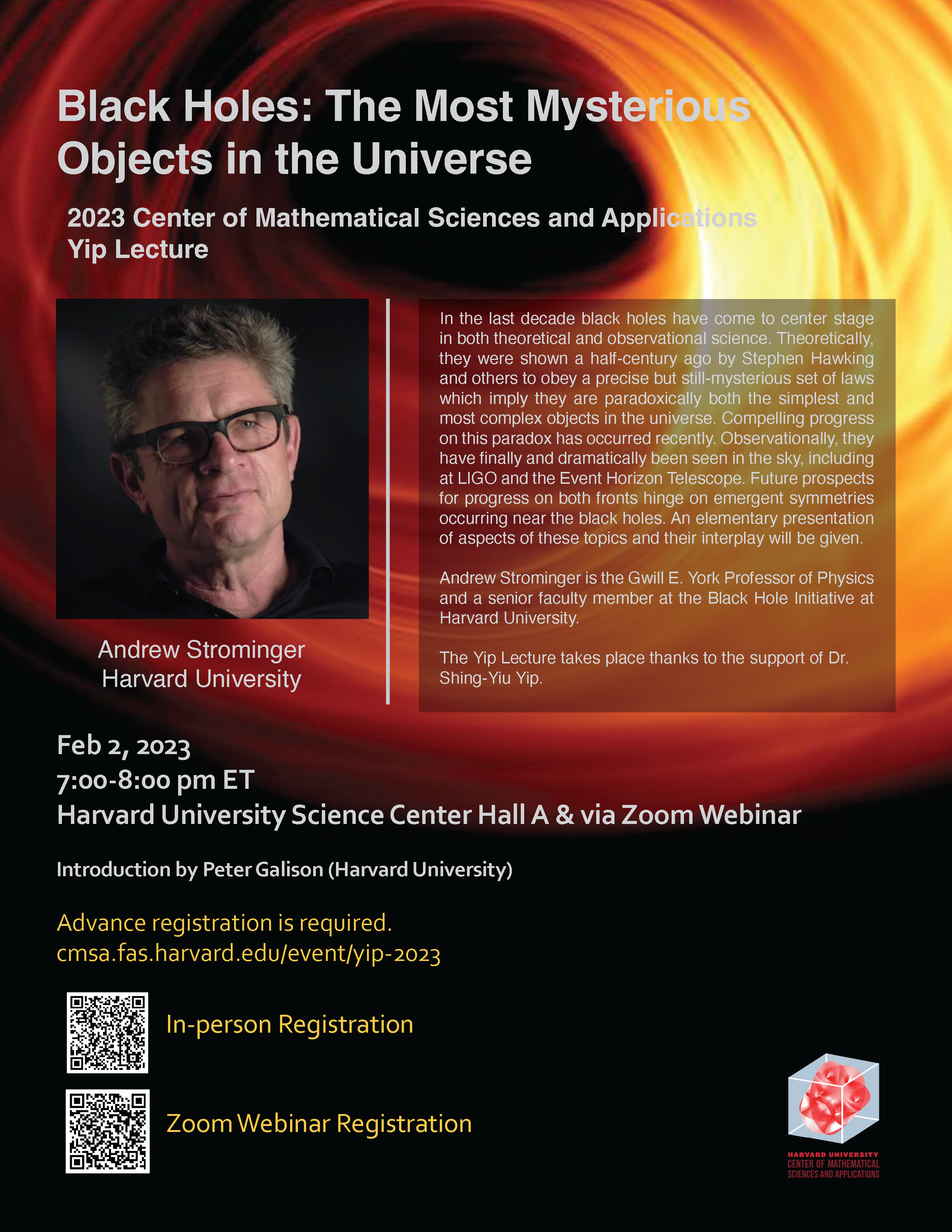
  • Third Annual Yip Lecture

    Harvard Science Center 1 Oxford Street, Cambridge, MA

    Andrew Strominger will give the Third Annual Yip Lecture on February 2, 2023. Time: 7:00-8:00 pm ET Location: Harvard Science Center Hall A   Title: Black Holes: The Most Mysterious Objects in the Universe Abstract: In the last decade black holes have come to center stage in both theoretical and observational science. Theoretically, they were […]

  • Fracton orders in hyperbolic space and its excitations with fractal mobility

    Virtual

    Quantum Matter Seminar Speaker: Han Yan (Rice U) Title: Fracton orders in hyperbolic space and its excitations with fractal mobility Abstract: Unlike ordinary topological quantum phases, fracton orders are intimately dependent on the underlying lattice geometry. In this work, we study a generalization of the X-cube model, on lattices embedded in a stack of hyperbolic […]

  • Motivic Geometry of Two-Loop Feynman Integrals

    CMSA Room G10 CMSA, 20 Garden Street, Cambridge, MA, United States

    Member Seminar Speaker: Chuck Doran Title: Motivic Geometry of Two-Loop Feynman Integrals Abstract: We study the geometry and Hodge theory of the cubic hypersurfaces attached to two-loop Feynman integrals for generic physical parameters. We show that the Hodge structure attached to planar two-loop Feynman graphs decomposes into a mixed Tate piece and a variation of Hodge structure from […]

  • From spin glasses to Boolean circuits lower bounds – Algorithmic barriers from the overlap gap property

    CMSA Room G10 CMSA, 20 Garden Street, Cambridge, MA, United States

    Speaker: David Gamarnik (MIT) Title: From spin glasses to Boolean circuits lower bounds. Algorithmic barriers from the overlap gap property Abstract: Many decision and optimization problems over random structures exhibit an apparent gap between the existentially optimal values and algorithmically achievable values. Examples include the problem of finding a largest independent set in a random graph, the problem […]

  • Bakry-Emery theory and renormalisation

    Hybrid

    Probability Seminar Speaker: Roland Bauerschmidt (Cambridge) Title: Bakry-Emery theory and renormalisation Abstract: I will discuss an approach to log-Sobolev inequalities that combines the Bakry-Emery theory with renormalisation and present several applications. These include log-Sobolev inequalities with polynomial dependence for critical Ising models on Z^d when d>4 and singular SPDEs with uniform dependence of the log-Sobolev […]

  • Quasinormal modes and Ruelle resonances: mathematician’s perspective

    CMSA Room G10 CMSA, 20 Garden Street, Cambridge, MA, United States

    https://youtu.be/FyJ6TieNQBc General Relativity Seminar Speaker: Maciej Zworski, UC Berkeley Title: Quasinormal modes and Ruelle resonances: mathematician's perspective Abstract: Quasinormal modes of gravitational waves and Ruelle resonances in hyperbolic classical dynamics share many general properties and can be considered "scattering resonances": they appear in expansions of correlations, as poles of Green functions and are associated to […]

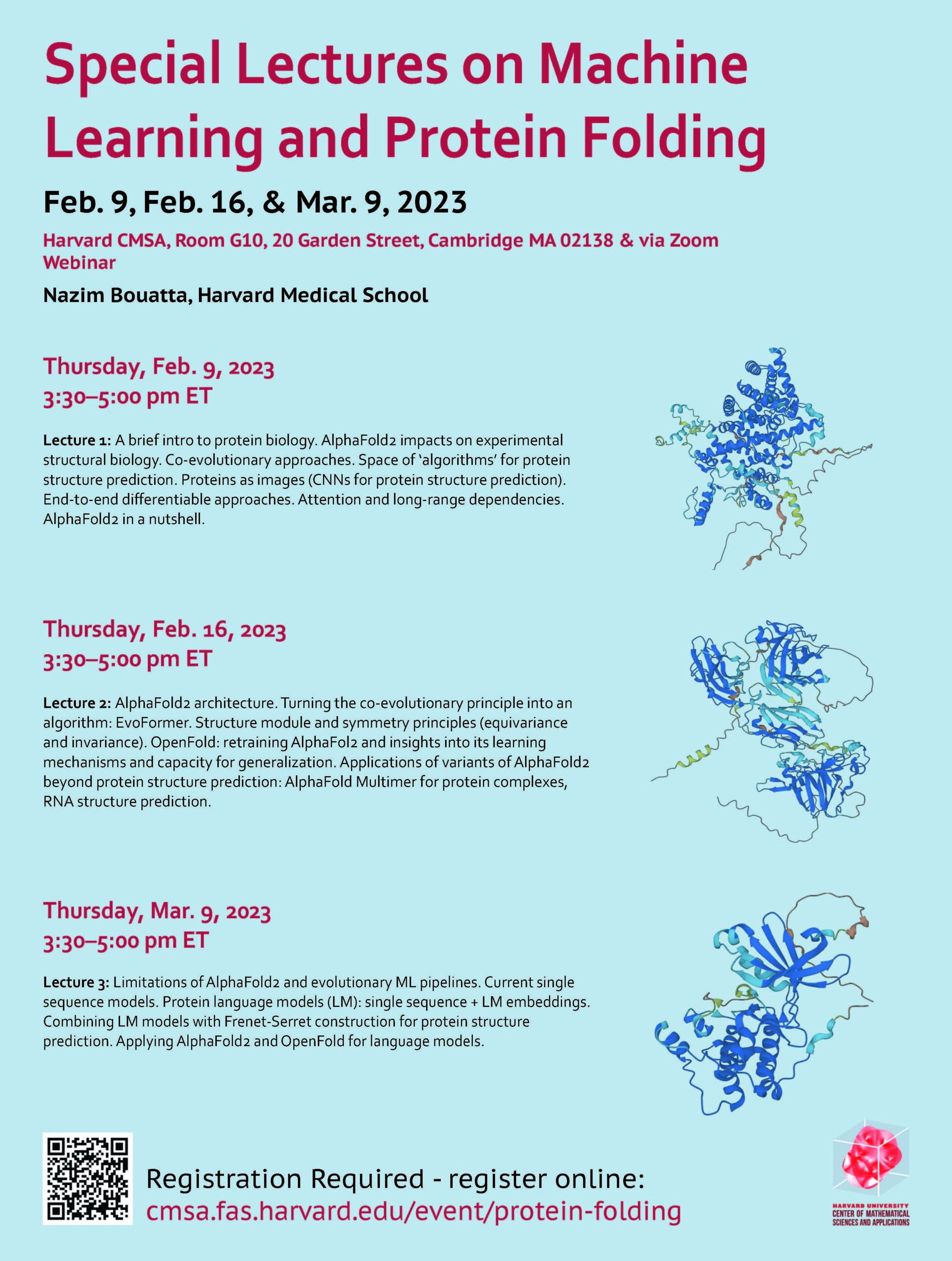
  • Special Lectures on Machine Learning and Protein Folding

    CMSA Room G10 CMSA, 20 Garden Street, Cambridge, MA, United States

    The CMSA hosted a series of three 90-minute lectures on the subject of machine learning for protein folding. Thursday Feb. 9, Thursday Feb. 16, & Thursday March 9, 2023, 3:30-5:00 pm ET Location: G10, CMSA, 20 Garden Street, Cambridge MA 02138 & via Zoom     Speaker: Nazim Bouatta, Harvard Medical School Abstract: AlphaFold2, a […]

  • Non-invertible Symmetry Enforced Gaplessness

    Virtual

    Quantum Matter Seminar Speaker: Ho Tat Lam (MIT) Title: Non-invertible Symmetry Enforced Gaplessness Abstract: Quantum systems in 3+1-dimensions that are invariant under gauging a one-form symmetry enjoy novel non-invertible duality symmetries encoded by topological defects. These symmetries are renormalization group invariants which constrain infrared dynamics. We show that such non-invertible symmetries often forbid a symmetry-preserving vacuum state […]

  • Parity and Cobordism

    CMSA Room G10 CMSA, 20 Garden Street, Cambridge, MA, United States

    Swampland Seminar Speaker: Jake McNamara (Caltech) Title: Parity and Cobordism Abstract: The swampland cobordism conjecture provides a convenient way to discuss conserved charges associated with the topology of spacetime. However, much of the power of the cobordism conjecture comes from a mathematical black box: the Adams spectral sequence. In this talk, I will give physical meaning to […]

  • Complete Calabi-Yau metrics: Recent progress and open problems

    CMSA Room G10 CMSA, 20 Garden Street, Cambridge, MA, United States

    Speaker: Tristan Collins, MIT Title: Complete Calabi-Yau metrics: Recent progress and open problems Abstract: Complete Calabi-Yau metrics are fundamental objects in Kahler geometry arising as singularity models or "bubbles" in degenerations of compact Calabi-Yau manifolds.  The existence of these metrics and their relationship with algebraic geometry are the subjects of several long standing conjectures due […]

  • Dynamics of active nematic defects on cones

    CMSA Room G10 CMSA, 20 Garden Street, Cambridge, MA, United States

    Member Seminar Speaker: Farzan Vafa Title: Dynamics of active nematic defects on cones Abstract: In the first part of the talk, we investigate the ground-state configurations of two-dimensional liquid crystals with p-fold rotational symmetry (p-atics) on cones. The cone apex develops an effective topological charge, which in analogy to electrostatics, leads to defect absorption and emission […]