• Exploring and Exploiting the Universality Phenomena in High-Dimensional Estimation and Learning

    Hybrid

    Interdisciplinary Science Seminar Speaker: Yue M. Lu, Harvard University Title: Exploring and Exploiting the Universality Phenomena in High-Dimensional Estimation and Learning Abstract: Universality is a fascinating high-dimensional phenomenon. It points to the existence of universal laws that govern the macroscopic behavior of wide classes of large and complex systems, despite their differences in microscopic details. The notion of […]
  • Transport in large-N critical Fermi surface

    Virtual

    Speaker: Haoyu Guo (Harvard) Title: Transport in large-N critical Fermi surface Abstract: A Fermi surface coupled to a scalar field can be described in a 1/N expansion by choosing the fermion-scalar Yukawa coupling to be random in the N-dimensional flavor space, but invariant under translations. We compute the conductivity of such a theory in two spatial […]

  • Scalable Dynamic Graph Algorithms

    CMSA Room G10 CMSA, 20 Garden Street, Cambridge, MA, United States

    CMSA Interdisciplinary Science Seminar Speaker: Quanquan Liu, Northwestern University Title: Scalable Dynamic Graph Algorithms Abstract: The field of dynamic graph algorithms seeks to understand and compute statistics on real-world networks that undergo changes with time. Some of these networks could have up to millions of edge insertions and deletions per second. In light of these […]

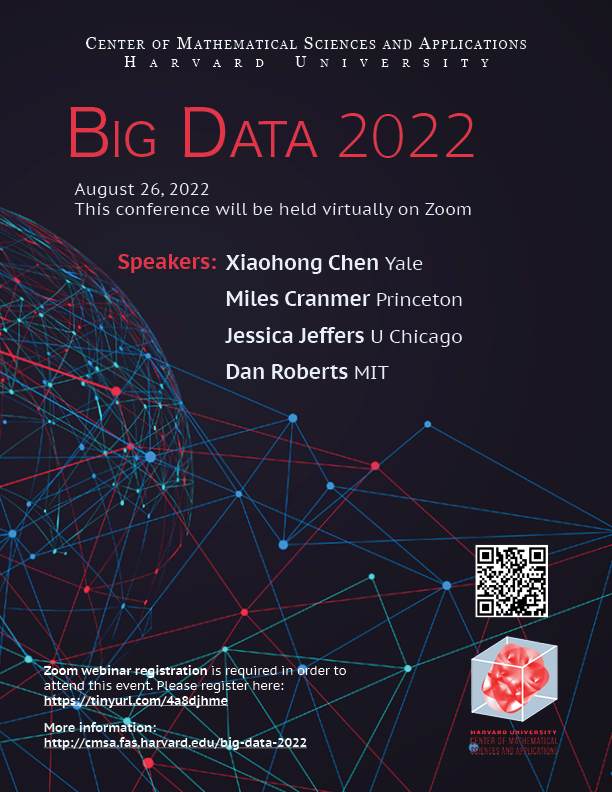
  • Big Data Conference 2022

    Virtual

    https://youtu.be/lmgwSxwDAHg On August 26, 2022 the CMSA hosted our eighth annual Conference on Big Data. The Big Data Conference features speakers from the Harvard community as well as scholars from across the globe, with talks focusing on computer science, statistics, math and physics, and economics. The 2022 Big Data Conference took place virtually on Zoom. […]

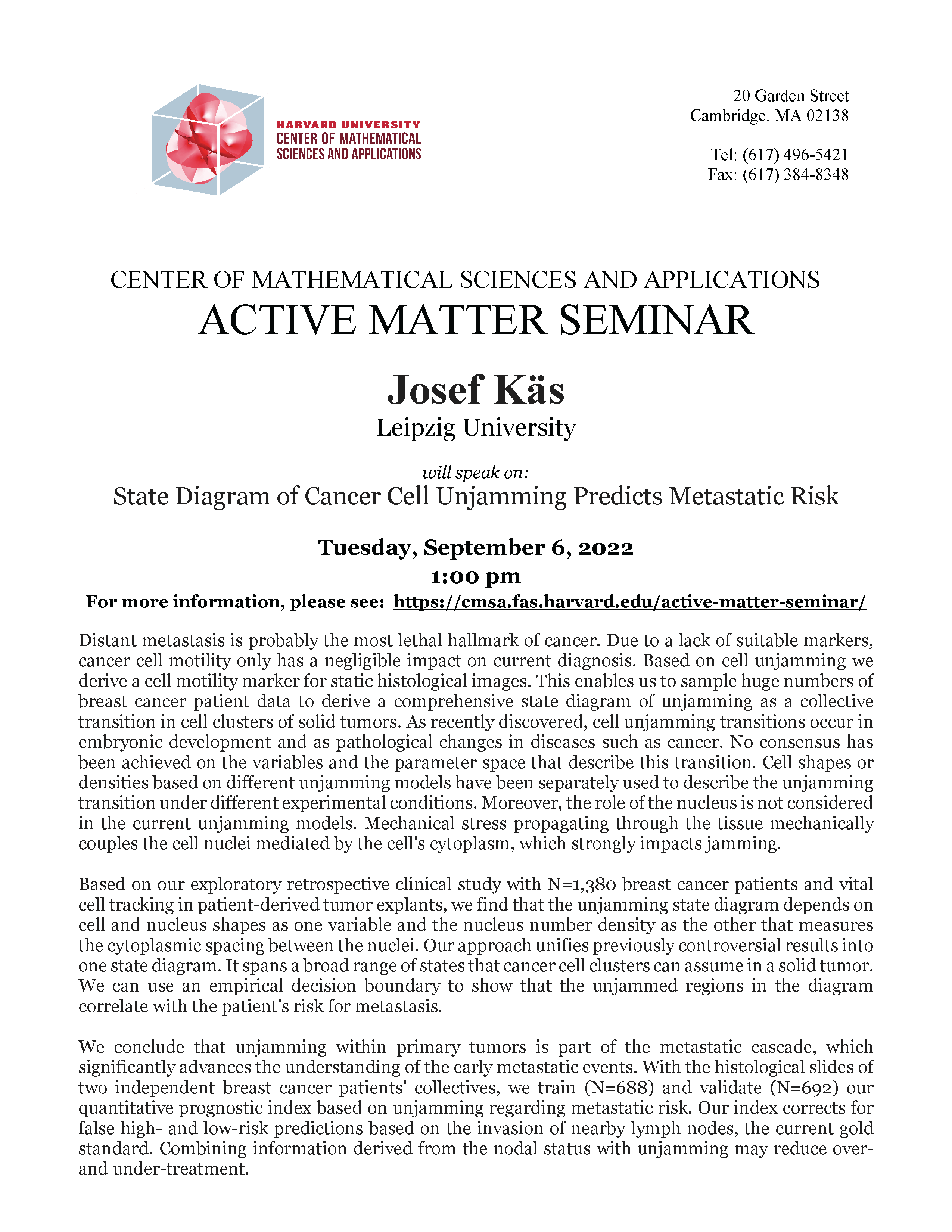
  • State Diagram of Cancer Cell Unjamming Predicts Metastatic Risk

    https://youtu.be/KmWQPMivxXw Speaker: Josef Käs, Leipzig University Title: State Diagram of Cancer Cell Unjamming Predicts Metastatic Risk Abstract: Distant metastasis is probably the most lethal hallmark of cancer. Due to a lack of suitable markers, cancer cell motility only has a negligible impact on current diagnosis. Based on cell unjamming we derive a cell motility marker for […]

  • Gifts from anomalies: new results on quantum critical transport in non- Fermi liquids

    CMSA Room G10 CMSA, 20 Garden Street, Cambridge, MA, United States

    https://www.youtube.com/watch?v=tCSeu7ykzLs&list=PL0NRmB0fnLJQAnYwkpt9PN2PBKx4rvdup&index=5 Quantum Matter in Mathematics and Physics Seminar Speaker: Zhengyan Darius Shi (MIT) Title: Gifts from anomalies: new results on quantum critical transport in non-Fermi liquids Abstract: Non-Fermi liquid phenomena arise naturally near Landau ordering transitions in metallic systems. Here, we leverage quantum anomalies as a powerful nonperturbative tool to calculate optical transport in these models […]

  • The second law of black hole mechanics in effective field theory

    CMSA Room G10 CMSA, 20 Garden Street, Cambridge, MA, United States

    General Relativity Seminar Speaker: Professor Harvey Reall (University of Cambridge)  Title: The second law of black hole mechanics in effective field theory Abstract: I shall discuss the second law of black hole mechanics in gravitational theories with higher derivative terms in the action. Wall has described a method for defining an entropy that satisfies the second law […]

  • Duality in Einstein’s Gravity

    CMSA Room G10 CMSA, 20 Garden Street, Cambridge, MA, United States

    Title: Duality in Einstein’s Gravity Abstract: Electric-Magnetic duality has been a key feature behind our understanding of Quantum Field Theory for over a century. In this talk I will describe a similar property in Einstein’s gravity. The gravitational duality reveals, in turn, a wide range of new IR phenomena, including aspects of the double copy […]

  • Non-invertible Symmetries in Nature

    https://www.youtube.com/watch?v=aq_XXzbFr18&list=PL0NRmB0fnLJQAnYwkpt9PN2PBKx4rvdup&index=3 Quantum Matter in Mathematics and Physics Speaker: Yichul Cho (SUNY Stony Brook) Title: Non-invertible Symmetries in Nature Abstract: In this talk, I will discuss non-invertible symmetries in familiar 3+1d quantum field theories describing our Nature. In massless QED, the classical U(1) axial symmetry is not completely broken by the ABJ anomaly. Instead, it turns […]

  • Strategyproof-Exposing Mechanisms Descriptions

    CMSA Room G10 CMSA, 20 Garden Street, Cambridge, MA, United States

    Colloquium Speaker: Yannai Gonczarowski (Harvard) Title: Strategyproof-Exposing Mechanisms Descriptions Abstract: One of the crowning achievements of the field of Mechanism Design has been the design and usage of the so-called "Deferred Acceptance" matching algorithm. Designed in 1962 and awarded the Nobel Prize in 2012, this algorithm has been used around the world in settings ranging […]

  • Breaking the one-mind-barrier in mathematics using formal verification

    CMSA Room G10 CMSA, 20 Garden Street, Cambridge, MA, United States

    https://youtu.be/D7dqadF5k9Q New Technologies in Mathematics Seminar Speaker: Johan Commelin, Mathematisches Institut, Albert-Ludwigs-Universität Freiburg Title: Breaking the one-mind-barrier in mathematics using formal verification Abstract: In this talk I will argue that formal verification helps break the one-mind-barrier in mathematics. Indeed, formal verification allows a team of mathematicians to collaborate on a project, without one person understanding all parts of […]

  • The Gregory-Laflamme instability of black strings revisited

    CMSA Room G10 CMSA, 20 Garden Street, Cambridge, MA, United States

    General Relativity Seminar Title: The Gregory-Laflamme instability of black strings revisited   Abstract: In this talk I will discuss our recent work that reproduces and extends the famous work of Lehner and Pretorius on the end point of the Gregory-Laflamme instability of black strings. We consider black strings of different thicknesses and our numerics allow us to get closer to the singularity than ever before. In […]