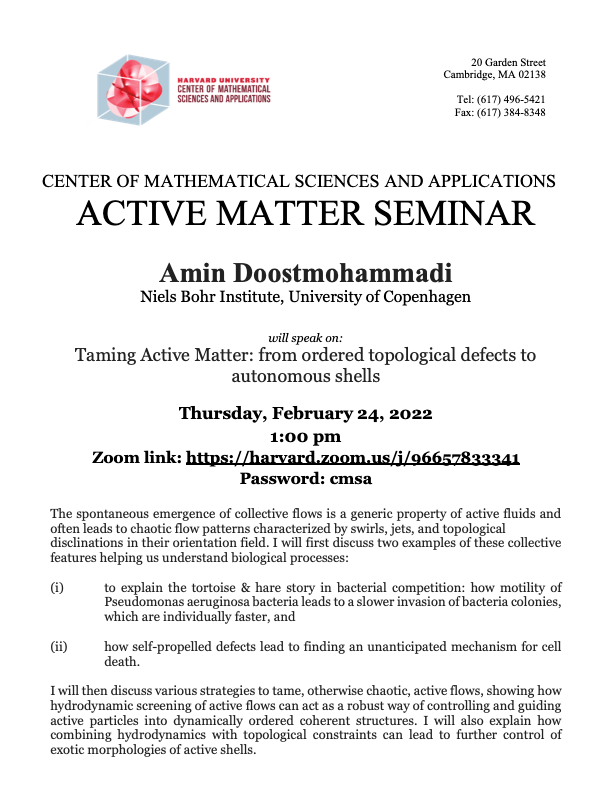
• Taming Active Matter: from ordered topological defects to autonomous shells

    Abstract: The spontaneous emergence of collective flows is a generic property of active fluids and often leads to chaotic flow patterns characterized by swirls, jets, and topological disclinations in their orientation field. I will first discuss two examples of these collective features helping us understand biological processes: (i) to explain the tortoise & hare story in bacterial competition: […]
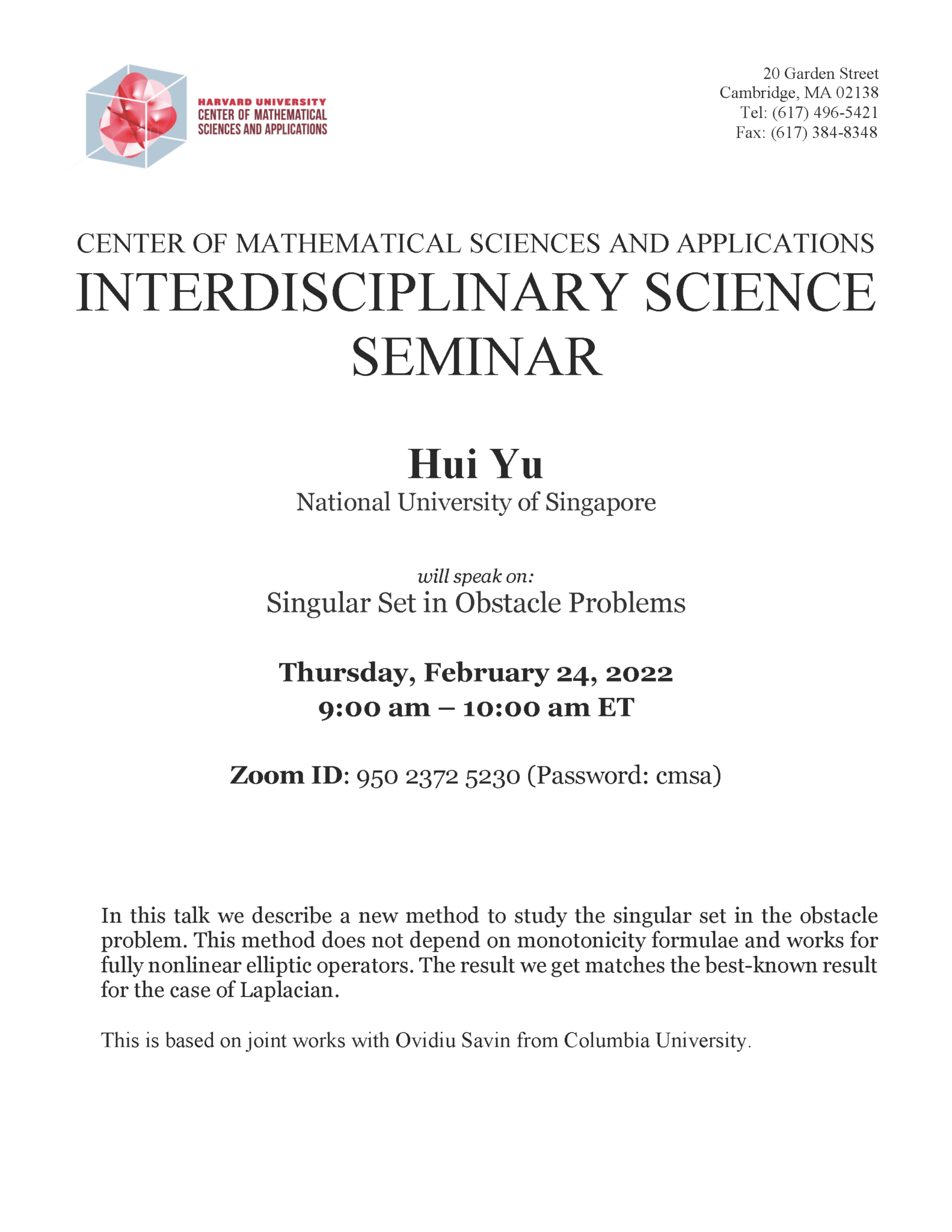
  • Singular Set in Obstacle Problems

    Abstract: In this talk we describe a new method to study the singular set in the obstacle problem. This method does not depend on monotonicity formulae and works for fully nonlinear elliptic operators. The result we get matches the best-known result for the case of Laplacian.

  • Bridging three-dimensional coupled-wire models and cellular topological states

    Abstract: Three-dimensional (3d) gapped topological phases with fractional excitations are divided into two subclasses: One has topological order with point-like and loop-like excitations fully mobile in the 3d space, and the other has fracton order with point-like excitations constrained in lower-dimensional subspaces. These exotic phases are often studied by exactly solvable Hamiltonians made of commuting projectors, […]

  • Rational Polypols

    Abstract: Eugene Wachspress introduced polypols as real bounded semialgebraic sets in the plane that generalize polygons. He aimed to generalize barycentric coordinates from triangles to arbitrary polygons and further to polypols. For this, he defined the adjoint curve of a rational polypol. In the study of scattering amplitudes in physics, positive geometries are real semialgebraic […]

  • Virtual localization for Artin stacks

    Virtual

    Abstract: This is a report about work in progress with: Adeel Khan, Aloysha Latyntsev, Hyeonjun Park and Charanya Ravi. We will describe a virtual Atiyah-Bott formula for Artin stacks.  In the Deligne-Mumford case our methods allow us to remove the global resolution hypothesis for the virtual normal bundle.

  • Dimers and webs

    Virtual

    Speaker: Richard Kenyon (Yale) Title: Dimers and webs Abstract: We consider SL_n-local systems on graphs on surfaces and show how the associated Kasteleyn matrix can be used to compute probabilities of various topological events involving the overlay of n independent dimer covers (or “n-webs”). This is joint work with Dan Douglas and Haolin Shi.

  • Tropical Lagrangian multi-sections and locally free sheaves

    Abstract: The SYZ proposal suggests that mirror symmetry is T-duality. It is a folklore that locally free sheaves are mirror to a Lagrangian multi-section of the SYZ fibration. In this talk, I will introduce the notion of tropical Lagrangian multi-sections and discuss how to obtain from such object to a class of locally free sheaves on the log Calabi-Yau spaces that Gross-Siebert have considered. I will also discuss a joint work […]

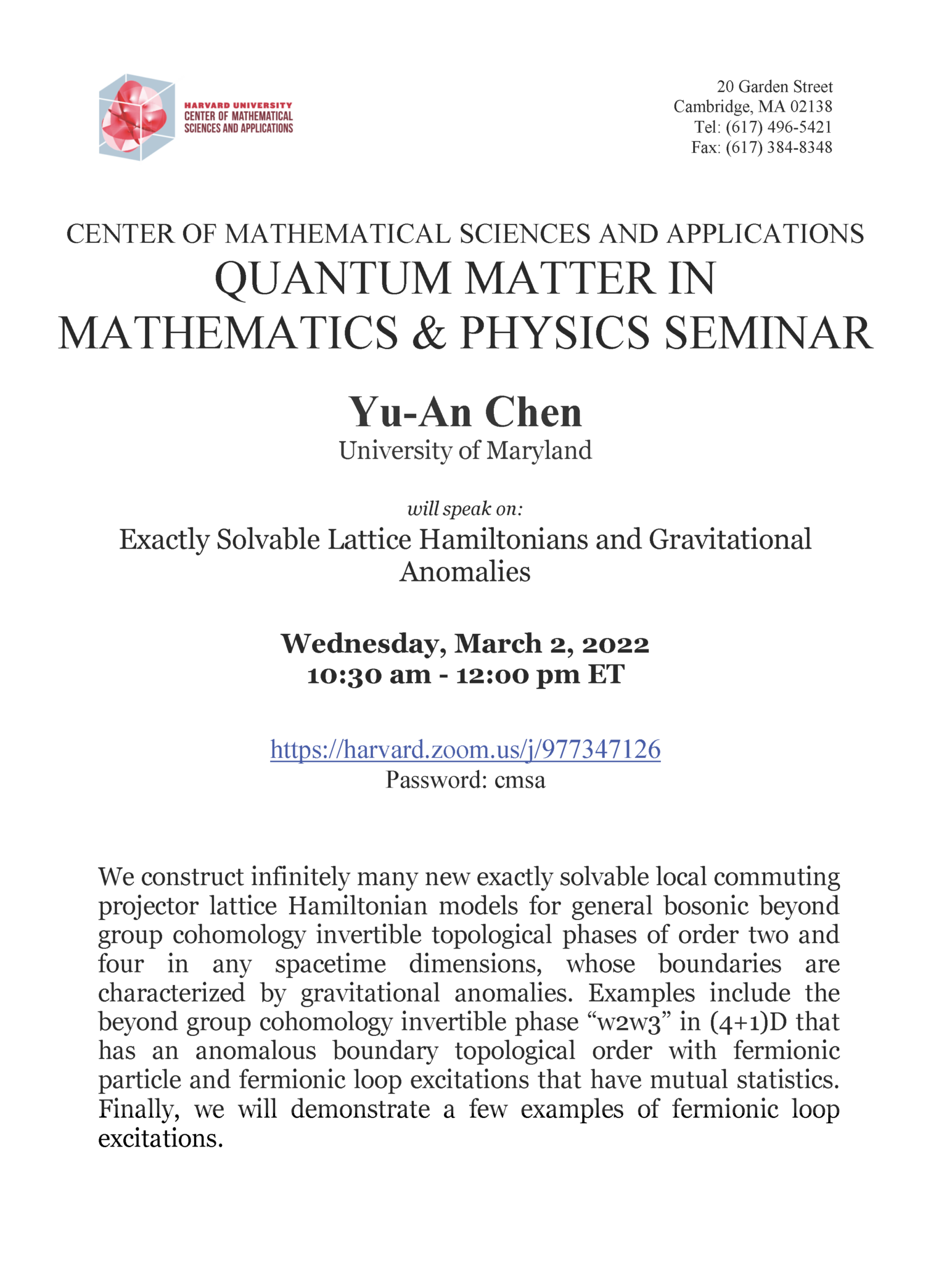
  • Exactly Solvable Lattice Hamiltonians and Gravitational Anomalies

    Abstract: We construct infinitely many new exactly solvable local commuting projector lattice Hamiltonian models for general bosonic beyond group cohomology invertible topological phases of order two and four in any spacetime dimensions, whose boundaries are characterized by gravitational anomalies. Examples include the beyond group cohomology invertible phase “w2w3” in (4+1)D that has an anomalous boundary topological […]

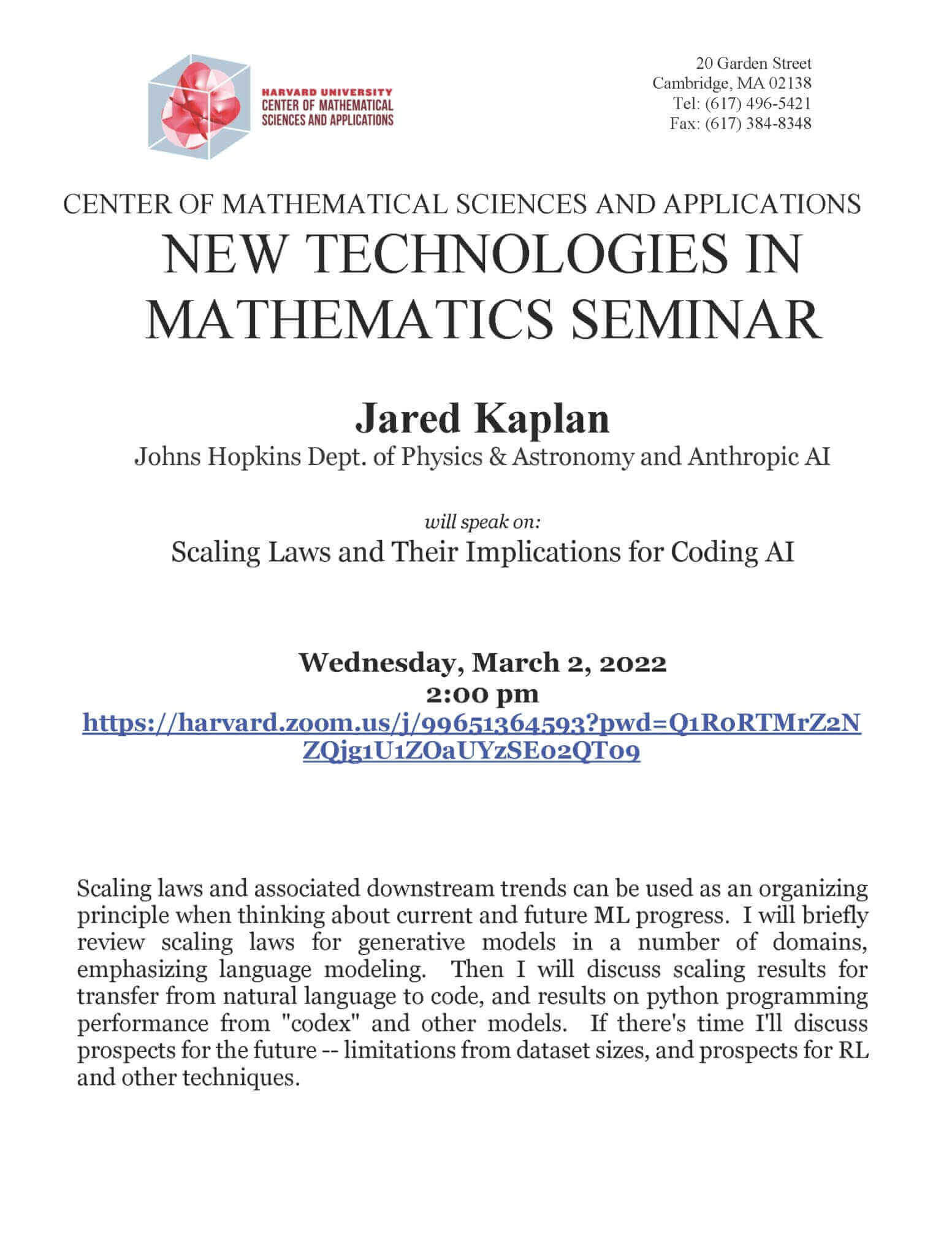
  • Scaling Laws and Their Implications for Coding AI

    Virtual

    https://youtu.be/Suhp3OLASSo Speaker: Jared Kaplan, Johns Hopkins Dept. of Physics & Astronomy Title: Scaling Laws and Their Implications for Coding AI Abstract:  Scaling laws and associated downstream trends can be used as an organizing principle when thinking about current and future ML progress.  I will briefly review scaling laws for generative models in a number of […]

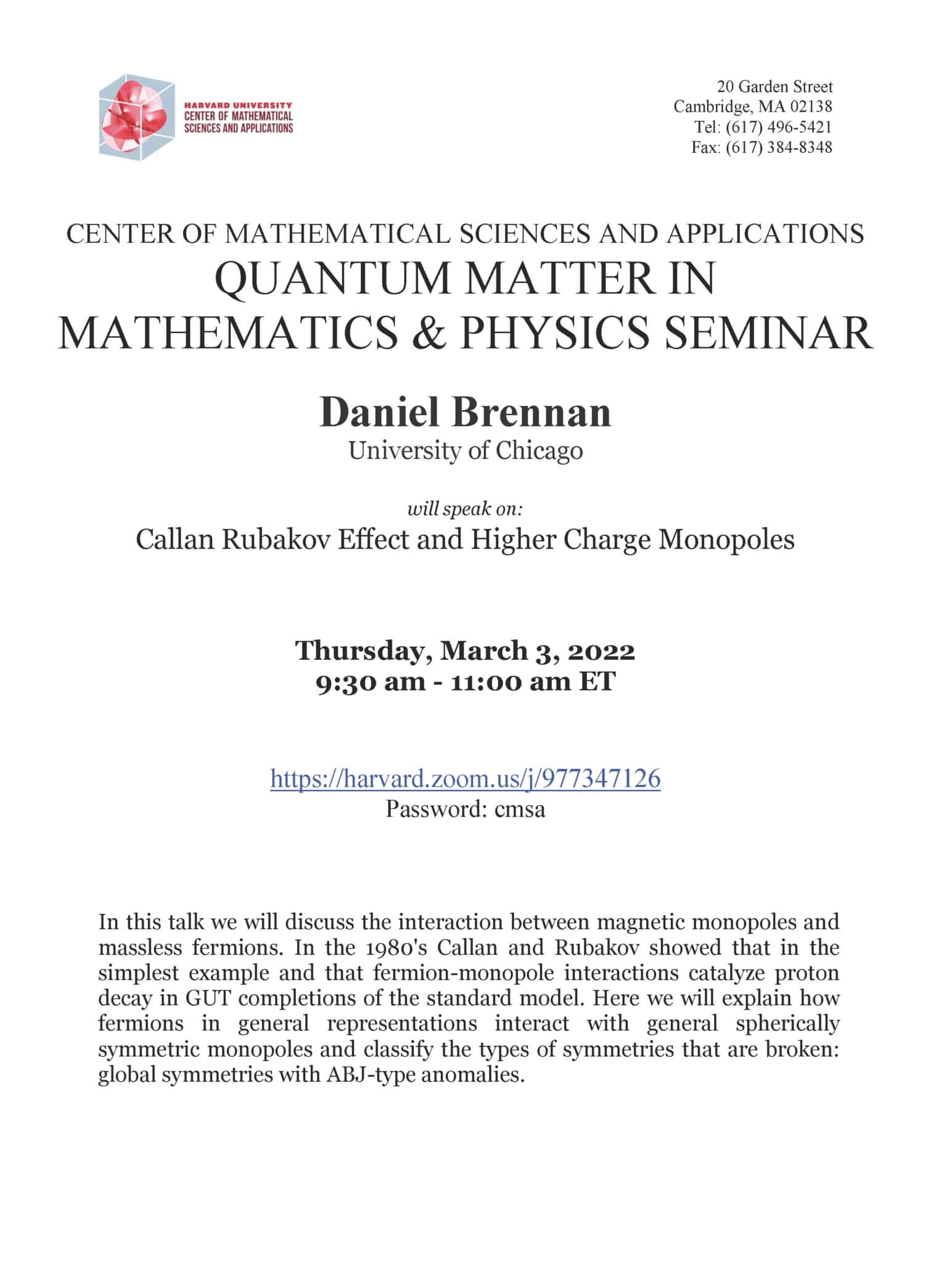
  • Callan Rubakov Effect and Higher Charge Monopoles

    Virtual

    Abstract: In this talk we will discuss the interaction between magnetic monopoles and massless fermions. In the 1980’s Callan and Rubakov showed that in the simplest example and that fermion-monopole interactions catalyze proton decay in GUT completions of the standard model. Here we will explain how fermions in general representations interact with general spherically symmetric monopoles […]

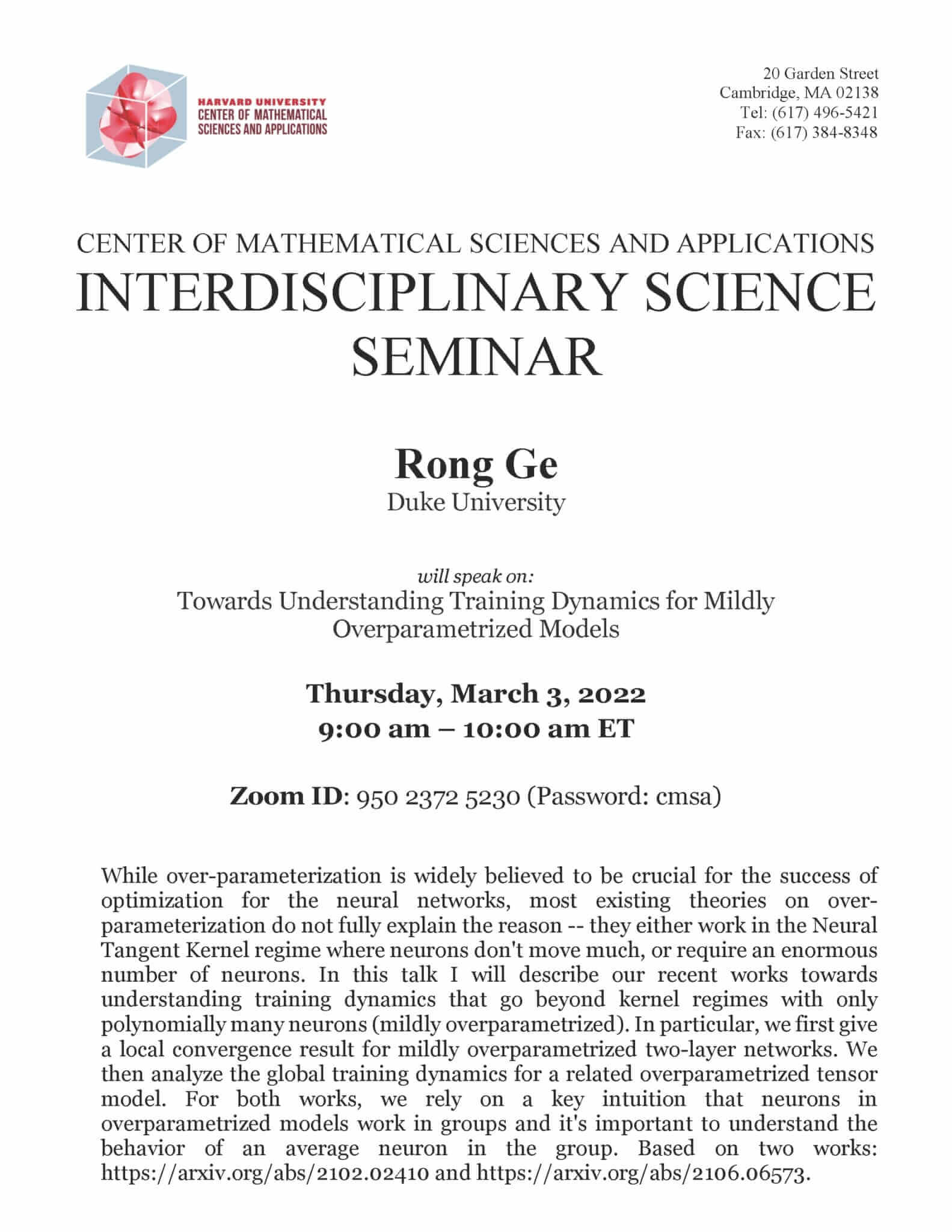
  • Towards Understanding Training Dynamics for Mildly Overparametrized Models

    Abstract: While over-parameterization is widely believed to be crucial for the success of optimization for the neural networks, most existing theories on over-parameterization do not fully explain the reason — they either work in the Neural Tangent Kernel regime where neurons don’t move much, or require an enormous number of neurons. In this talk I will […]