• Force transmission informs the collective behavior of active cell layers

    CMSA Room G10 CMSA, 20 Garden Street, Cambridge, MA, United States

    Active Matter Seminar Speaker: Siavash Monfared, Niels Bohr Institute, Copenhagen Title: Force transmission informs the collective behavior of active cell layers Abstract: Collective cell migration drives numerous physiological processes such as tissue morphogenesis, wound healing, tumor progression and cancer invasion. However, how the interplay of mechanical interactions and the modes of collective self-organization among cells informs […]
  • EFT strings and emergence

    CMSA Room G10 CMSA, 20 Garden Street, Cambridge, MA, United States

    Swampland Seminar Speaker: Fernando Marchesano (IFT Madrid) Title: EFT strings and emergence Abstract: We revisit the Emergence Proposal in 4d N=2 vector multiplet sectors that arise from  type II string Calabi-Yau compactifications, with emphasis on the role of axionic fundamental strings, or EFT strings. We focus on large-volume type IIA compactifications, where EFT strings arise from NS5-branes wrapping […]

  • Topological symmetry in field theory

    Virtual

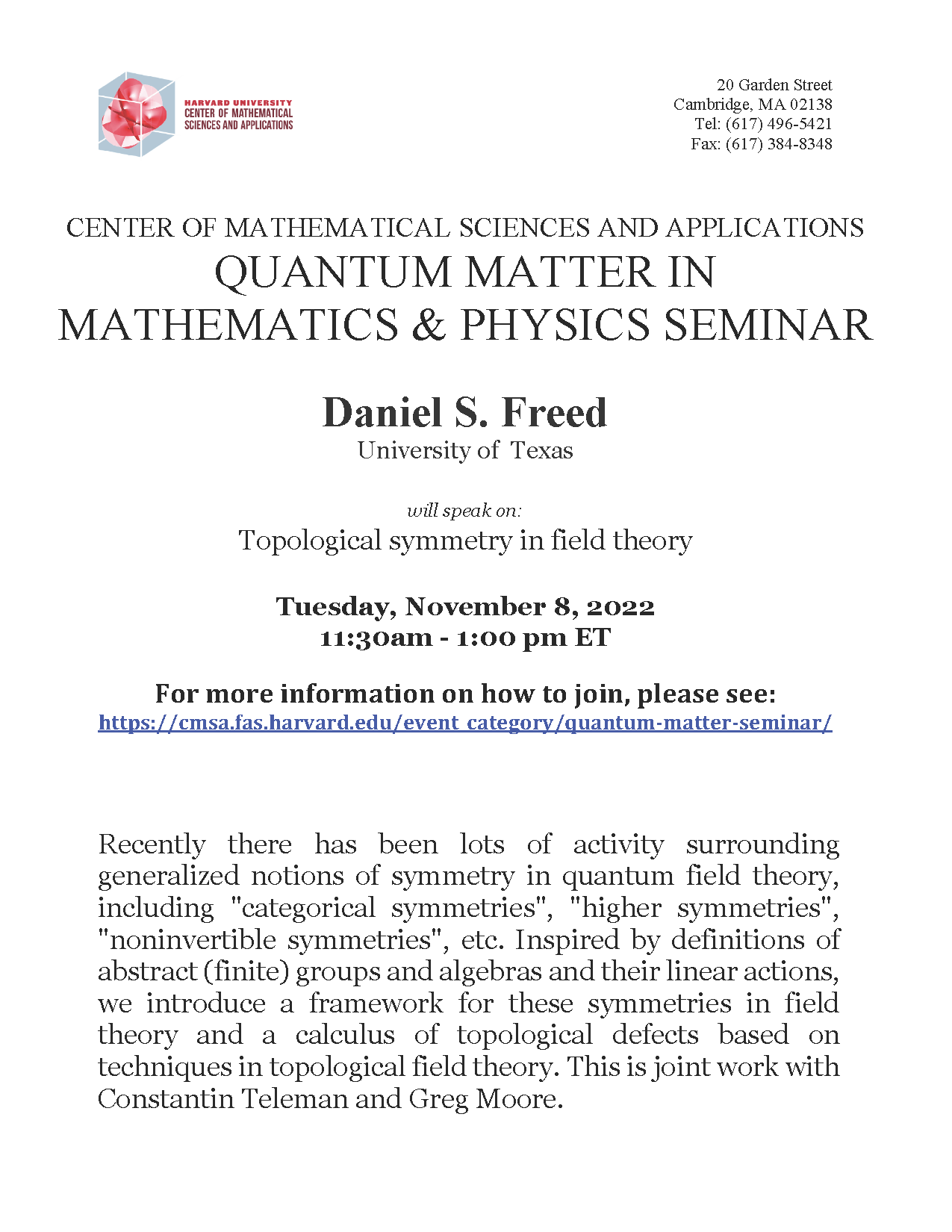
    Quantum Matter Seminar Speaker: Daniel S. Freed (U Texas) Title: Topological symmetry in field theory Abstract: Recently there has been lots of activity surrounding generalized notions of symmetry in quantum field theory, including “categorical symmetries,” “higher symmetries,” “noninvertible symmetries,” etc. Inspired by definitions of abstract (finite) groups and algebras and their linear actions, we introduce […]

  • CMSA/Tsinghua Math-Science Literature Lecture: Large cardinals and small sets: The AD+ Duality Program

    CMSA Room G10 CMSA, 20 Garden Street, Cambridge, MA, United States

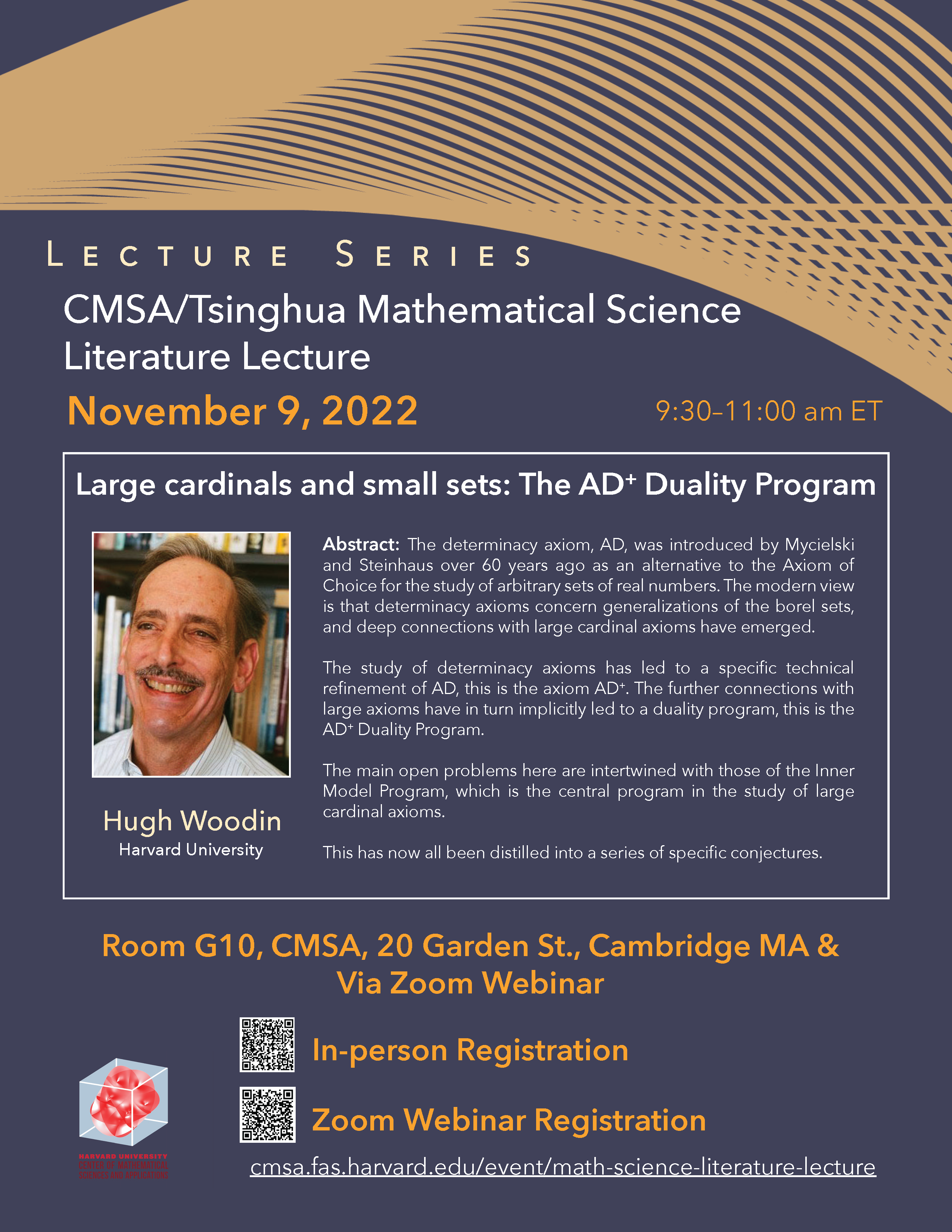
    https://youtu.be/eqCez92m9XE CMSA/Tsinghua Math-Science Literature Lecture Prof. Hugh Woodin will present a lecture in the CMSA/Tsinghua Math-Science Literature Lecture Series. Date: Wednesday, November 9, 2022 Time: 9:30 - 11:00 am ET Location: Via Zoom Webinar and Room G10, CMSA, 20 Garden Street, Cambridge MA 02138   Title: Large cardinals and small sets: The AD+ Duality Program […]

  • Liouville quantum gravity from random matrix dynamics

    CMSA Room G10 CMSA, 20 Garden Street, Cambridge, MA, United States

    Probability Seminar Speaker: Hugo Falconet (Courant Institute, NYU) Title: Liouville quantum gravity from random matrix dynamics Abstract: The Liouville quantum gravity measure is a properly renormalized exponential of the 2d GFF. In this talk, I will explain how it appears as a limit of natural random matrix dynamics: if (U_t) is a Brownian motion on the unitary […]

  • Schwarzschild-like Topological Solitons in Gravity

    Virtual

    https://youtu.be/hhjIPdyIM3U General Relativity Seminar Speaker: Pierre Heidmann (Johns Hopkins) Title: Schwarzschild-like Topological Solitons in Gravity Abstract: We present large classes of non-extremal solitons in gravity that are asymptotic to four-dimensional Minkowski spacetime plus extra compact dimensions. They correspond to smooth horizonless geometries induced by topology in spacetime and supported by electromagnetic flux, which characterize coherent states of quantum gravity. We discuss […]

  • Quantum trace and length conjecture for hyperbolic knot

    CMSA Room G10 CMSA, 20 Garden Street, Cambridge, MA, United States

    Member Seminar Speaker: Mauricio Romo Title: Quantum trace and length conjecture for hyperbolic knot Abstract: I will define the quantum trace map for an ideally triangulated hyperbolic knot complement on S^3. This map assigns an operator to each element L of  the Kauffman Skein module of knot complement.  Motivated by an interpretation of this operator in the context of […]

  • Topology of the Fermi sea: Ordinary metals as topological materials

    Quantum Matter Seminar Speaker: Pok Man Tam (University of Pennsylvania) Title: Topology of the Fermi sea: Ordinary metals as topological materials Abstract: It has long been known that the quantum ground state of a metal is characterized by an abstract manifold in momentum space called the Fermi sea. Fermi sea can be distinguished topologically in […]

  • The Emergence Proposal in Quantum Gravity and the Species Scale

    CMSA Room G10 CMSA, 20 Garden Street, Cambridge, MA, United States

    Swampland Seminar Speaker: Alvaro Herraez (Saclay) Title: The Emergence Proposal in Quantum Gravity and the Species Scale Abstract: The Emergence Proposal claims that in Quantum Gravity the kinetic terms of the fields in the IR emerge from integrating out (infinite) towers of particles up to the QG cutoff. After introducing this proposal in the context of the Swampland […]

  • Vacuum fluctuations in cavities: breakdown of the topological protection in the integer Quantum Hall effect

    CMSA Room G10 CMSA, 20 Garden Street, Cambridge, MA, United States

    https://youtu.be/mtheRASO2e0 Topological Quantum Matter Seminar Speaker: Jérôme Faist  (ETH Zurich) Title: Vacuum fluctuations in cavities: breakdown of the topological protection in the integer Quantum Hall effect Abstract: When a collection of electronic excitations are strongly coupled to a single mode cavity, mixed light-matter excitations called polaritons are created. The situation is especially interesting when the […]

  • Noether’s Learning Dynamics: Role of Symmetry Breaking in Neural Networks

    CMSA Room G10 CMSA, 20 Garden Street, Cambridge, MA, United States

    Colloquium Speaker: Hidenori Tanaka (NTT Research at Harvard) Title: Noether’s Learning Dynamics: Role of Symmetry Breaking in Neural Networks Abstract: In nature, symmetry governs regularities, while symmetry breaking brings texture. In artificial neural networks, symmetry has been a central design principle, but the role of symmetry breaking is not well understood. Here, we develop a […]

  • Outlier-Robust Algorithms for Clustering Non-Spherical Mixtures

    Probability Seminar Speaker: Ainesh Bakshi (MIT) Title: Outlier-Robust Algorithms for Clustering Non-Spherical Mixtures Abstract: In this talk, we describe the first polynomial time algorithm for robustly clustering a mixture of statistically-separated, high-dimensional Gaussians. Prior to our work this question was open even in the special case of 2 components in the mixture. Our main conceptual contribution […]