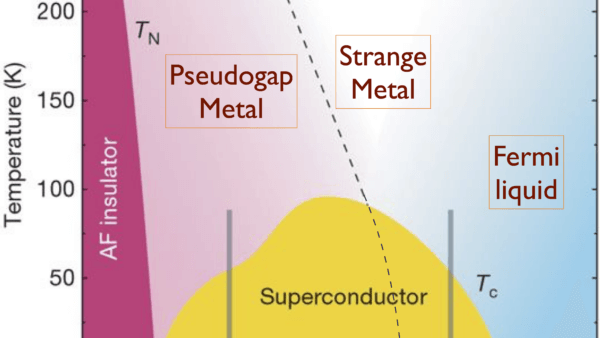
In the 2020-2021 academic year, the CMSA will be hosting a lecture series on Strongly Correlated Materials and High Tc Superconductor. All talks will take place from 10:30-12:00pm ET virtually on Zoom. Cuprate high-temperature superconductors are a classic quantum material system to demonstrate the beauty of “Emergence and Entanglement” in the quantum phases of matter. Merely by […]
During the 2021–2022 academic year, the CMSA will host a program on the so-called “Swampland.” The Swampland program aims to determine which low-energy effective field theories are consistent with nonperturbative quantum gravity considerations. Not everything is possible in String Theory, and finding out what is and what is not strongly constrains the low energy physics. These constraints are naturally […]
During the 2021–22 academic year, the CMSA will be hosting a Colloquium, organized by Du Pei, Changji Xu, and Michael Simkin. It will take place on Wednesdays at 9:30am – 10:30am (Boston time). The meetings will take place virtually on Zoom. All CMSA postdocs/members are required to attend the weekly CMSA Members’ Seminars, as well as the weekly CMSA […]
Abstract: In this talk I will review massive type IIA flux compactifications that seem to give rise to infinite families of supersymmetric 4d AdS vacua. These vacua provide an interesting testing ground for the swampland program. After reviewing potential shortcomings of this setup, I will discuss recent progress on overcoming them and getting a better understanding of these […]
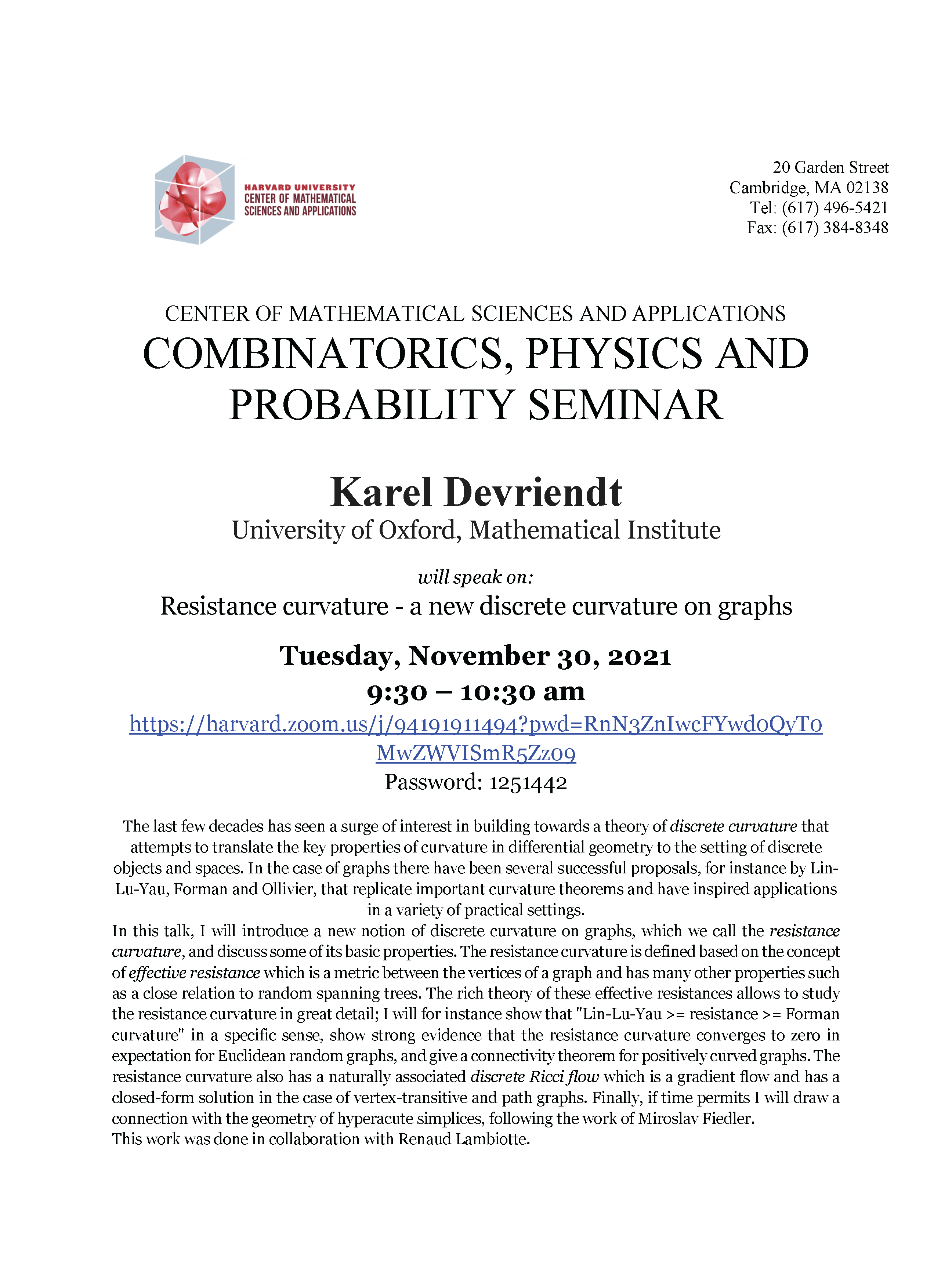
Abstract: The last few decades have seen a surge of interest in building towards a theory of discrete curvature that attempts to translate the key properties of curvature in differential geometry to the setting of discrete objects and spaces. In the case of graphs there have been several successful proposals, for instance by Lin-Lu-Yau, Forman […]
Speaker: Richard Wentworth, University of Maryland Title: The Hitchin connection for parabolic G-bundles Abstract: For a simple and simply connected complex group G, I will discuss some elements of the proof of the existence of a flat projective connection on the bundle of nonabelian theta functions on the moduli space of semistable parabolic G-bundles over families of […]
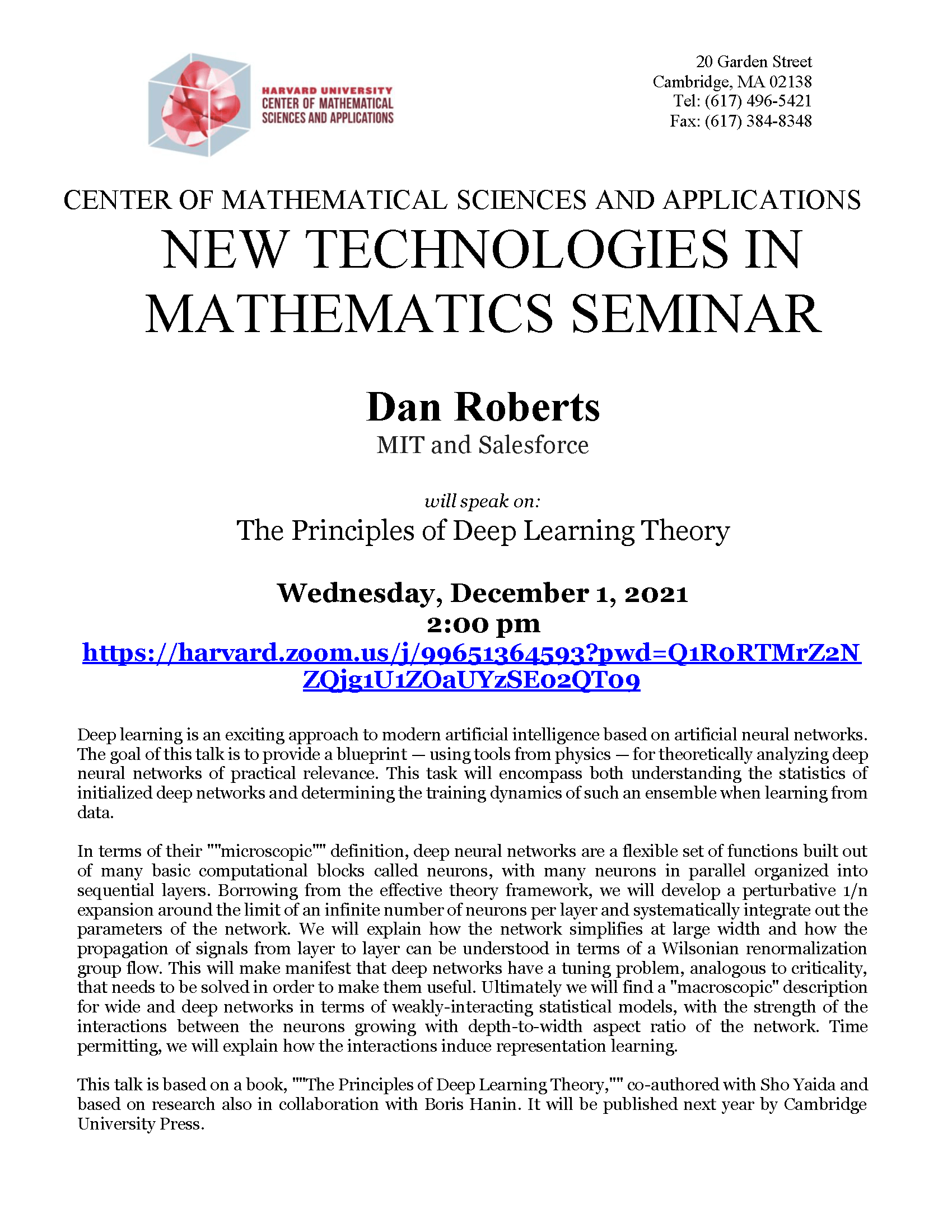
https://youtu.be/wXZKoHEzASg Speaker: Dan Roberts, MIT & Salesforce Title: The Principles of Deep Learning Theory Abstract: Deep learning is an exciting approach to modern artificial intelligence based on artificial neural networks. The goal of this talk is to provide a blueprint — using tools from physics — for theoretically analyzing deep neural networks of practical relevance. This […]
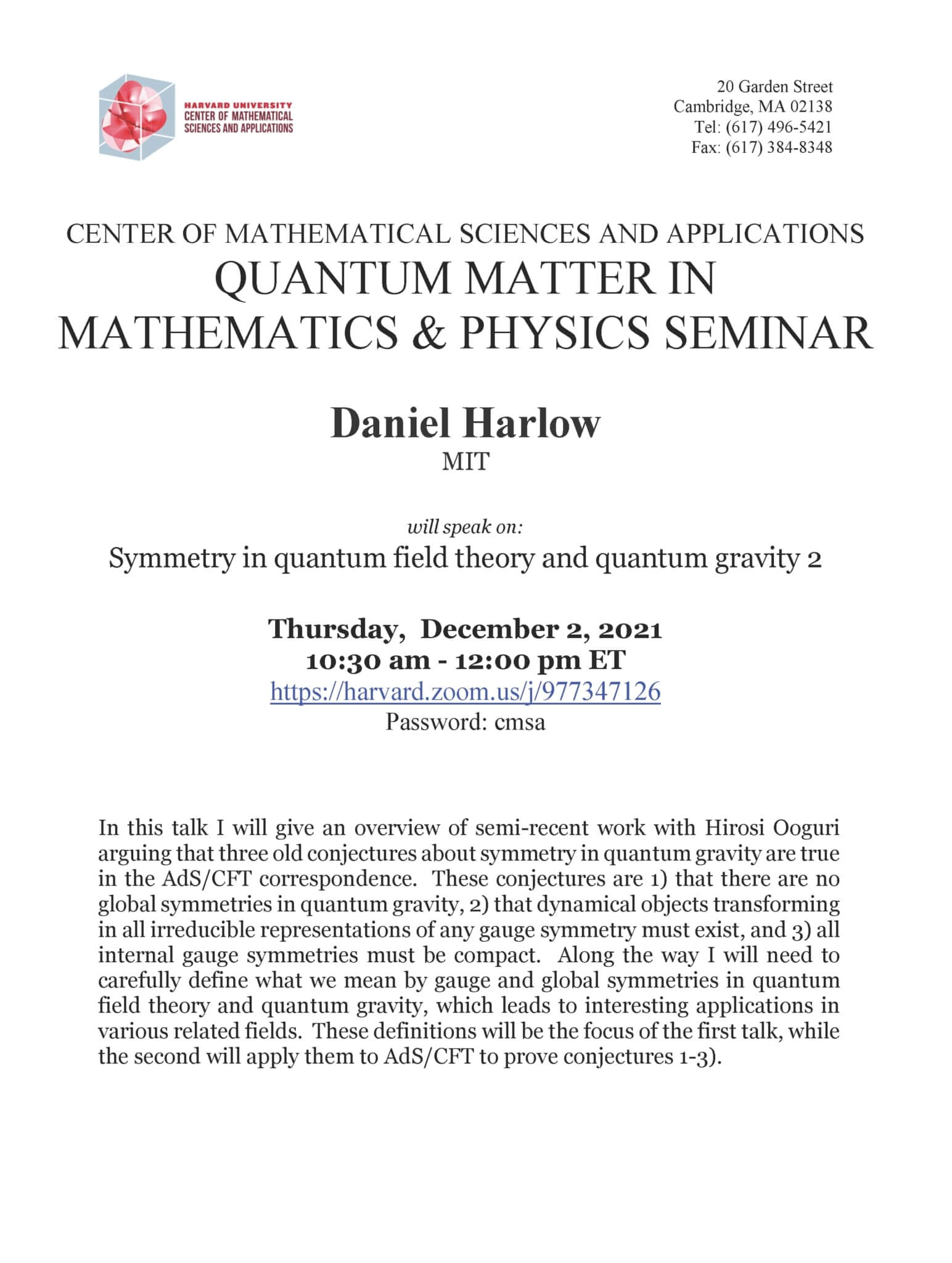
Speaker: Daniel Harlow (MIT) Title: Symmetry in quantum field theory and quantum gravity 2 Abstract: In this talk I will give an overview of semi-recent work with Hirosi Ooguri arguing that three old conjectures about symmetry in quantum gravity are true in the AdS/CFT correspondence. These conjectures are 1) that there are no global symmetries […]
Abstract: The two-body motion in General Relativity can be solved perturbatively in the small mass ratio expansion. Kerr geodesics describe the leading order motion. After a short summary of the classification of polar and radial Kerr geodesic motion, I will consider the inspiral motion of a point particle around the Kerr black hole subjected to the […]
Member Seminar Speaker: Dan Kapec Title: Black Holes, 2D Gravity, and Random Matrices Abstract: I will discuss old and new connections between black hole physics, 2D quantum gravity, and random matrix theory. Black holes are believed to be very complicated, strongly interacting quantum mechanical systems, and certain aspects of their Hamiltonians should be well approximated by random […]
Abstract: Extremal black holes play a key role in our understanding of various swampland conjectures and in particular the WGC. The mild form of the WGC states that higher-derivative corrections should decrease the mass of extremal black holes at fixed charge. Whether or not this conjecture is satisfied depends on the sign of the combination […]
Abstract: Let M_n be drawn uniformly from all n by n symmetric matrices with entries in {-1,1}. In this talk I’ll consider the following basic question: what is the probability that M_n is singular? I’ll discuss recent joint work with Marcelo Campos, Marcus Michelen and Julian Sahasrabudhe where we show that this probability is exponentially small. […]
Speaker: Maria Chudnovsky, Princeton Title: Induced subgraphs and tree decompositions Abstract: Tree decompositions are a powerful tool in both structural graph theory and graph algorithms. Many hard problems become tractable if the input graph is known to have a tree decomposition of bounded “width”. Exhibiting a particular kind of a tree decomposition is also a useful way […]
Speaker: Fei Yan (Rutgers) Title: Defects, link invariants and exact WKB Abstract: I will describe some of my recent work on defects in supersymmetric field theories. The first part of my talk is focused on line defects in certain large classes of 4d N=2 theories and 3d N=2 theories. I will describe geometric methods to compute the […]
https://youtu.be/soqWNyrdjkw Speaker: Piotr Nawrot, University of Warsaw Title: Hierarchical Transformers are More Efficient Language Models Abstract: Transformer models yield impressive results on many NLP and sequence modeling tasks. Remarkably, Transformers can handle long sequences which allows them to produce long coherent outputs: full paragraphs produced by GPT-3 or well-structured images produced by DALL-E. These large language […]
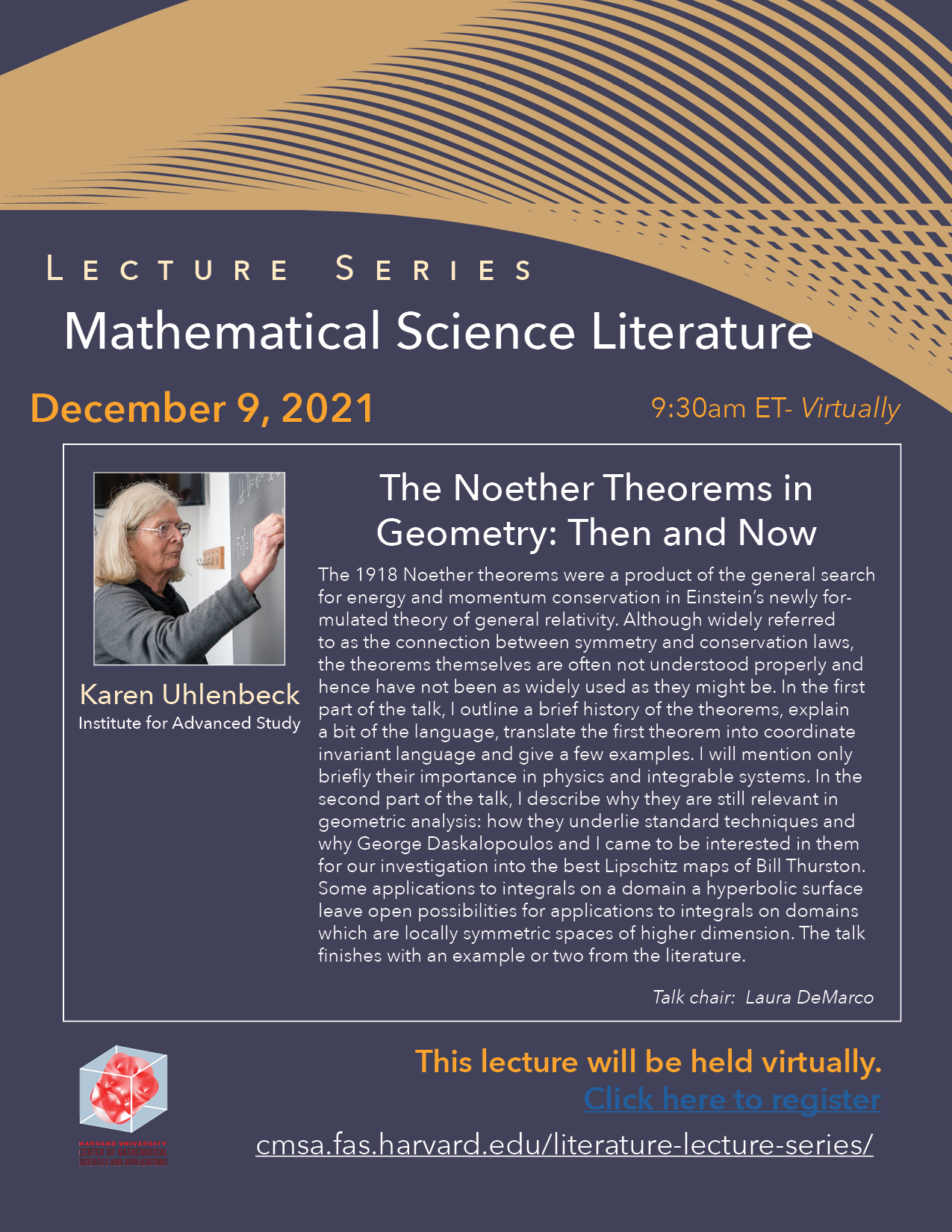
Karen Uhlenbeck (Institute for Advanced Study) Title: The Noether Theorems in Geometry: Then and Now Abstract: The 1918 Noether theorems were a product of the general search for energy and momentum conservation in Einstein’s newly formulated theory of general relativity. Although widely referred to as the connection between symmetry and conservation laws, the theorems themselves […]
Title: Numerical Higher Dimensional Geometry Abstract: In 1977, Yau proved that a Kahler manifold with zero first Chern class admits a Ricci flat metric, which is uniquely determined by certain “moduli” data. These metrics have been very important in mathematics and in theoretical physics, but despite much subsequent work we have no analytical expressions for them. But […]
Member Seminar Speaker: Changji Xu Title: On the solution space of the Ising perceptron model Abstract: Consider the discrete cube $\{-1,1\}^N$ and a random collection of half spaces which includes each half space $H(x) := \{y \in \{-1,1\}^N: x \cdot y \geq \kappa \sqrt{N}\}$ for $x \in \{-1,1\}^N$ independently with probability $p$. The solution space is […]
Speaker: Lukasz Fidkowski (U Washington) Title: Gravitational anomaly of 3 + 1 dimensional Z2 toric code with fermionic charges and ferionic loop self-statistics Abstract: Quasiparticle excitations in 3 + 1 dimensions can be either bosons or fermions. In this work, we introduce the notion of fermionic loop excitations in 3 + 1 dimensional topological phases. Specifically, we […]
Abstract: A long-standing problem in random graph theory has been to determine asymptotically the length of a longest induced path in sparse random graphs. Independent work of Luczak and Suen from the 90s showed the existence of an induced path of roughly half the optimal size, which seems to be a barrier for certain natural approaches. […]
Speaker: Constantin Teleman (UC Berkeley) Title: The Kapustin-Rozanski-Saulina “2-category” of a holomorphic integrable system Abstract: I will present a construction of the object in the title which, applied to the classical Toda system, controls the theory of categorical representations of compact Lie groups, along with applications (some conjectural, some rigorous) to gauged Gromov-Witten theory. Time permitting, we […]
https://youtu.be/wKCgR3aFpnc Speaker: Anurag Anshu, Department of EECS & Challenge Institute for Quantum Computation, UC Berkeley Title: Unreasonable effectiveness of the quantum complexity view on quantum many-body physics Abstract: A central challenge in quantum many-body physics is to estimate the properties of natural quantum states, such as the quantum ground states and Gibbs states. Quantum Hamiltonian complexity […]
Abstract: We construct counterexamples to the local existence of low-regularity solutions to elastic wave equations and to the ideal compressible magnetohydrodynamics (MHD) system in three spatial dimensions (3D). Inspired by the recent works of Christodoulou, we generalize Lindblad’s classic results on the scalar wave equation by showing that the Cauchy problems for 3D elastic waves and […]
Title: Quadratic reciprocity from a family of adelic conformal field theories Abstract: We consider a deformation of the 2d free scalar field action by raising the Laplacian to a positive real power. It turns out that the resulting non-local generalized free action is invariant under two commuting actions of the global conformal symmetry algebra, although it’s no […]
The methods of topology have been applied to condensed matter physics in the study of topological phases of matter. Topological states of matter are new quantum states that can be characterized by their topological properties. For example, the first topological states of matter discovered were the integer quantum Hall states. The two dimensional integer quantum […]
During the 2021–22 academic year, the CMSA will be hosting a Colloquium, organized by Du Pei, Changji Xu, and Michael Simkin. It will take place on Wednesdays at 9:30am – 10:30am (Boston time). The meetings will take place virtually on Zoom. All CMSA postdocs/members are required to attend the weekly CMSA Members’ Seminars, as well as the weekly CMSA […]