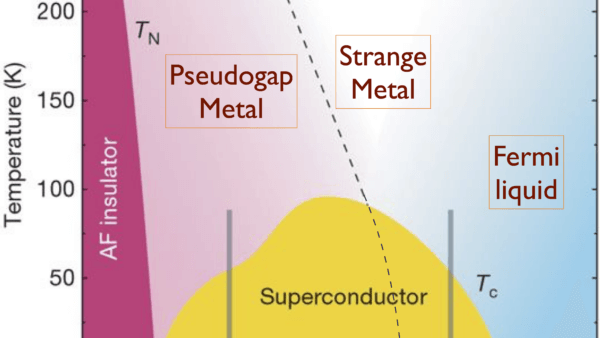
In the 2020-2021 academic year, the CMSA will be hosting a lecture series on Strongly Correlated Materials and High Tc Superconductor. All talks will take place from 10:30-12:00pm ET virtually on Zoom. Cuprate high-temperature superconductors are a classic quantum material system to demonstrate the beauty of “Emergence and Entanglement” in the quantum phases of matter. Merely by […]
During the 2021–2022 academic year, the CMSA will host a program on the so-called “Swampland.” The Swampland program aims to determine which low-energy effective field theories are consistent with nonperturbative quantum gravity considerations. Not everything is possible in String Theory, and finding out what is and what is not strongly constrains the low energy physics. These constraints are naturally […]
During the 2021–22 academic year, the CMSA will be hosting a Colloquium, organized by Du Pei, Changji Xu, and Michael Simkin. It will take place on Wednesdays at 9:30am – 10:30am (Boston time). The meetings will take place virtually on Zoom. All CMSA postdocs/members are required to attend the weekly CMSA Members’ Seminars, as well as the weekly CMSA […]
Speaker: Pieter Bomans, Princeton Title: Bubble instability of mIIA on AdS_4 x S^6 Abstract: Recently, a set of non-supersymmetric AdS_4 vacua of massive type IIA string theory has been constructed. These vacua are perturbatively stable with respect to the full KK spectrum of type mIIA supergravity and furthermore, they are stable against a variety of […]
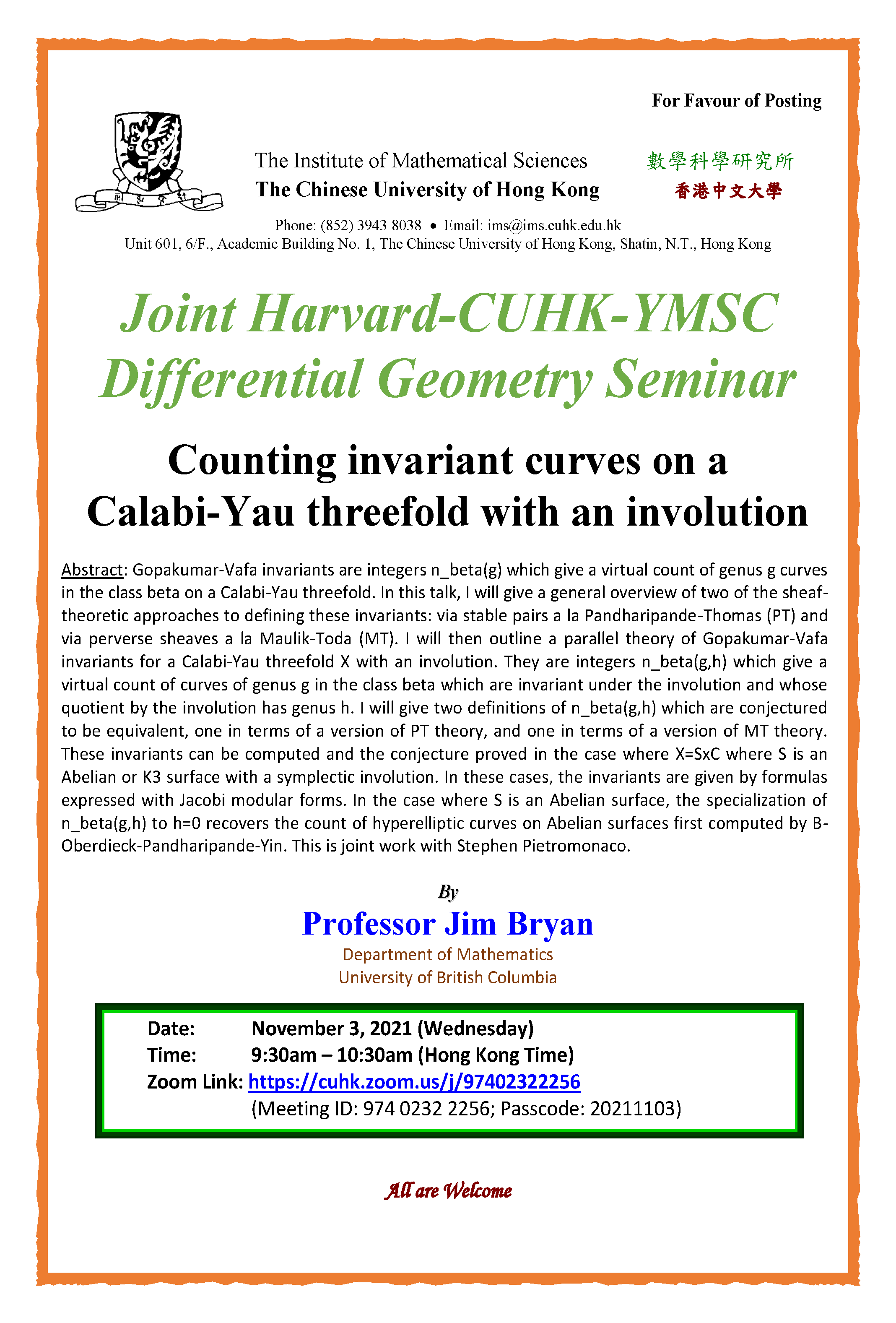
Abstract: Gopakumar-Vafa invariants are integers n_beta(g) which give a virtual count of genus g curves in the class beta on a Calabi-Yau threefold. In this talk, I will give a general overview of two of the sheaf-theoretic approaches to defining these invariants: via stable pairs a la Pandharipande-Thomas (PT) and via perverse sheaves a la Maulik-Toda […]
Abstract: We consider the moduli space of abelian varieties with two marked points and a frame of the relative de Rham cohomology with boundary at these points compatible with its mixed Hodge structure. Such a moduli space gives a natural algebro-geometric framework for higher genus quasi Jacobi forms of index zero and their differential equations […]
Speaker: Tamás Hausel (IST Austria) Title: Hitchin map as spectrum of equivariant cohomology Abstract: We will explain how to model the Hitchin integrable system on a certain Lagrangian upward flow as the spectrum of equivariant cohomology of a Grassmannian.
Speaker: Clay Cordova (U Chicago) Title: Non-Invertible Duality Defects in 3+1 Dimensions Abstract: For any quantum system invariant under gauging a higher-form global symmetry, we construct a non-invertible topological defect by gauging in only half of spacetime. This generalizes the Kramers-Wannier duality line in 1+1 dimensions to higher spacetime dimensions. We focus on the case of a […]
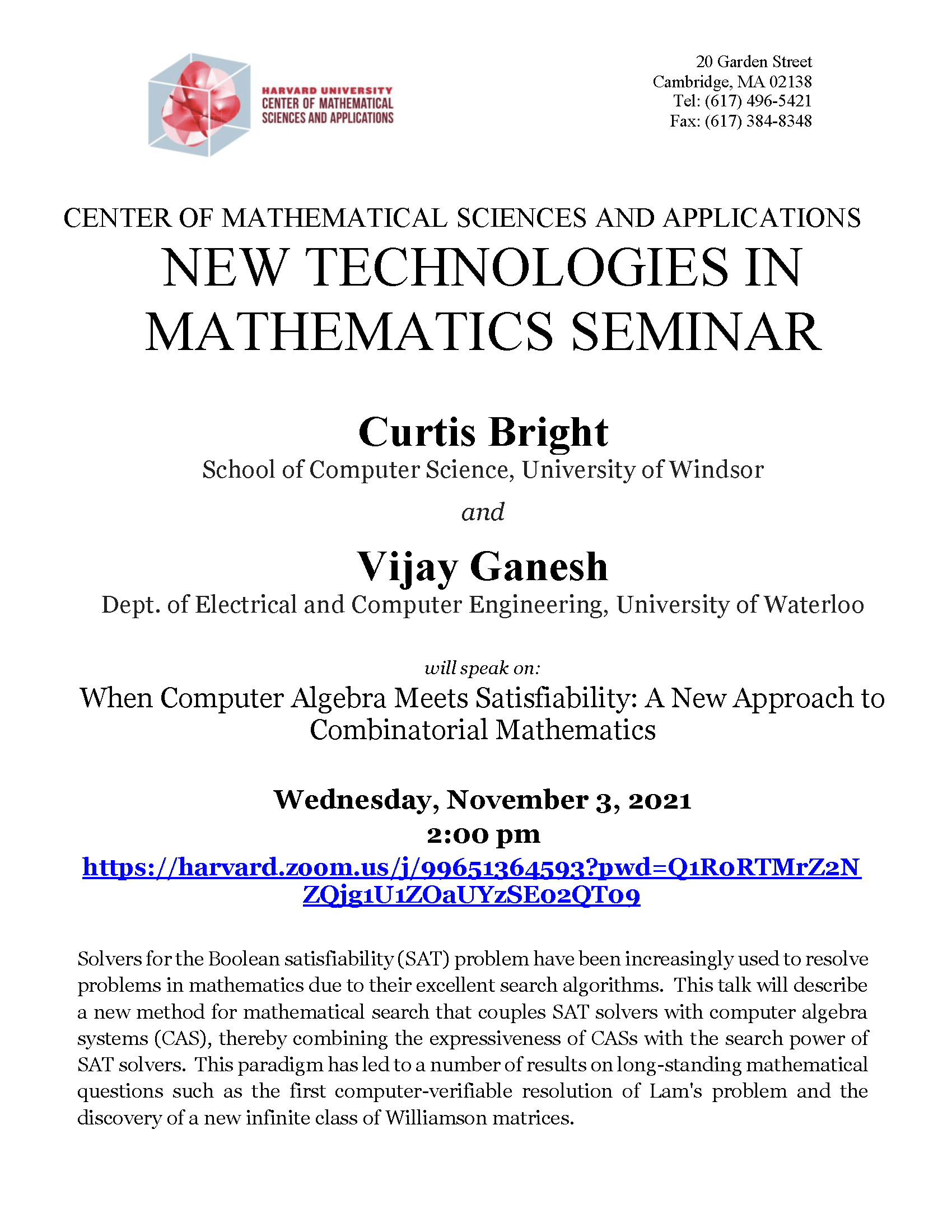
https://youtu.be/h-LEf4YnWhQ Speakers: Curtis Bright, School of Computer Science, University of Windsor and Vijay Ganesh, Dept. of Electrical and Computer Engineering, University of Waterloo Title: When Computer Algebra Meets Satisfiability: A New Approach to Combinatorial Mathematics Abstract: Solvers for the Boolean satisfiability (SAT) problem have been increasingly used to resolve problems in mathematics due to their […]
Speaker: Yifan Wang (NYU) Title: Fusion Category Symmetries in Quantum Field Theory Abstract: Topological defects provide a modern perspective on symmetries in quantum field theory. They generalize the familiar inverti https://www.youtube.com/watch?v=p82wzcicCk8&t=72s ble symmetries described by groups to non-invertible symmetries described by fusion categories. Such generalized symmetries are ubiquitous in quantum field theory and provide new constraints on […]
Abstract: Black holes solutions in General Relativity are parametrized by their mass, spin and charge. In this talk, I will motivate why the charge of black holes adds interesting dynamics to solutions of the Einstein equation thanks to the interaction between gravitational and electromagnetic radiation. Such radiations are solutions of a system of coupled wave equations […]
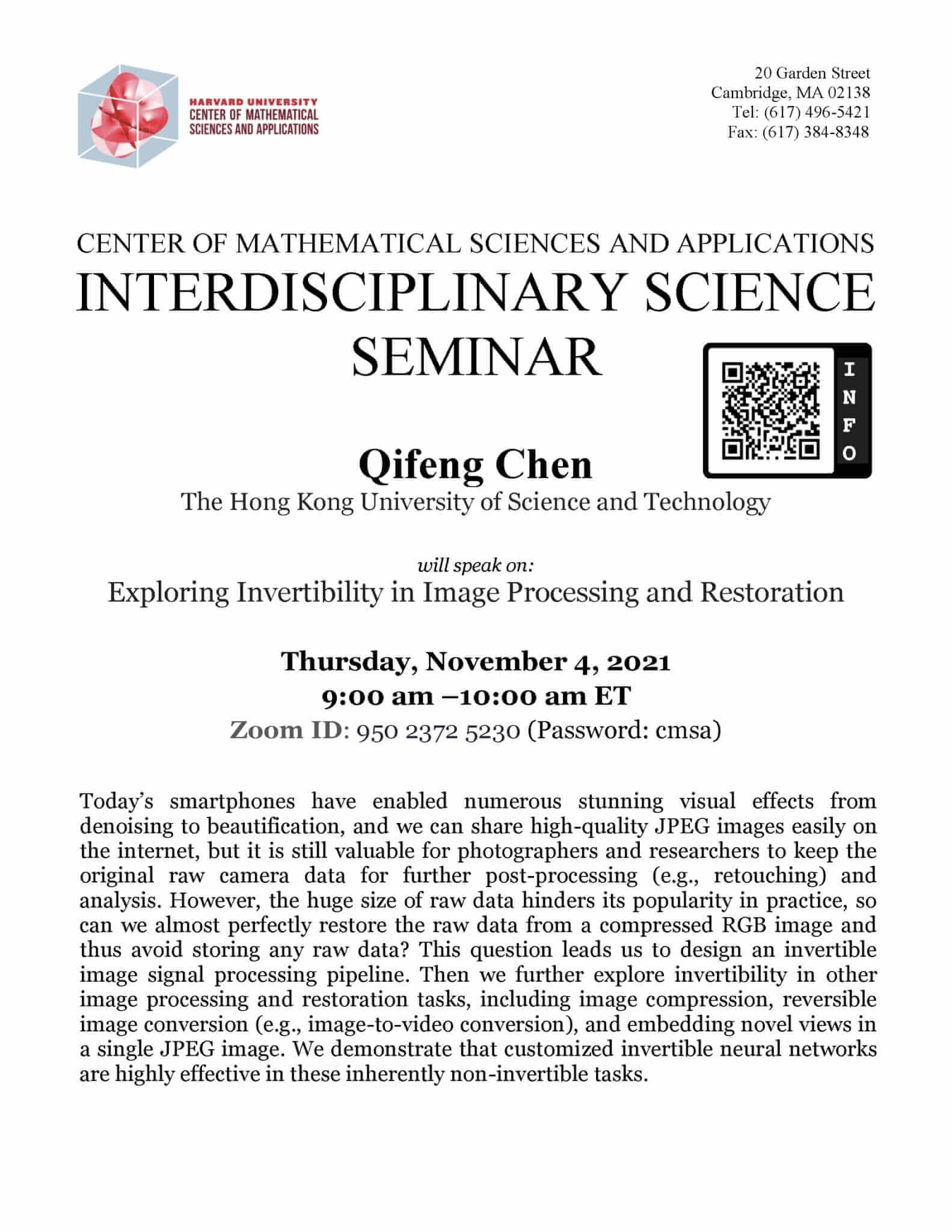
Title: Exploring Invertibility in Image Processing and Restoration Abstract: Today’s smartphones have enabled numerous stunning visual effects from denoising to beautification, and we can share high-quality JPEG images easily on the internet, but it is still valuable for photographers and researchers to keep the original raw camera data for further post-processing (e.g., retouching) and analysis. However, the […]
Member Seminar Speaker: Chuck Doran Title: The Greene-Plesser Construction Revisited Abstract: The first known construction of mirror pairs of Calabi-Yau manifolds was the Greene-Plesser “quotient and resolve” procedure which applies to pencils of hypersurfaces in projective space. We’ll review this approach, uncover the hints it gives for some more general mirror constructions, and describe a brand-new variant […]
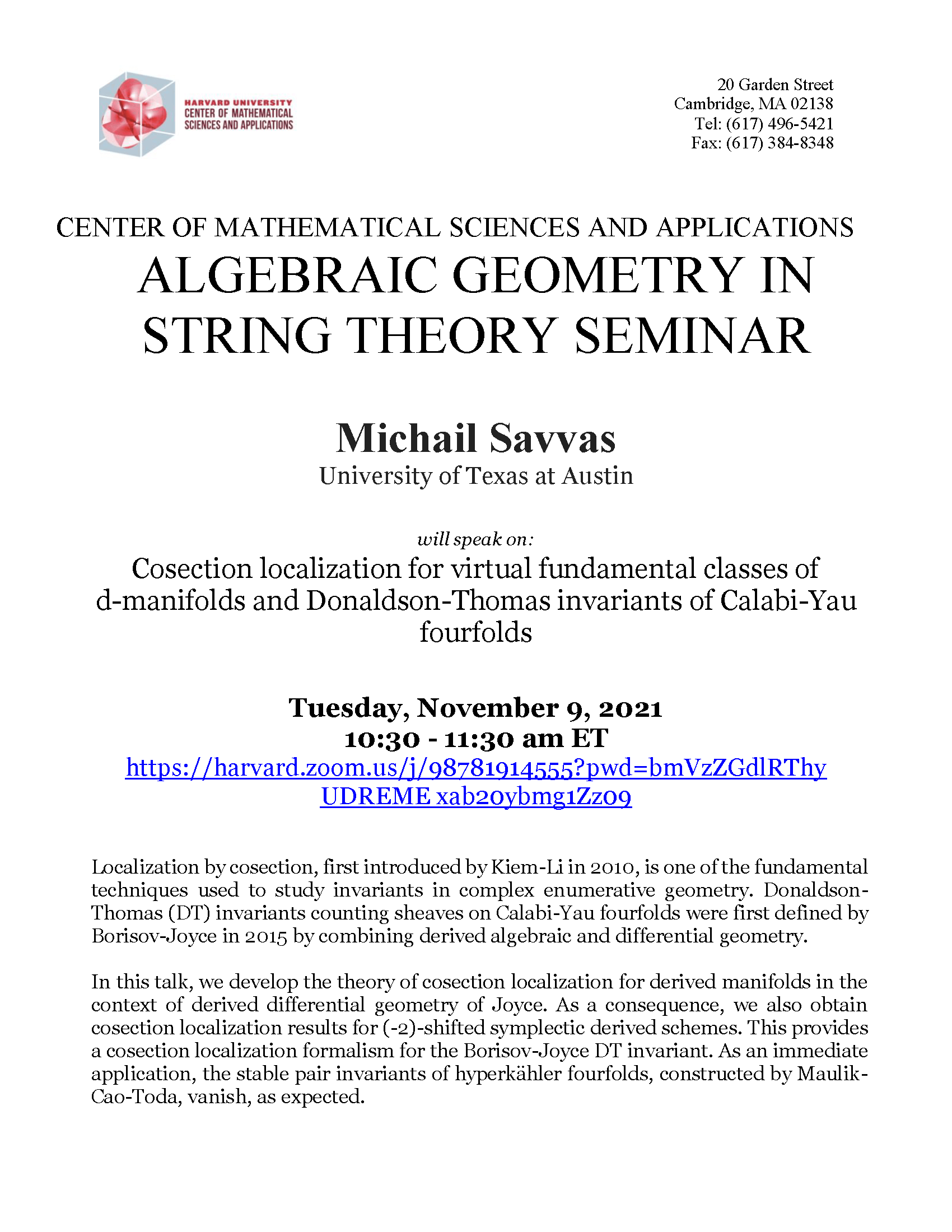
Abstract: Localization by cosection, first introduced by Kiem-Li in 2010, is one of the fundamental techniques used to study invariants in complex enumerative geometry. Donaldson-Thomas (DT) invariants counting sheaves on Calabi-Yau fourfolds were first defined by Borisov-Joyce in 2015 by combining derived algebraic and differential geometry. In this talk, we develop the theory of cosection localization […]
Speaker: Michail Savvas, UT Austin Title: Cosection localization for virtual fundamental classes of d-manifolds and Donaldson-Thomas invariants of Calabi-Yau fourfolds Abstract: Localization by cosection, first introduced by Kiem-Li in 2010, is one of the fundamental techniques used to study invariants in complex enumerative geometry. Donaldson-Thomas (DT) invariants counting sheaves on Calabi-Yau fourfolds were first defined by Borisov-Joyce […]
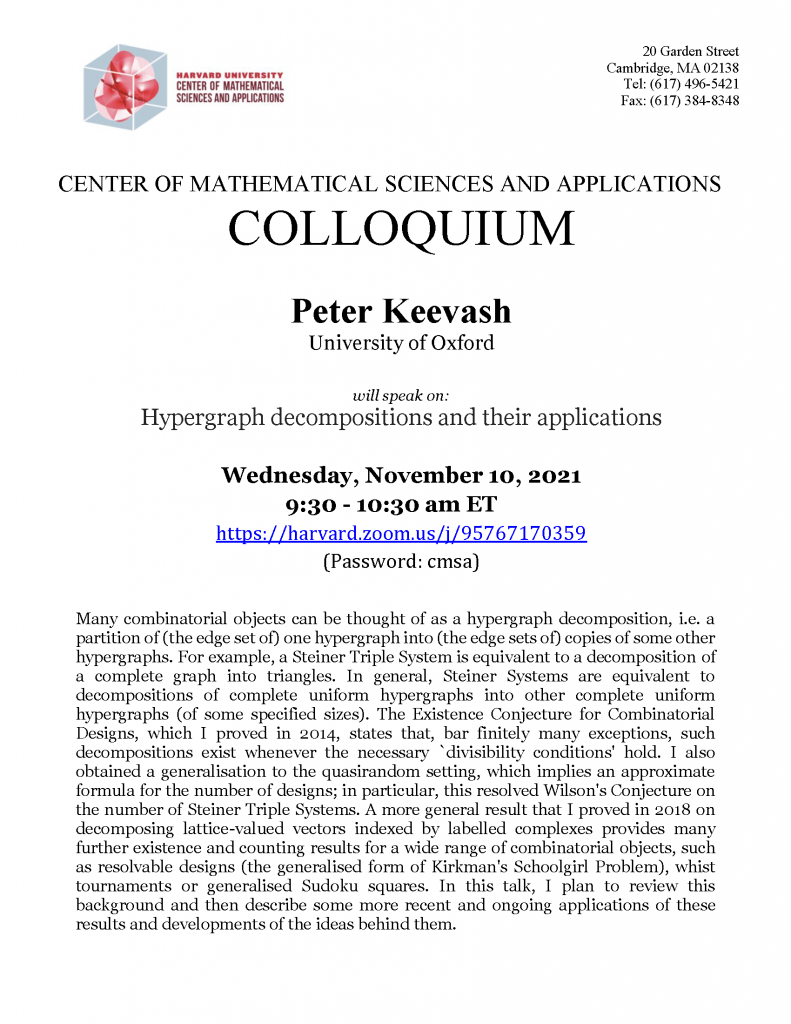
Speaker: Peter Keevash, Oxford Title: Hypergraph decompositions and their applications Abstract: Many combinatorial objects can be thought of as a hypergraph decomposition, i.e. a partition of (the edge set of) one hypergraph into (the edge sets of) copies of some other hypergraphs. For example, a Steiner Triple System is equivalent to a decomposition of a complete graph […]
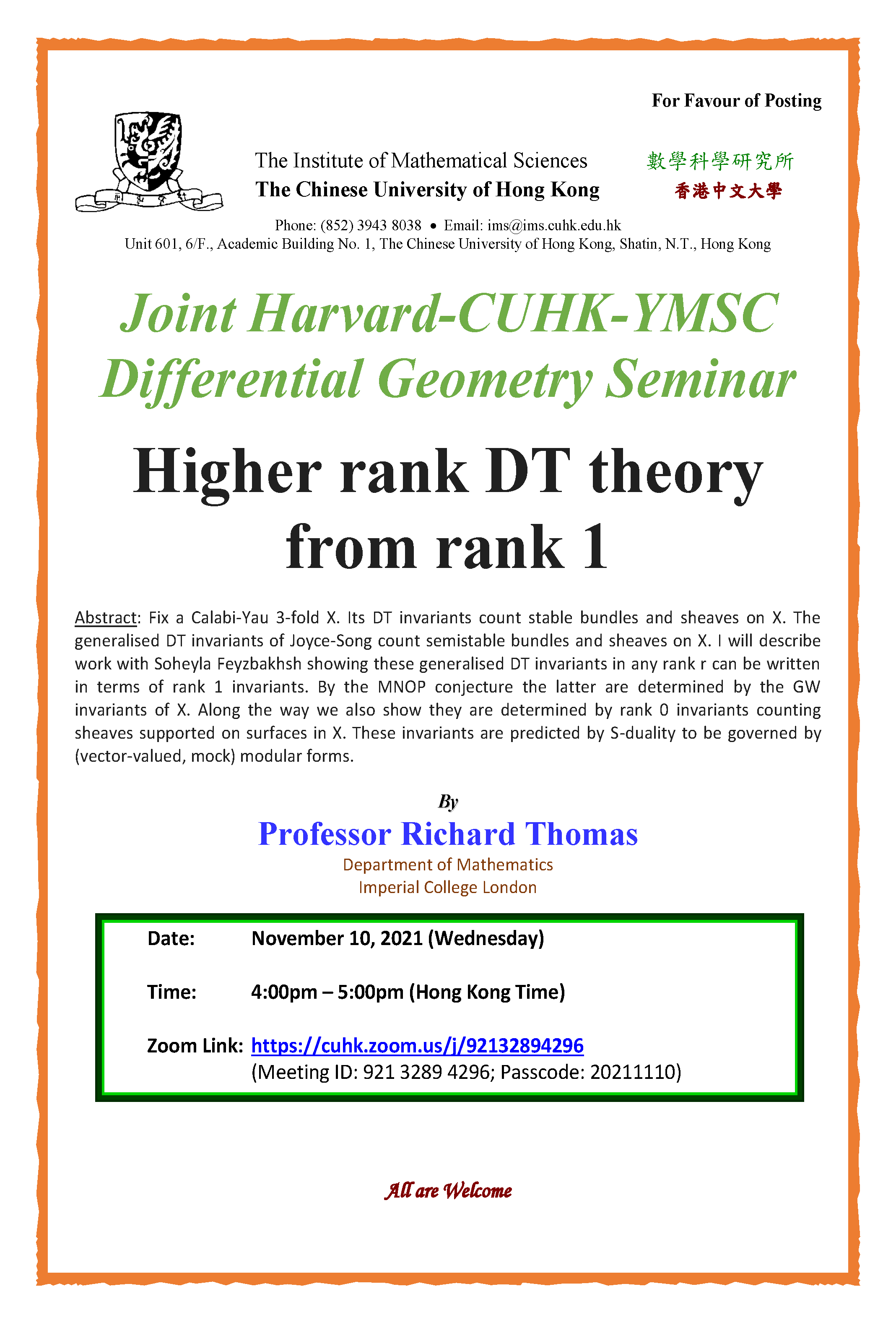
Abstract: Fix a Calabi-Yau 3-fold X. Its DT invariants count stable bundles and sheaves on X. The generalised DT invariants of Joyce-Song count semistable bundles and sheaves on X. I will describe work with Soheyla Feyzbakhsh showing these generalised DT invariants in any rank r can be written in terms of rank 1 invariants. By the […]
Abstract: Active crystals are highly ordered structures that emerge from the nonequilibrium self-organization of motile objects, and have been widely studied in synthetic and bacterial active matter. In this talk, I will describe how swimming sea star embryos spontaneously assemble into chiral crystals that span thousands of spinning organisms and persist for tens of hours. Combining […]
Abstract: Teukolsky equation in Kerr spacetimes governs the dynamics of the spin $s$ components, $s=0, \pm 1, \pm 2$ corresponding to the scalar field, the Maxwell field, and the linearized gravity, respectively. I will discuss recent joint work with L. Zhang on proving the precise asymptotic profiles for these spin $s$ components in Schwarzschild and […]
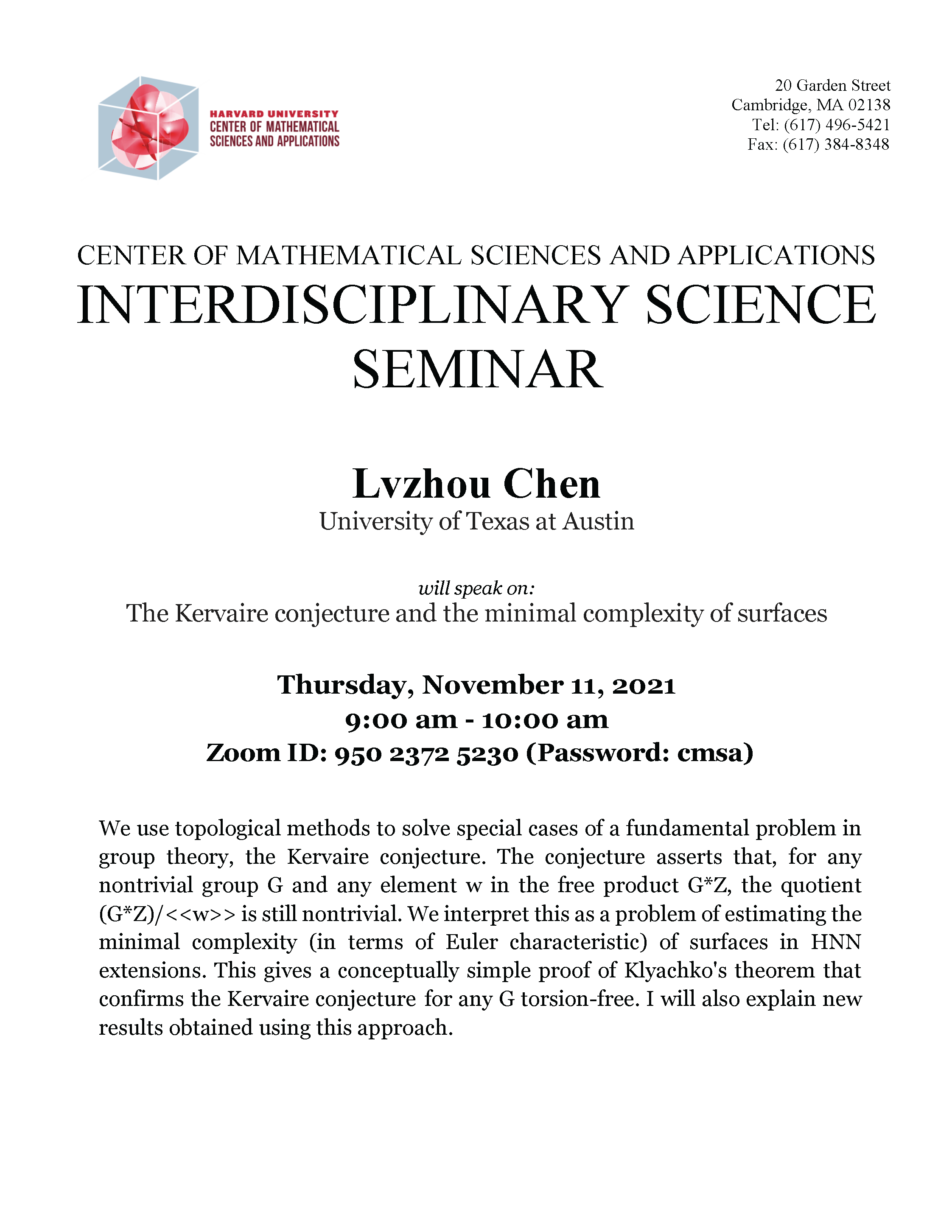
Title: The Kervaire conjecture and the minimal complexity of surfaces Abstract: We use topological methods to solve special cases of a fundamental problem in group theory, the Kervaire conjecture. The conjecture asserts that, for any nontrivial group G and any element w in the free product G*Z, the quotient (G*Z)/<<w>> is still nontrivial. We interpret this […]
Member Seminar Speaker: Gabriel Wong Title: Universal relations between entanglement, symmetries, and entropy Abstract: Entanglement is an essential property of quantum systems that distinguishes them from classical ones. It is responsible for the nonlocal character of quantum information and provides a resource for quantum teleportation and quantum computation. In this talk I will provide an introduction […]
This week’s seminar will be an open mic discussion which will be led by Nima Arkani-Hamed (IAS), and by Gary Shiu (UW-Madison), and the topic will be “Swampland constraints, Unitarity and Causality”. They will start with a brief introduction sharing their thoughts about the topic and moderate a discussion afterwards.
Abstract: I will describe an inductive algorithm computing Gromov-Witten invariants in all genera with arbitrary insertions of all smooth complete intersections in projective space. The main idea is to show that invariants with insertions of primitive cohomology classes are controlled by their monodromy and by invariants defined without primitive insertions but with imposed nodes in the […]
Speaker: Andrea Brini, U Sheffield Title: Curve counting on surfaces and topological strings Abstract: Enumerative geometry is a venerable subfield of Mathematics, with roots dating back to Greek Antiquity and a present inextricably linked with developments in other domains. Since the early 90s, in particular, the interaction with String Theory has sent shockwaves through the subject, giving […]
Title: Amplituhedra, Scattering Amplitudes and Triangulations Abstract: In this talk I will discuss about Amplituhedra – generalizations of polytopes inside the Grassmannian – recently introduced by physicists as new geometric constructions encoding interactions of elementary particles in certain Quantum Field Theories. In particular, I will explain how the problem of finding triangulations of Amplituhedra is connected to […]
Speaker: B. Andrei Bernevig (Princeton University) Title: Exact Eigenstates in Non-Integrable Systems: A violation of the ETH Abstract: We find that several non-integrable systems exhibit some exact eigenstates that span the energy spectrum from lowest to the highest state. In the AKLT Hamiltonian and in several others “special” non-integrable models, we are able to obtain the analytic […]
Member Seminar Speaker: Kan Lin Title: China’s financial regulatory reform, financial opening-up, and Central Bank Digital Currency (CBDC) Abstract: In this talk, I will explain the overall situation of China’s financial industry and review the development of China’s financial regulatory system reform from 1949 to 2021. Then, I will explain the policies of the 3 stages […]
strong>Abstract: The analysis of global structure of the Einstein equations for general relativity, in the context of the initial value problem, is a difficult and intricate mathematical subject. Any additional structure in their formulation is welcome, in order to alleviate the problem. It is expected that the initial value problem of the Einstein equations on spacetimes admitting a translational, […]
Abstract: In this talk I will introduce a generalized notion of finiteness that provides a structural principle for the set of effective theories that can be consistently coupled to quantum gravity. More concretely, I will propose a ‘tameness conjecture’ that states that all scalar field spaces and coupling functions that appear in such an effective theory must be definable in an o-minimal structure. The fascinating field […]
Abstract: The Prague dimension of graphs was introduced by Nesetril, Pultr and Rodl in the 1970s: as a combinatorial measure of complexity, it is closely related to clique edges coverings and partitions. Proving a conjecture of Furedi and Kantor, we show that the Prague dimension of the binomial random graph is typically of order n/(log […]
Speaker: Shinsei Ryu (Princeton University) Title: Multipartitioning topological phases and quantum entanglement Abstract: We discuss multipartitions of the gapped ground states of (2+1)-dimensional topological liquids into three (or more) spatial regions that are adjacent to each other and meet at points. By considering the reduced density matrix obtained by tracing over a subset of the regions, we […]
Abstract: Let X be a compact symplectic manifold, and D a normal crossings symplectic divisor in X. We give a criterion under which the quantum cohomology of X is the cohomology of a natural deformation of the symplectic cochain complex of X \ D. The criterion can be thought of in terms of the Kodaira dimension of X […]
Abstract: In this talk I will review massive type IIA flux compactifications that seem to give rise to infinite families of supersymmetric 4d AdS vacua. These vacua provide an interesting testing ground for the swampland program. After reviewing potential shortcomings of this setup, I will discuss recent progress on overcoming them and getting a better understanding of these […]
Abstract: The last few decades have seen a surge of interest in building towards a theory of discrete curvature that attempts to translate the key properties of curvature in differential geometry to the setting of discrete objects and spaces. In the case of graphs there have been several successful proposals, for instance by Lin-Lu-Yau, Forman […]
Speaker: Richard Wentworth, University of Maryland Title: The Hitchin connection for parabolic G-bundles Abstract: For a simple and simply connected complex group G, I will discuss some elements of the proof of the existence of a flat projective connection on the bundle of nonabelian theta functions on the moduli space of semistable parabolic G-bundles over families of […]
https://youtu.be/wXZKoHEzASg Speaker: Dan Roberts, MIT & Salesforce Title: The Principles of Deep Learning Theory Abstract: Deep learning is an exciting approach to modern artificial intelligence based on artificial neural networks. The goal of this talk is to provide a blueprint — using tools from physics — for theoretically analyzing deep neural networks of practical relevance. This […]
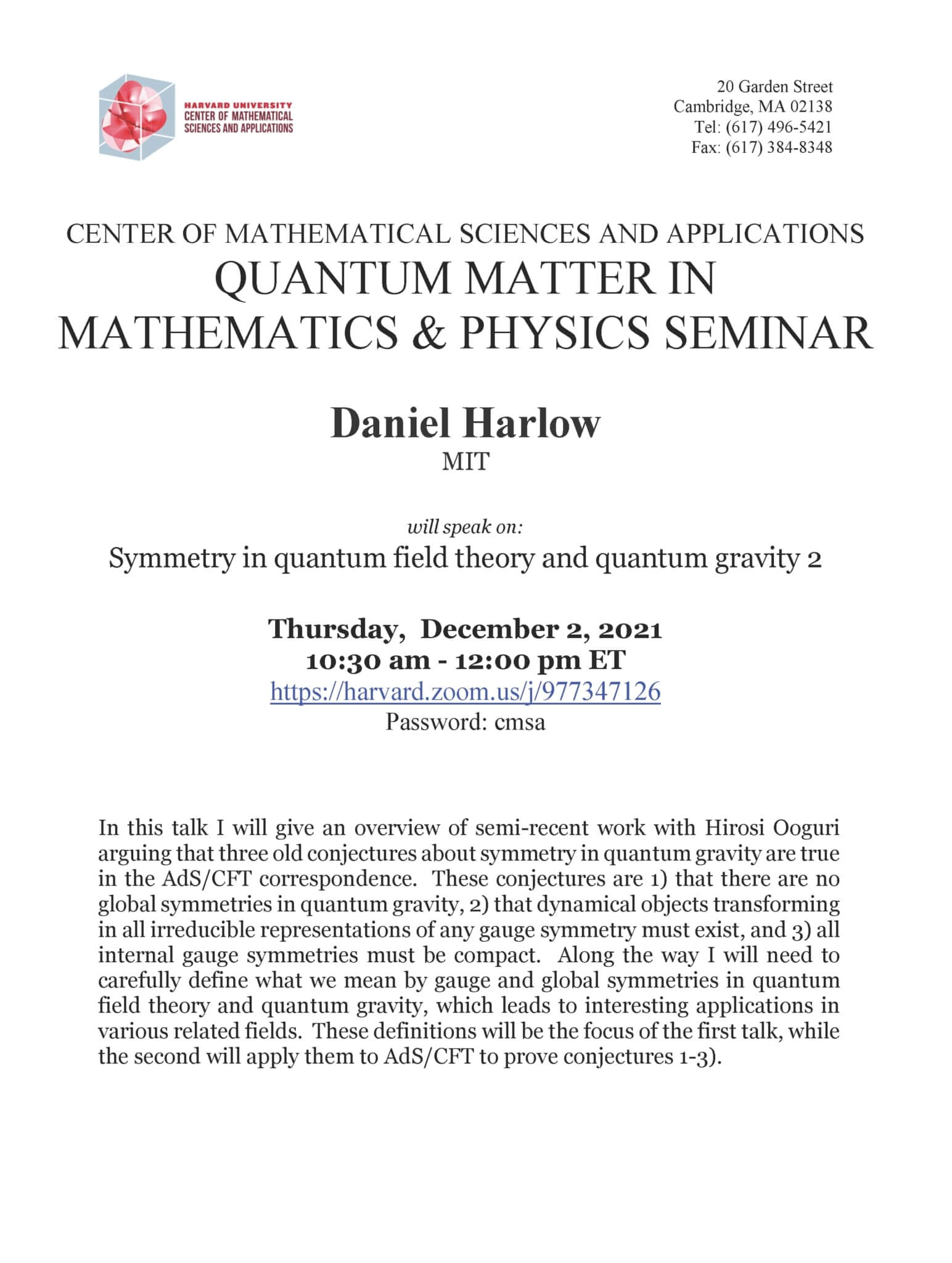
Speaker: Daniel Harlow (MIT) Title: Symmetry in quantum field theory and quantum gravity 2 Abstract: In this talk I will give an overview of semi-recent work with Hirosi Ooguri arguing that three old conjectures about symmetry in quantum gravity are true in the AdS/CFT correspondence. These conjectures are 1) that there are no global symmetries […]
Abstract: The two-body motion in General Relativity can be solved perturbatively in the small mass ratio expansion. Kerr geodesics describe the leading order motion. After a short summary of the classification of polar and radial Kerr geodesic motion, I will consider the inspiral motion of a point particle around the Kerr black hole subjected to the […]
Member Seminar Speaker: Dan Kapec Title: Black Holes, 2D Gravity, and Random Matrices Abstract: I will discuss old and new connections between black hole physics, 2D quantum gravity, and random matrix theory. Black holes are believed to be very complicated, strongly interacting quantum mechanical systems, and certain aspects of their Hamiltonians should be well approximated by random […]
20 Garden Street Cambridge,
MA
02138United States+ Google Map
Algebraic Geometry in String Theory Seminar Event Title: Cosection localization for virtual fundamental classes of d-manifolds and Donaldson-Thomas invariants of Calabi-Yau fourfolds
Algebraic Geometry in String Theory Seminar Event Title: Cosection localization for virtual fundamental classes of d-manifolds and Donaldson-Thomas invariants of Calabi-Yau fourfolds