• Traversable wormhole dynamics on a quantum processor

    Hybrid - G10

    Quantum Matter Seminar Speaker: Alexander Zlokapa, MIT Title: Traversable wormhole dynamics on a quantum processor Abstract: The holographic principle, theorized to be a property of quantum gravity, postulates that the description of a volume of space can be encoded on a lower-dimensional boundary. The anti-de Sitter (AdS)/conformal field theory correspondence or duality is the principal example […]
  • CMSA/MATH Bi-Annual Gathering

    Common Room, CMSA 20 Garden Street, Cambridge, MA, United States

    On Friday, March 24th, 4:30PM - 6PM, the CMSA will host the CMSA/MATH Bi-Annual Gathering for Harvard CMSA and Math affiliates in the Common Room at 20 Garden Street, Cambridge MA 02138.

  • Recent developments on the tidal Love numbers of black holes

    CMSA Room G10 CMSA, 20 Garden Street, Cambridge, MA, United States

    Swampland Seminar Speaker: Valerio De Luca (UPenn) Title: Recent developments on the tidal Love numbers of black holes Abstract: Tidal Love numbers describe the deformability of compact objects under the presence of external tidal perturbations, and are found to be exactly zero for black holes in pure General Relativity. This property is however fragile, since […]

  • Monotonicity of quasilocal mass for asymptotically flat Riemannian manifolds

    CMSA Room G10 CMSA, 20 Garden Street, Cambridge, MA, United States

    Member Seminar Speaker: Jue Liu Title: Monotonicity of quasilocal mass for asymptotically flat Riemannian manifolds Abstract: The study of quasilocal mass in general relativity has a long history. In previous papers by many authors we have a deep understanding of the properties of quasilocal mass such as positivity, rigidity and asymptotics etc. In this talk I will focus […]

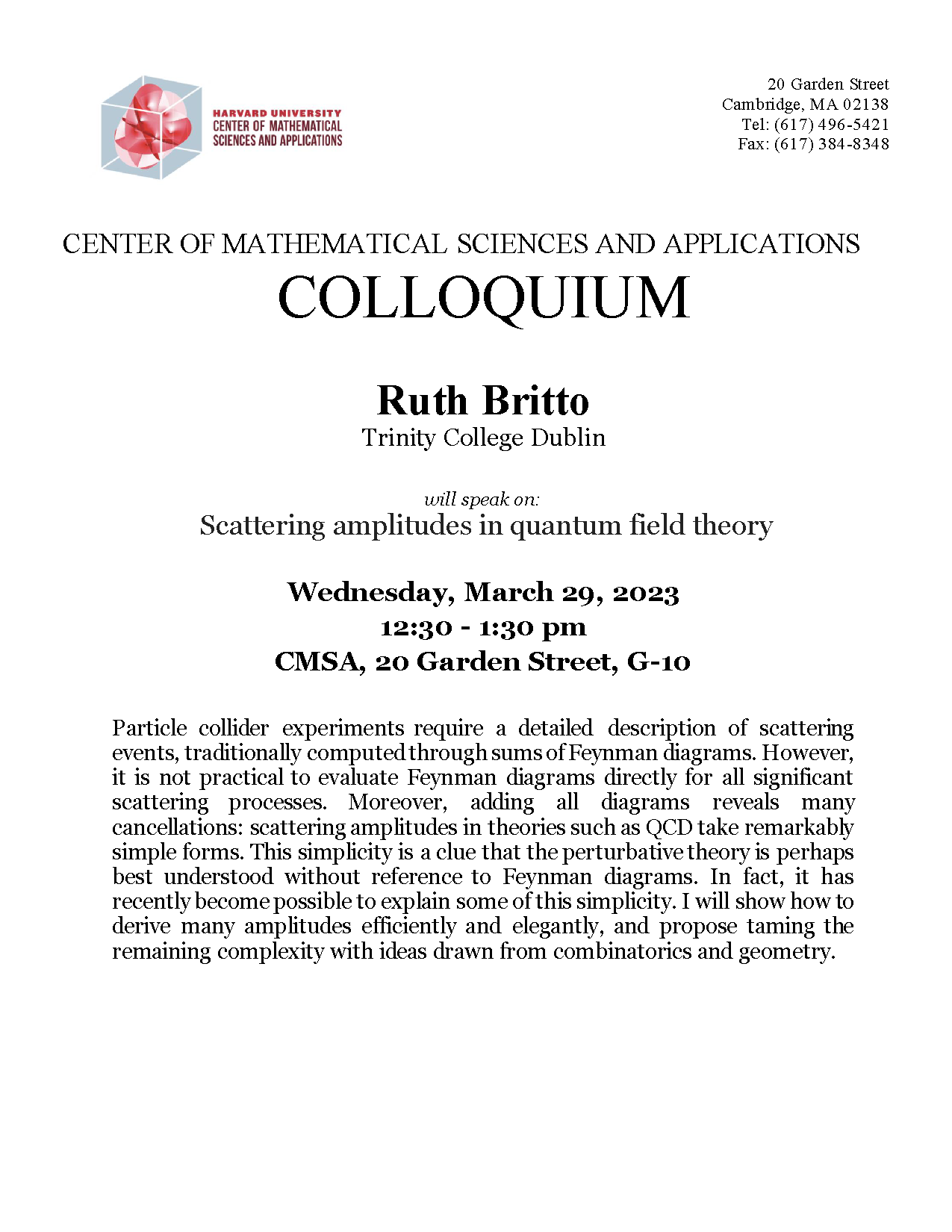
  • Scattering amplitudes in quantum field theory

    CMSA Room G10 CMSA, 20 Garden Street, Cambridge, MA, United States

    Speaker: Ruth Britto (Trinity College Dublin) Title: Scattering amplitudes in quantum field theory Abstract: Particle collider experiments require a detailed description of scattering events, traditionally computed through sums of Feynman diagrams. However, it is not practical to evaluate Feynman diagrams directly for all significant scattering processes. Moreover, adding all diagrams reveals many cancellations: scattering amplitudes […]

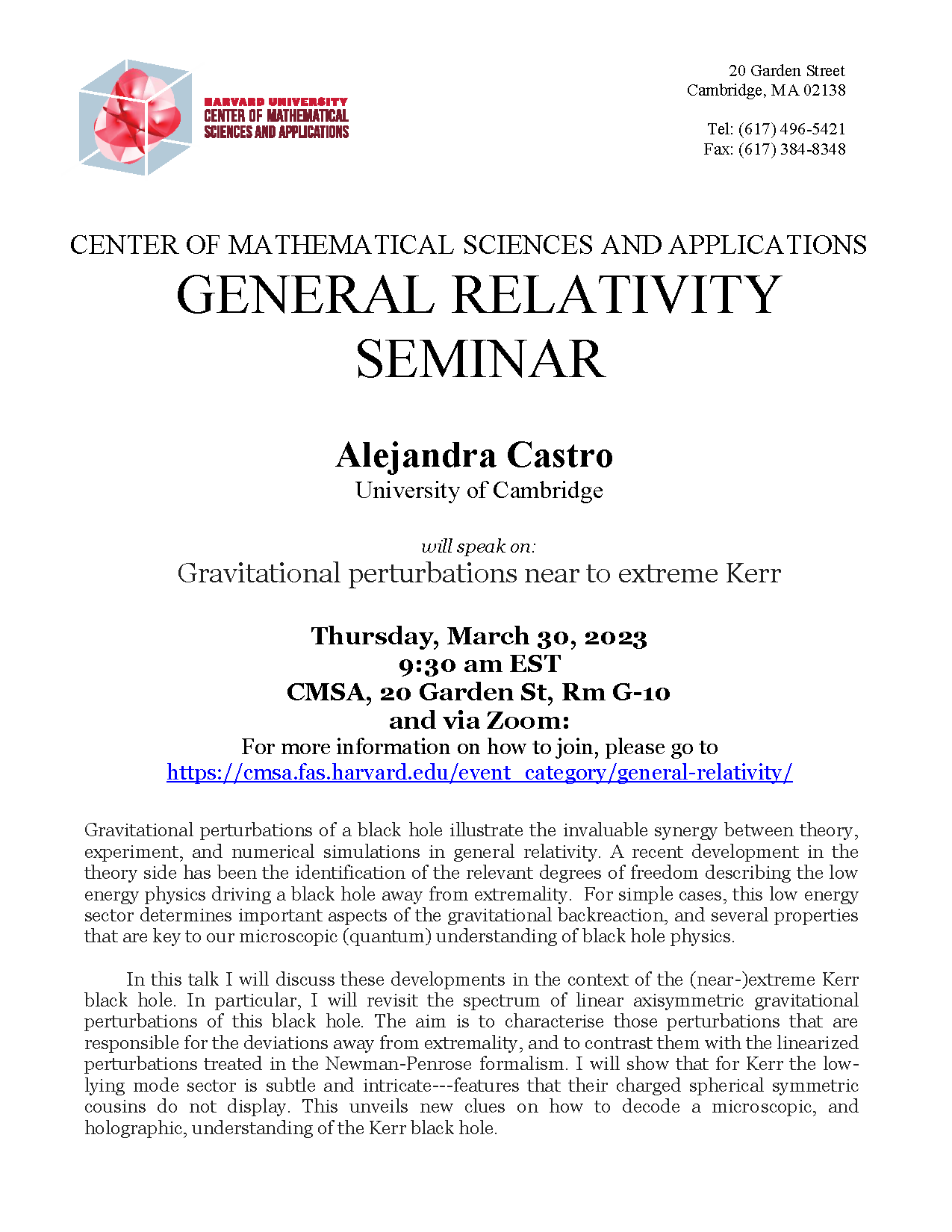
  • Gravitational perturbations near to extreme Kerr

    CMSA Room G10 CMSA, 20 Garden Street, Cambridge, MA, United States

    https://youtu.be/VdfmeuDoofY General Relativity Seminar Speaker: Alejandra Castro (University of Cambridge) Title: Gravitational perturbations near to extreme Kerr Abstract: Gravitational perturbations of a black hole illustrate the invaluable synergy between theory, experiment, and numerical simulations in general relativity. A recent development in the theory side has been the identification of the relevant degrees of freedom describing the low energy […]

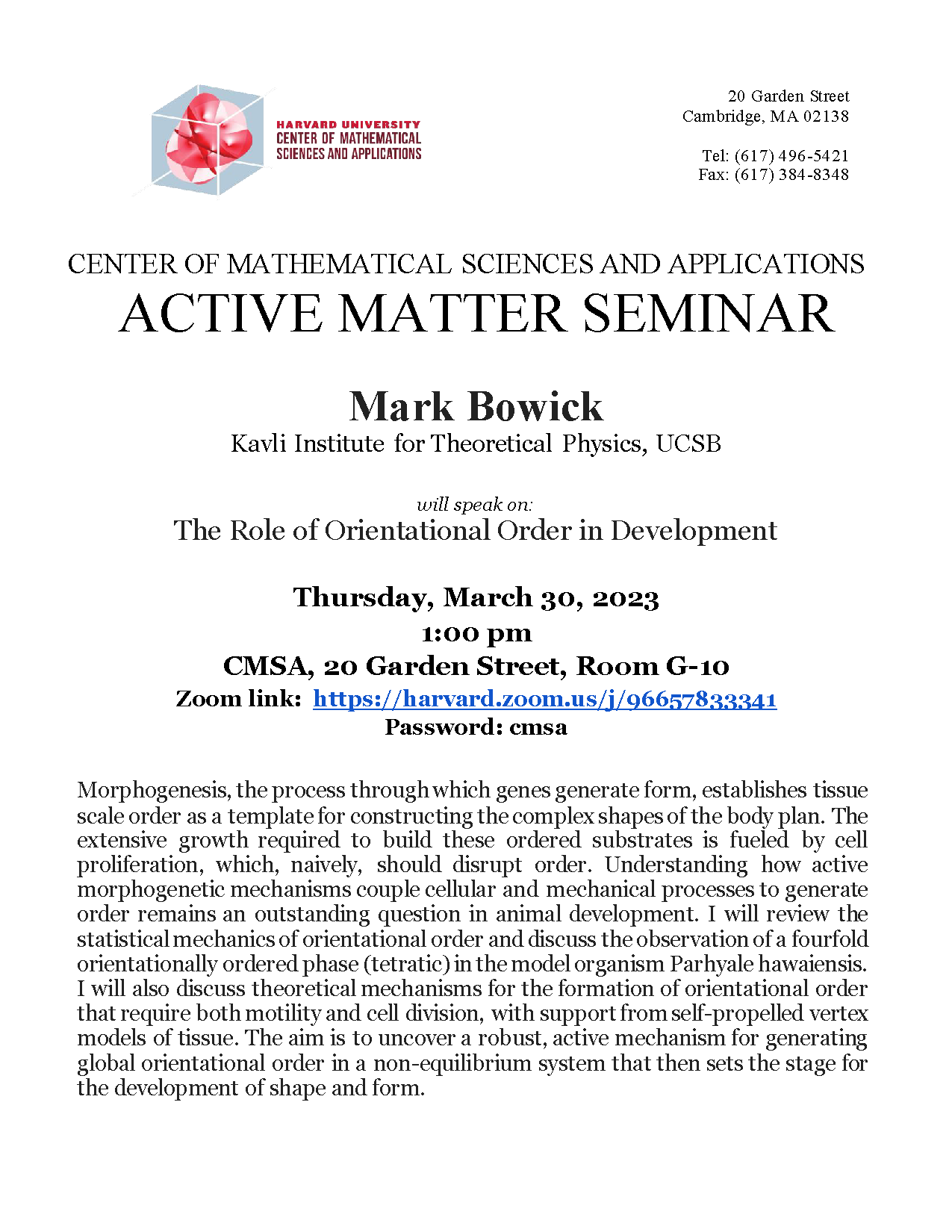
  • The Role of Orientational Order in Development

    CMSA Room G10 CMSA, 20 Garden Street, Cambridge, MA, United States

    Active Matter Seminar Speaker: Mark Bowick, Kavli Institute for Theoretical Physics, UCSB Title: The Role of Orientational Order in Development Abstract: Morphogenesis, the process through which genes generate form, establishes tissue scale order as a template for constructing the complex shapes of the body plan. The extensive growth required to build these ordered substrates is fueled […]

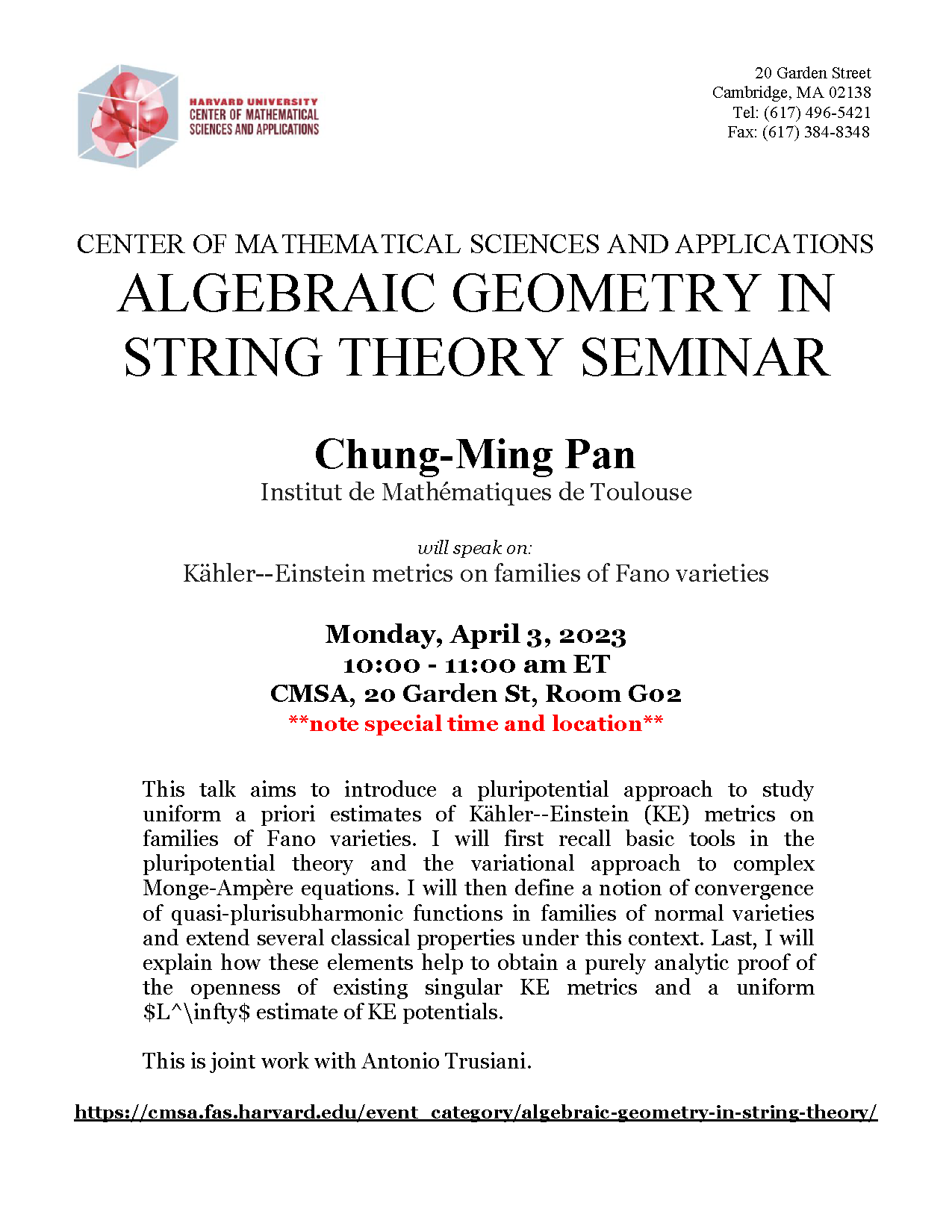
  • Kähler-Einstein metrics on families of Fano varieties

    Virtual

    Algebraic Geometry in String Theory Seminar Speaker: Chung-Ming Pan, Institut de Mathématiques de Toulouse Title: Kähler-Einstein metrics on families of Fano varieties Abstract: This talk aims to introduce a pluripotential approach to study uniform a priori estimates of Kähler-Einstein (KE) metrics on families of Fano varieties. I will first recall basic tools in the pluripotential theory […]

  • Black hole microstate counting from the gravitational path integral

    CMSA Room G10 CMSA, 20 Garden Street, Cambridge, MA, United States

    Colloquium Speaker: Luca Iliesiu, Stanford Title: Black hole microstate counting from the gravitational path integral Abstract: Reproducing the integer count of black hole micro-states from the gravitational path integral is an important problem in quantum gravity. In the first part of the talk, I will show that, by using supersymmetric localization, the gravitational path integral for 1/16-BPS black […]

  • Optimal Dynamic Allocation: Simplicity through Information Design

    CMSA Room G10 CMSA, 20 Garden Street, Cambridge, MA, United States

    Member Seminar Speaker: Faidra Monachou Title: Optimal Dynamic Allocation: Simplicity through Information Design Abstract: We study dynamic nonmonetary markets where objects are allocated to unit-demand agents with private types. An agent’s value for an object is supermodular in her type and the quality of the object, and her payoff is quasilinear in her waiting cost. The […]

  • Sampling from the SK and mixed p-spin measures with stochastic localization

    CMSA Room G10 CMSA, 20 Garden Street, Cambridge, MA, United States

    Probability Seminar Speaker: Ahmed El Alaoui (Cornell) Title: Sampling from the SK and mixed p-spin measures with stochastic localization Abstract: I will present an algorithm which efficiently samples from the Sherrington-Kirkpatrick (SK) measure with no external field at high temperature. The approach is based on the stochastic localization process of Eldan, together with a subroutine for […]

  • Rough solutions of the relativistic Euler equations

    CMSA Room G10 CMSA, 20 Garden Street, Cambridge, MA, United States

    https://youtu.be/8QfTA8wmChY General Relativity Seminar Speaker: Sifan Yu, Vanderbilt University Title: Rough solutions of the relativistic Euler equations Abstract: I will discuss recent works on the relativistic Euler equations with dynamic vorticity and entropy. We use a new formulation of the equations, which has geo-analytic structures. In this geometric formulation, we decompose the flow into geometric "sound-wave […]