• Sampling from the SK and mixed p-spin measures with stochastic localization

    CMSA Room G10 CMSA, 20 Garden Street, Cambridge, MA, United States

    Probability Seminar Speaker: Ahmed El Alaoui (Cornell) Title: Sampling from the SK and mixed p-spin measures with stochastic localization Abstract: I will present an algorithm which efficiently samples from the Sherrington-Kirkpatrick (SK) measure with no external field at high temperature. The approach is based on the stochastic localization process of Eldan, together with a subroutine for […]
  • Rough solutions of the relativistic Euler equations

    CMSA Room G10 CMSA, 20 Garden Street, Cambridge, MA, United States

    https://youtu.be/8QfTA8wmChY General Relativity Seminar Speaker: Sifan Yu, Vanderbilt University Title: Rough solutions of the relativistic Euler equations Abstract: I will discuss recent works on the relativistic Euler equations with dynamic vorticity and entropy. We use a new formulation of the equations, which has geo-analytic structures. In this geometric formulation, we decompose the flow into geometric "sound-wave […]

  • Enhancing Detection of Topological Order by Local Error Correction

    CMSA Room G10 CMSA, 20 Garden Street, Cambridge, MA, United States

    Quantum Matter Seminar Speaker: Nishad Maskara (Harvard) Title: Enhancing Detection of Topological Order by Local Error Correction Abstract: The exploration of topologically-ordered states of matter is a long-standing goal at the interface of several subfields of the physical sciences. Such states feature intriguing physical properties such as long-range entanglement, emergent gauge fields and non-local correlations, and can […]

  • Modular graph forms and iterated integrals in string amplitudes

    CMSA Room G10 CMSA, 20 Garden Street, Cambridge, MA, United States

    Algebraic Geometry in String Theory Seminar Speaker: Oliver Schlotterer (Uppsala University) Title: Modular graph forms and iterated integrals in string amplitudes Abstract: I will discuss string amplitudes as a laboratory for special functions and period integrals that drive fruitful cross-talk with particle physicists and mathematicians. At genus zero, integration over punctures on a disk or […]

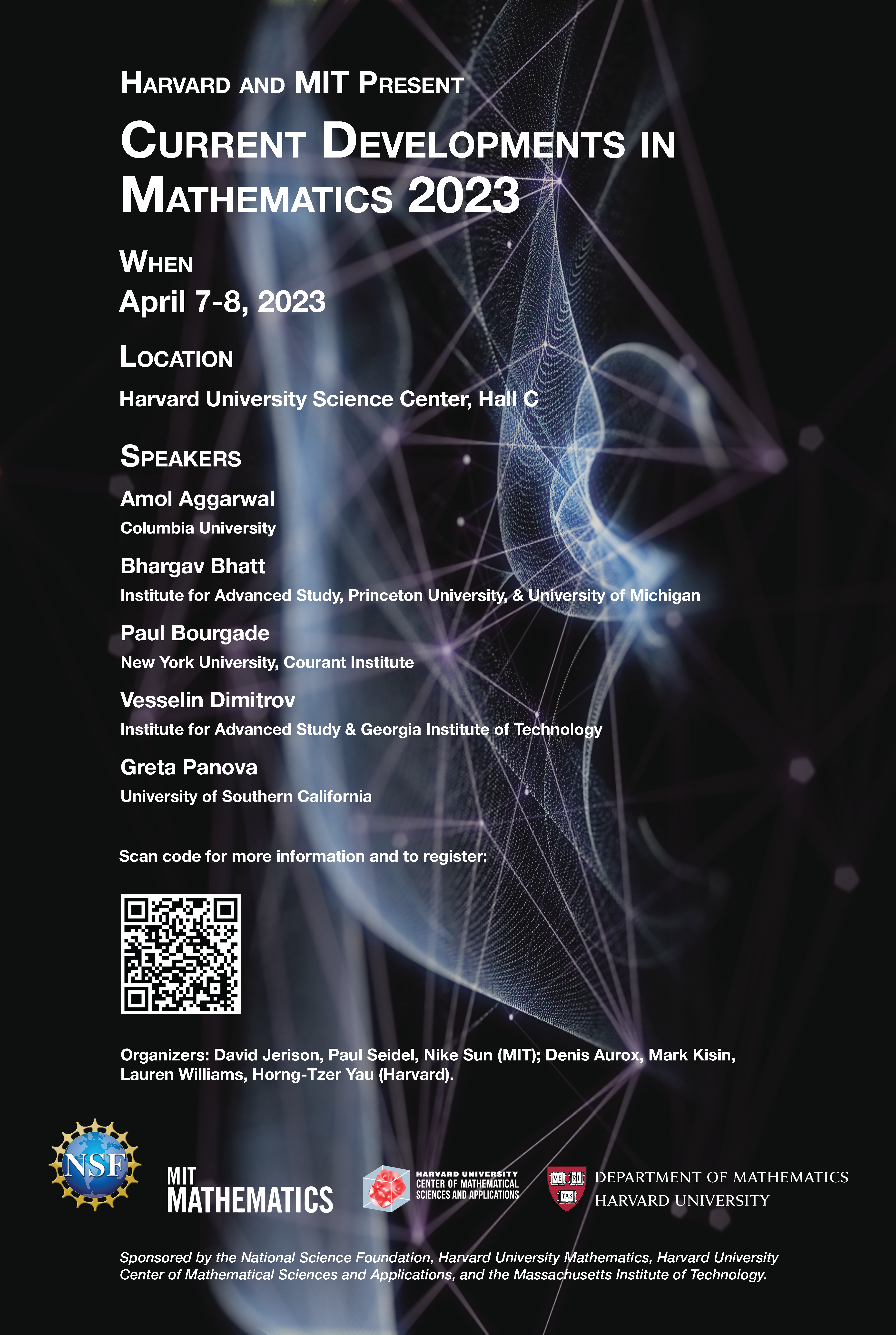
  • Current Developments in Mathematics Conference 2023

    Harvard Science Center 1 Oxford Street, Cambridge, MA

    Current Developments in Mathematics 2023 Harvard University Science Center, Lecture Hall C April 7-8, 2023 Speakers: Amol Aggarwal - Columbia University Bhargav Bhatt - Institute for Advanced Study, Princeton University, & University of Michigan Paul Bourgade - New York University, Courant Institute Vesselin Dimitrov - Institute for Advanced Study & Georgia Institute of Technology Greta […]

  • Swampland bounds on the abelian gauge sectors

    CMSA Room G10 CMSA, 20 Garden Street, Cambridge, MA, United States

    Swampland Seminar Speaker: Seung-Joo Lee (IBS Daejeon) Title: Swampland bounds on the abelian gauge sectors Abstract: In this talk we will derive various bounds on the 0-form and the 1-form abelian gauge sectors of gravitational effective theories in 6 dimensions with minimal supersymmetry. We will start by considering 6-dimensional F-theory vacua with at least one tensor […]

  • Localization for random band matrices

    Harvard Science Center 1 Oxford Street, Cambridge, MA

    Probability Seminar *Please note room change: Science Center 232* Speaker: Ron Peled (Tel Aviv University) Title: Localization for random band matrices Abstract: I will explain an approach via "an adaptive Mermin-Wagner style shift" which proves localization of N x N Gaussian random band matrices with band width W satisfying W << N^{1/4}. Joint work with Giorgio Cipolloni, Jeffrey […]

  • Spectral gap and two-point functions in spin glasses

    CMSA Room G10 CMSA, 20 Garden Street, Cambridge, MA, United States

    Member Seminar Speaker: Changji Xu Title: Spectral gap and two-point functions in spin glasses Abstract: Many have worked on spin glass models over the past 50 years, including physicists, mathematicians, and computers. A question that arises is whether computers yield dependable simulation results. In this talk, I will discuss some recent mathematical progress on spectral […]

  • Unexpected Uses of Neural Networks: Field Theory and Metric Flows  

    CMSA Room G10 CMSA, 20 Garden Street, Cambridge, MA, United States

    Speaker: James Halverson (Northeastern University)   Title: Unexpected Uses of Neural Networks: Field Theory and Metric Flows Abstract:  We are now quite used to the idea that deep neural networks may be trained in a variety of ways to tackle cutting-edge problems in physics and mathematics, sometimes leading to rigorous results. In this talk, however, I will argue […]

  • Large deviations of Selberg’s central limit theorem

    CMSA Room G10 CMSA, 20 Garden Street, Cambridge, MA, United States

    Probability Seminar Speaker: Emma Bailey (CUNY) Title: Large deviations of Selberg’s central limit theorem Abstract: Selberg’s CLT concerns the typical behaviour of the Riemann zeta function and shows that the random variable $\Re \log \zeta(1/2 + i t)$, for a uniformly drawn $t$, behaves as a Gaussian random variable with a particular variance.  It is […]

  • Resolving the photon ring

    CMSA Room G10 CMSA, 20 Garden Street, Cambridge, MA, United States

    https://youtu.be/KCo0iWFox1s General Relativity Seminar Speaker: Shahar Hadar (University of Haifa) Title: Resolving the photon ring Abstract: In the past few years, the Event Horizon Telescope has released the first close-up interferometric images of two supermassive black holes, M87* and SgrA*. It is believed that within these images is embedded a fine, yet-unresolved brightness enhancement called the photon ring. […]

  • Control of actin cable length by decelerated growth and network geometry

    CMSA Room G10 CMSA, 20 Garden Street, Cambridge, MA, United States

    Active Matter Seminar Speaker: Shane McInally, Brandeis Title: Control of actin cable length by decelerated growth and network geometry Abstract: The sizes of many subcellular structures are coordinated with cell size to ensure that these structures meet the functional demands of the cell. In eukaryotic cells, these subcellular structures are often membrane-bound organelles, whose volume is […]