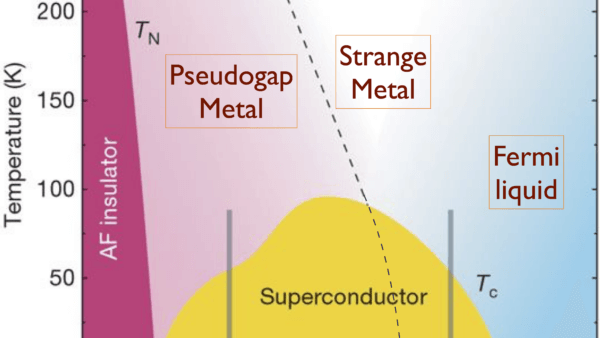
In the 2020-2021 academic year, the CMSA will be hosting a lecture series on Strongly Correlated Materials and High Tc Superconductor. All talks will take place from 10:30-12:00pm ET virtually on Zoom. Cuprate high-temperature superconductors are a classic quantum material system to demonstrate the beauty of “Emergence and Entanglement” in the quantum phases of matter. Merely by […]
Title: Naturalness and muon anomalous magnetic moment Abstract: We study a model for explaining the apparent deviation of the muon anomalous magnetic moment, (g-2), from the Standard Model expectation. There are no new scalars and hence no new hierarchy puzzles beyond those associated with the Standard model Higgs; the only new particles that are relevant […]
Abstract: Living matter relies on the self organization of its components into higher order structures, on the molecular as well as on the cellular, organ or even organism scale. Collective motion due to active transport processes has been shown to be a promising route for attributing fascinating order formation processes on these different length scales. […]
Title: Exotic quantum matter: From lattice gauge theory to hyperbolic lattices Abstract: This talk, in two parts, will discuss two (unrelated) instances of exotic quantum matter. In the first part, I will discuss quantum critical points describing possible transitions out of the Dirac spin liquid, towards either symmetry-breaking phases or topologically ordered spin liquids. I […]
During the 2021-22 academic year, the CMSA will be co-hosting a seminar on Swampland, with the Harvard Physics Department, organized by Miguel Montero, Cumrun Vafa, Irene Valenzuela. This seminar is a part of the Swampland Program. This seminar will take place on Mondays at 10:00 am – 11:30 am (Boston time). To learn how to attend, please subscribe here. Talks will […]
Abstract: Conifold transitions are important algebraic geometric constructions that have been of special interests in mirror symmetry, transforming Calabi-Yau 3-folds between A- and B-models. In this talk, I will discuss the change of the quintic del Pezzo 3-fold (Fano 3-fold of index 2 and degree 5) under the conifold transition at the level of the […]
Title: Cornering the universal shape of fluctuations and entanglement Abstract: Understanding the fluctuations of observables is one of the main goals in physics. We investigate such fluctuations when a subregion of the full system can be observed, focusing on geometries with corners. We report that the dependence on the opening angle is super-universal: up to […]
https://youtu.be/leONsS4LiV4 Speaker: JM Landsberg, Texas A&M Title: The complexity of matrix multiplication approached via algebraic geometry and representation theory Abstract: In 1968 V. Strassen discovered the way we usually multiply matrices is not the most efficient possible, and after considerable work by many authors, it is generally conjectured by computer scientists that as the size […]
Title: Quantum gravity from quantum matter Abstract: We present a model of quantum gravity in which dimension, topology and geometry of spacetime are collective dynamical variables that describe the pattern of entanglement of underlying quantum matter. As spacetimes with arbitrary dimensions can emerge, the gauge symmetry is generalized to a group that includes diffeomorphisms in […]
Title: Asymptotic localization, massive fields, and gravitational singularities Abstract: I will review three recent developments on Einstein’s field equations under low decay or low regularity conditions. First, the Seed-to-Solution Method for Einstein’s constraint equations, introduced in collaboration with T.-C. Nguyen generates asymptotically Euclidean manifolds with the weakest or strongest possible decay (infinite ADM mass, Schwarzschild […]
Member Seminar Speaker: Michael Simkin Title: Threshold phenomena in random graphs and hypergraphs Abstract: In 1959 Paul Erdos and Alfred Renyi introduced a model of random graphs that is the cornerstone of modern probabilistic combinatorics. Now known as the “Erdos-Renyi” model of random graphs it has far-reaching applications in combinatorics, computer science, and other fields. The […]
Title: More Exact Results in Gauge Theories: Confinement and Chiral Symmetry Breaking Abstract: In this follow-up to Hitoshi Murayama’s talk “Some Exact Results in QCD-like and Chiral Gauge Theories”, I present a detailed analysis of the phases of $SO(N_c)$ gauge theory. Starting with supersymmetric $SO(N_c)$ with $N_F$ flavors, we extrapolate to the non-supersymmetric limit using […]
Abstract: One can view a partial flag variety in C^n as an adjoint orbit inside the Lie algebra of n x n skew-Hermitian matrices. We use the orbit context to study the totally nonnegative part of a partial flag variety from an algebraic, geometric, and dynamical perspective. We classify gradient flows on adjoint orbits in […]
During the 2021–2022 academic year, the CMSA will host a program on the so-called “Swampland.” The Swampland program aims to determine which low-energy effective field theories are consistent with nonperturbative quantum gravity considerations. Not everything is possible in String Theory, and finding out what is and what is not strongly constrains the low energy physics. These constraints are naturally […]
Speaker: John Stout, Harvard University Title: Decoding Divergent Distances Abstract: Motivated by a relationship between the Zamolodchikov and NLSM metrics to the so-called quantum information metric, I will discuss recent work (2106.11313) on understanding infinite distance limits within the context of information theory. I will describe how infinite distance points represent theories that are hyper-distinguishable, in […]
Abstract: Calabi–Yau manifolds of a given dimension are connected by an intricate web of birational maps. This web has deep consequences for the derived categories of coherent sheaves on such manifolds, and for the associated string theories. In particular, for 4-folds and beyond, I will highlight certain simplices appearing in the web, and identify corresponding derived […]
During the 2021–22 academic year, the CMSA will be hosting a Colloquium, organized by Du Pei, Changji Xu, and Michael Simkin. It will take place on Wednesdays at 9:30am – 10:30am (Boston time). The meetings will take place virtually on Zoom. All CMSA postdocs/members are required to attend the weekly CMSA Members’ Seminars, as well as the weekly CMSA […]
Speaker: Tian Yang (Texas A&M University) Title: Hyperbolic Geometry and Quantum Invariants Abstract: There are two very different approaches to 3-dimensional topology, the hyperbolic geometry following the work of Thurston and the quantum invariants following the work of Jones and Witten. These two approaches are related by a sequence of problems called the Volume Conjectures. In this talk, I […]
https://youtu.be/3Nxe7J07TQY Speaker: Francois Chollet, Google Title: Why abstraction is the key to intelligence, and what we’re still missing Abstract: This talk provides a personal perspective on the way forward towards more human-like and more intelligent artificial systems. Traditionally, symbolic and probabilistic methods have dominated the domains of concept formation, abstraction, and automated reasoning. More recently, deep […]
Title: Three-particle mechanism for pairing and superconductivity Abstract: I will present a new mechanism and an exact theory of electron pairing due to repulsive interaction in doped insulators. When the kinetic energy is small, the dynamics of adjacent electrons on the lattice is strongly correlated. By developing a controlled kinetic energy expansion, I will show […]
Title: The Hilbert Space of large N Chern-Simons matter theories Abstract: We demonstrate that all known formulae for the thermal partition function for large N Chern Simons matter theory admit a simple Hilbert Space interpretation. In each case this quantity equals the partition function of an associated ungauged large $N$ matter theory with a particular […]
Title: Stable Big Bang formation for the Einstein equations Abstract: I will discuss recent work concerning stability of cosmological singularities described by the generalized Kasner solutions. There are heuristics in the mathematical physics literature, going back more than 50 years, suggesting that the Big Bang formation should be stable under perturbations of the Kasner initial data, as […]
Member Seminar Speaker: Itamar Shamir Title: Geometry, Entanglement and Quasi Local Data Abstract: I will review some general ideas about gravity as motivation for an approach based on quasi local quantities.
Title: Strong Coupling Theory of Magic-Angle Graphene: A Pedagogical Introduction Abstract: In this talk, I will review a recently developed strong coupling theory of magic-angle twisted bilayer graphene. An advantage of this approach is that a single formulation can capture both the insulating and superconducting states, and with a few simplifying assumptions, can be treated […]
Abstract: We construct supersymmetric AdS4 vacua of type IIB string theory in compactifications on orientifolds of Calabi-Yau threefold hypersurfaces. We first find explicit orientifolds and quantized fluxes for which the superpotential takes the form proposed by Kachru, Kallosh, Linde, and Trivedi. Given very mild assumptions on the numerical values of the Pfaffians, these compactifications admit […]
Abstract: Gromov-Witten invariants count pseudo-holomorphic curves on a symplectic manifold passing through some fixed points and submanifolds. Similarly, open Gromov-Witten invariants are supposed to count disks with boundary on a Lagrangian, but in most cases such counts are not independent of some choices as we would wish. Motivated by Fukaya’11, J. Solomon and S. Tukachinsky constructed […]
Title: Symmetry types in QFT and the CRT theorem Abstract: I will discuss ideas around symmetry and Wick rotation contained in joint work with Mike Hopkins (https://arxiv.org/abs/1604.06527). This includes general symmetry types for relativistic field theories and their Wick rotation. I will then indicate how the basic CRT theorem works for general symmetry types, focusing […]
Speaker: Michael Simkin, Harvard CMSA Title: The number of n-queens configurations Abstract: The n-queens problem is to determine Q(n), the number of ways to place n mutually non-threatening queens on an n x n board. The problem has a storied history and was studied by such eminent mathematicians as Gauss and Polya. The problem has also […]
Title: Applications of instantons, sphalerons and instanton-dyons in QCD Abstract: I start with a general map of gauge topology, including monopoles, instantons and instanton-dyons. Then comes reminder of the “topological landscape”, the minimal energy gauge field configurations, as a function of Chern-Simons number Ncs and r.m.s. size. It includes “valleys” at integer Ncs separated by […]
Abstract: I will begin by introducing an emerging paradigm of cellular organization – the dynamic compartmentalization of biochemical pathways and molecules by phase separation into distinct and multi-phase condensates. Motivated by this, I will discuss two largely orthogonal problems, united by the theme of phase separation in multi-component and chemically active fluid mixtures. 1. I will […]
Title: On the Observable Shape of Black Hole Photon Rings Abstract: The photon ring is a narrow ring-shaped feature, predicted by General Relativity but not yet observed, that appears on images of sources near a black hole. It is caused by extreme bending of light within a few Schwarzschild radii of the event horizon and […]
Member Seminar Speaker: Puskar Mondal Title: Stability and convergence issues in mathematical cosmology Abstract: The standard model of cosmology is built on the fact that while viewed on a sufficiently coarse-grained scale the portion of our universe that is accessible to observation appears to be spatially homogeneous and isotropic. Therefore this observed `homogeneity and isotropy’ of our […]
Abstract: In this talk I will introduce a particular formulation of the Weak Gravity Conjecture in AdS space in terms of the self-binding energy of a particle. The holographic CFT dual of this formulation corresponds to a certain convex-like structure for operators charged under continuous global symmetries. Motivated by this, we propose a conjecture that this […]
Title: The hypersimplex and the m=2 amplituhedron Abstract: I’ll discuss a curious correspondence between the m=2 amplituhedron, a 2k-dimensional subset of Gr(k, k+2), and the hypersimplex, an (n-1)-dimensional polytope in R^n. The amplituhedron and hypersimplex are both images of the totally nonnegative Grassmannian under some map (the amplituhedron map and the moment map, respectively), but […]
Abstract: I will present a four-term exact sequence relating the cohomology of a fibration to the cohomology of an open set obtained by removing the preimage of a general linear section of the base. This exact sequence respects three filtrations, the Hodge, weight, and perverse Leray filtrations, so that it is an exact sequence of mixed […]
Title: Oscillations in the thermal conductivity of a spin liquid* Abstract: The layered honeycomb magnet alpha-RuCl3 orders below 7 K in a zigzag phase in zero field. An in-plane magnetic field H||a suppresses the zigzag order at 7 Tesla, leaving a spin-disordered phase widely believed to be a quantum spin liquid (QSL) that extends to […]
https://youtu.be/ufG0YLj_sik Speaker: Adam Wagner, Tel Aviv University Title: Constructions in combinatorics via neural networks Abstract: Recently, significant progress has been made in the area of machine learning algorithms, and they have quickly become some of the most exciting tools in a scientist’s toolbox. In particular, recent advances in the field of reinforcement learning have led […]
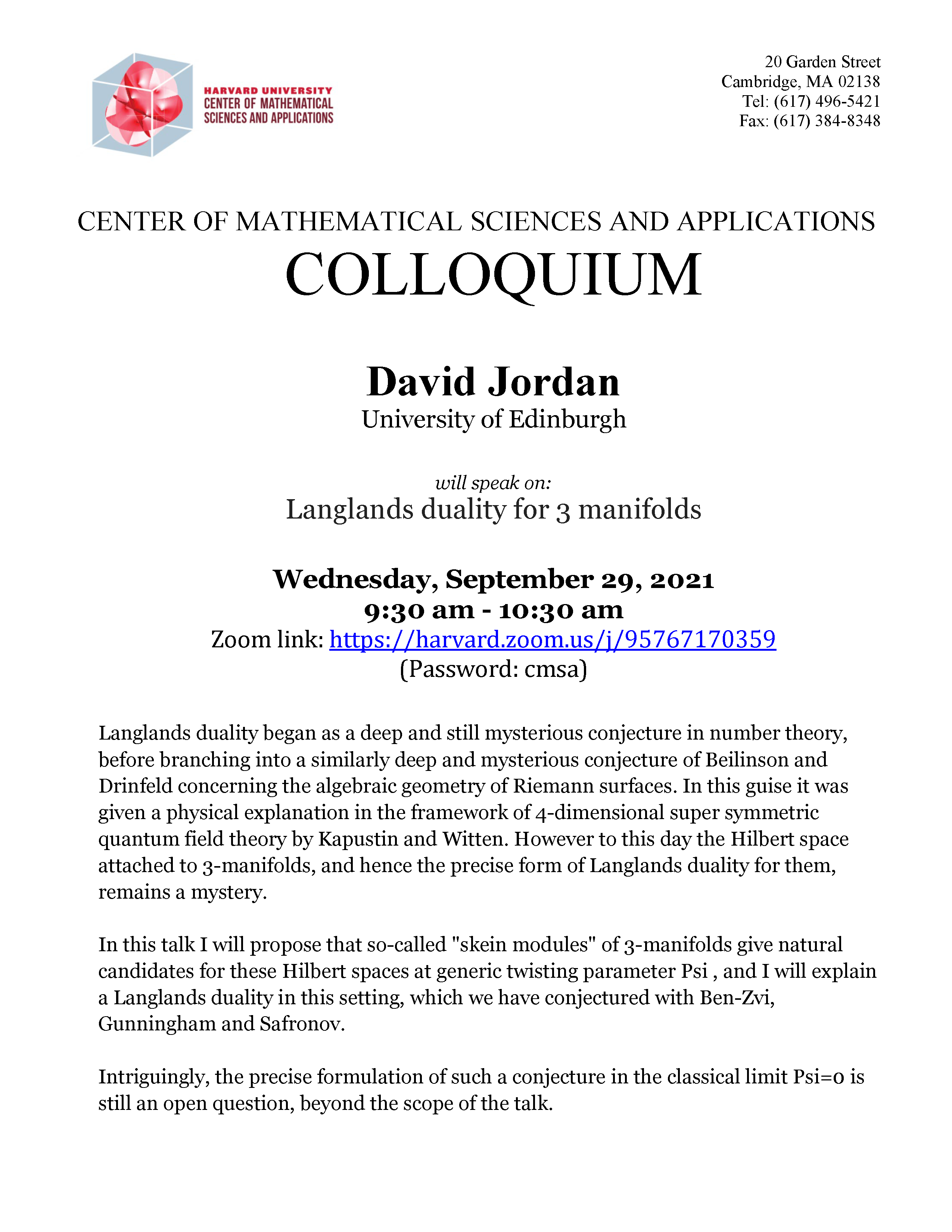
Speaker: David Jordan (U Edinburgh) Title: Langlands duality for 3 manifolds Abstract: Langlands duality began as a deep and still mysterious conjecture in number theory, before branching into a similarly deep and mysterious conjecture of Beilinson and Drinfeld concerning the algebraic geometry of Riemann surfaces. In this guise it was given a physical explanation in the framework of 4-dimensional super […]
Abstract: Life is a nonequilibrium phenomenon. Metabolism provides a continuous flux of energy that dictates the form and function of many subcellular structures. These subcellular structures are active materials, composed of molecules which use chemical energy to perform mechanical work and locally violate detailed balance. One of the most dramatic examples of such a self-organizing […]
Member Seminar Speaker: Jue Liu Title: Instability of naked singularities in general relativity Abstract: One of the fundamental problems in mathematical relativity is the weak cosmic censorship conjecture, proposed by Penrose, which roughly states that for generic physical spacetime, the singularities (if existed) must be hidden behind the black holes. Unfortunately, the singularities visible to faraway observers, […]
Abstract: The study of static vacuum Riemannian metrics arises naturally in differential geometry and general relativity. It plays an important role in scalar curvature deformation, as well as in constructing Einstein spacetimes. Existence of static vacuum Riemannian metrics with prescribed Bartnik data is one of the most fundamental problems in Riemannian geometry related to general relativity. […]