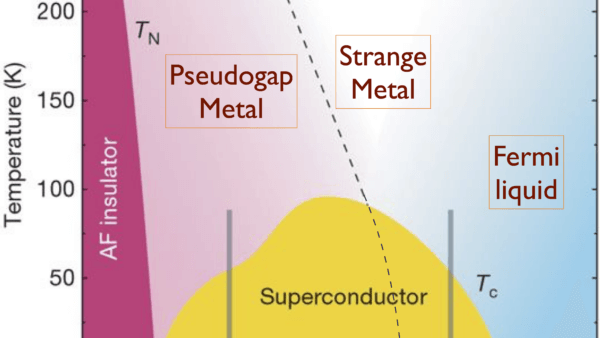
In the 2020-2021 academic year, the CMSA will be hosting a lecture series on Strongly Correlated Materials and High Tc Superconductor. All talks will take place from 10:30-12:00pm ET virtually on Zoom. Cuprate high-temperature superconductors are a classic quantum material system to demonstrate the beauty of “Emergence and Entanglement” in the quantum phases of matter. Merely by […]
During the 2021–2022 academic year, the CMSA will host a program on the so-called “Swampland.” The Swampland program aims to determine which low-energy effective field theories are consistent with nonperturbative quantum gravity considerations. Not everything is possible in String Theory, and finding out what is and what is not strongly constrains the low energy physics. These constraints are naturally […]
During the 2021–22 academic year, the CMSA will be hosting a Colloquium, organized by Du Pei, Changji Xu, and Michael Simkin. It will take place on Wednesdays at 9:30am – 10:30am (Boston time). The meetings will take place virtually on Zoom. All CMSA postdocs/members are required to attend the weekly CMSA Members’ Seminars, as well as the weekly CMSA […]
The methods of topology have been applied to condensed matter physics in the study of topological phases of matter. Topological states of matter are new quantum states that can be characterized by their topological properties. For example, the first topological states of matter discovered were the integer quantum Hall states. The two dimensional integer quantum […]
Speaker: Boyu Zhang, Princeton University Title: The smooth closing lemma for area-preserving surface diffeomorphisms Abstract: In this talk, I will introduce the smooth closing lemma for area-preserving diffeomorphisms on surfaces. The proof is based on a Weyl formula for PFH spectral invariants and a non-vanishing result of twisted Seiberg- Witten Floer homology. This is joint work […]
Member Seminar Speaker: Max Wiesner Title: Light strings, strong coupling, and the Swampland Abstract: In this talk, I will start by reviewing central ideas of the so-called Swampland Program. The Swampland Program aims to identify criteria that distinguish low-energy effective field theories, that can be consistently coupled to quantum gravity, from those theories that become inconsistent […]
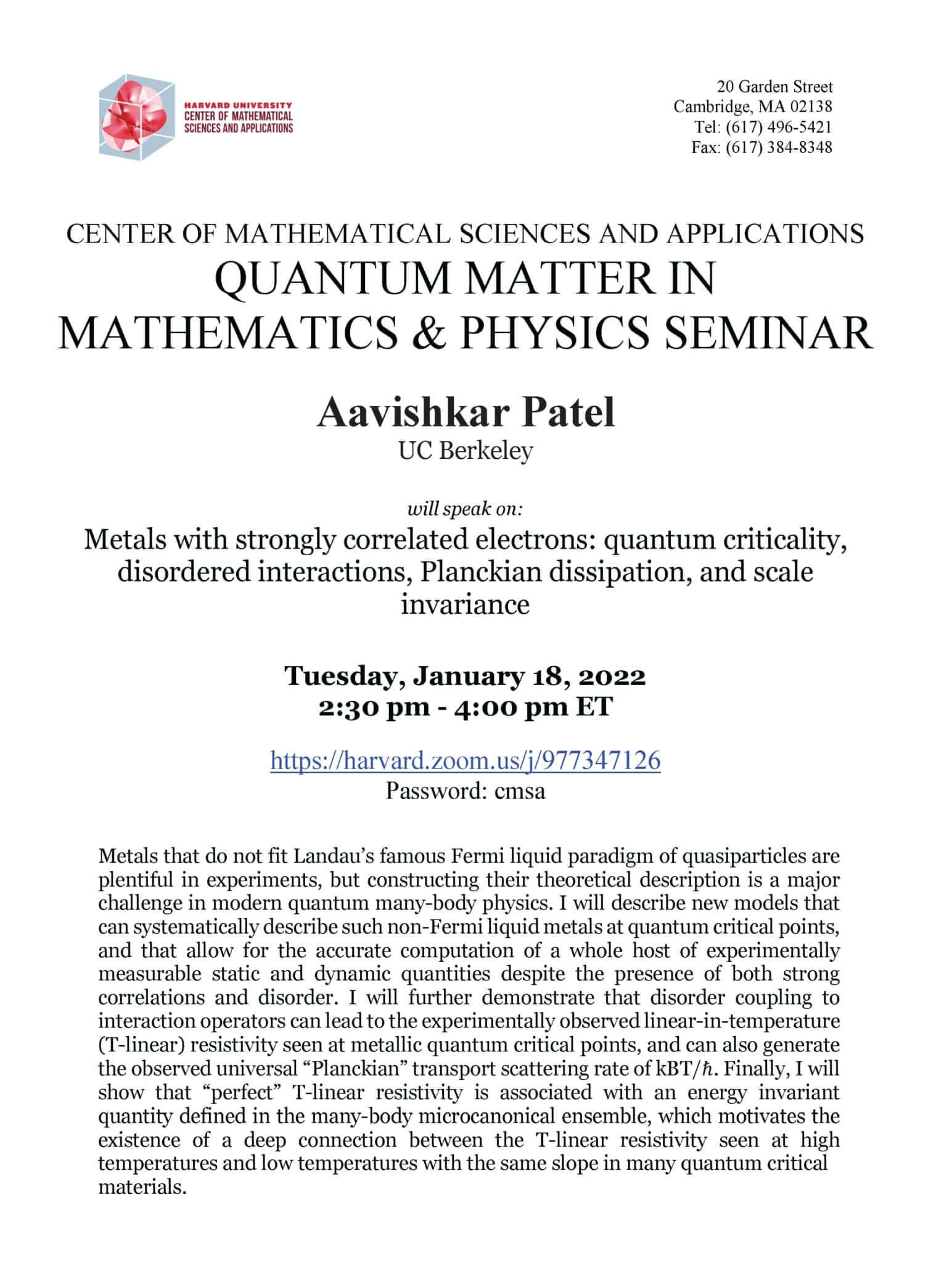
Speaker: Aavishkar Patel (UC Berkeley) Title: Metals with strongly correlated electrons: quantum criticality, disordered interactions, Planckian dissipation, and scale invariance Abstract: Metals that do not fit Landau’s famous Fermi liquid paradigm of quasiparticles are plentiful in experiments, but constructing their theoretical description is a major challenge in modern quantum many-body physics. I will describe new […]
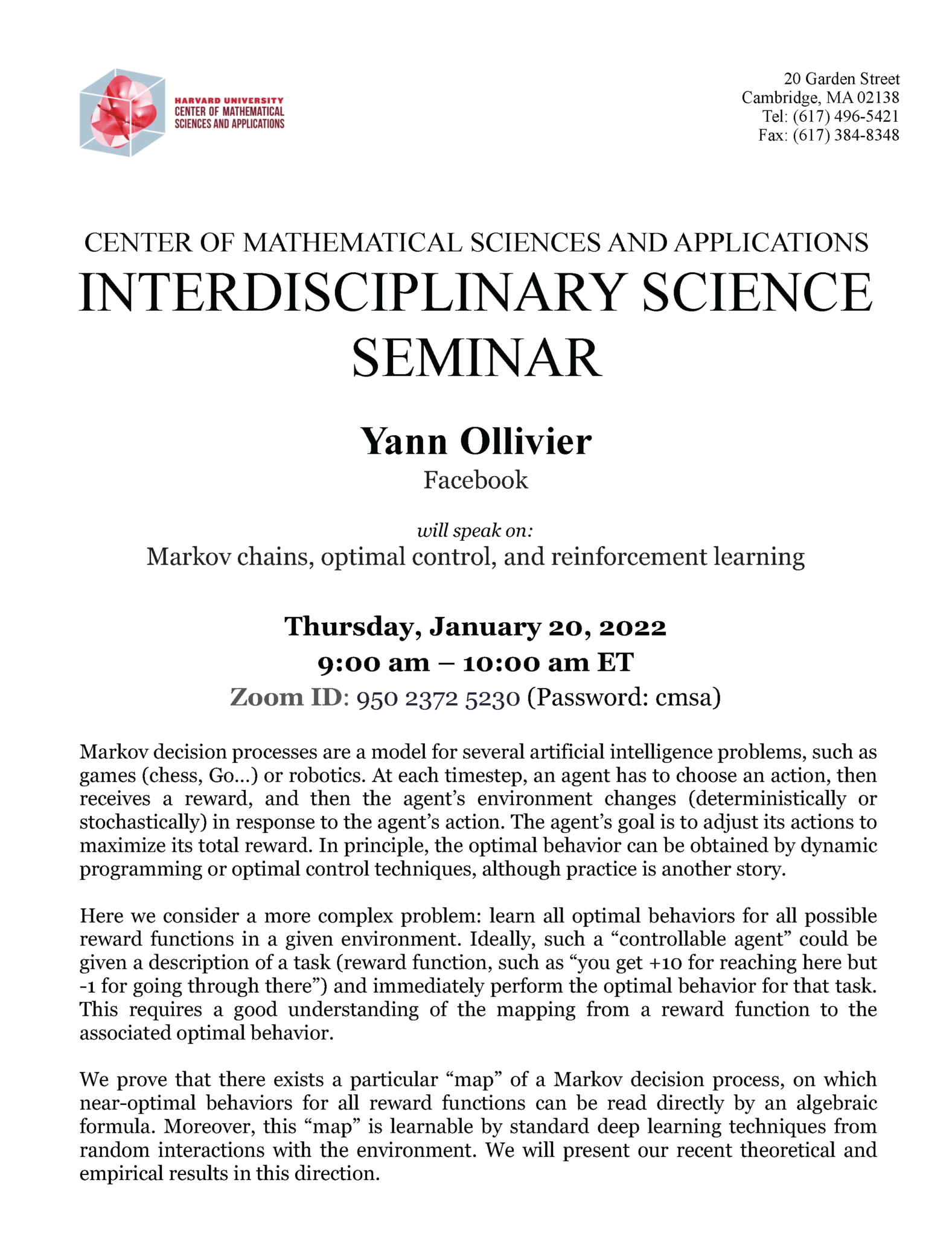
Title: Markov chains, optimal control, and reinforcement learning Abstract: Markov decision processes are a model for several artificial intelligence problems, such as games (chess, Go…) or robotics. At each timestep, an agent has to choose an action, then receives a reward, and then the agent’s environment changes (deterministically or stochastically) in response to the agent’s action. […]
Member Seminar Speaker: Daniel Junghans Title: AdS with Scale Separation Abstract: I will talk about Anti-de Sitter solutions in string theory with a parametric separation between the AdS curvature scale and the Kaluza-Klein scale. In particular, I will discuss recent progress on computing backreaction corrections in such solutions, and I will explain how to construct solutions without […]
During the Spring 2022 semester, the CMSA hosted a program on General Relativity. This semester-long program included four minicourses, a conference, and a workshop. General Relativity Mincourses: March–May, 2022 General Relativity Conference: April 4–8, 2022 General Relativity Workshop: May 2–5, 2022 Program Visitors Dan Lee, CMSA/CUNY, 1/24/22 – 5/20/22 Stefan Czimek, Brown, 2/27/22 – […]
Abstract: Recent years have seen tremendous advances in our understanding of perturbative quantum field theory—fueled largely by discoveries (and eventual explanations and exploitation) of shocking simplicity in the mathematical form of the predictions made for experiment. Among the most important frontiers in this progress is the understanding of loop amplitudes—their mathematical form, underlying geometric structure, and […]
During the 2021–22 academic year, the CMSA will be hosting a Colloquium, organized by Du Pei, Changji Xu, and Michael Simkin. It will take place on Wednesdays at 9:30am – 10:30am (Boston time). The meetings will take place virtually on Zoom. All CMSA postdocs/members are required to attend the weekly CMSA Members’ Seminars, as well as the weekly CMSA […]
Abstract: In this talk, I will survey the P=W conjecture, which describes certain structures of the cohomology of the moduli space of Higgs bundles on a curve in terms of the character variety of the curve. I will then explain how certain symmetries of this cohomology, which are predictions of this conjecture, can be constructed […]
Speaker: Samir Mathur (Ohio State University) Title: The black hole information paradox Abstract: In 1975, Stephen Hawking showed that black holes radiate away in a manner that violates quantum theory. Starting in 1997, it was observed that black holes in string theory did not have the form expected from general relativity: in place of “empty space will […]
Abstract: Fluids pervade complex systems, ranging from fish schools, to bacterial colonies and nanoparticles in drug delivery. Despite its importance, little is known about the role of fluid mechanics in such applications. Is schooling the result of vortex dynamics synthesized by individual fish wakes or the result of behavioral traits? Is fish schooling energetically favorable? I […]
Title: Polynomials vanishing at lattice points in convex sets Abstract: Let P be a convex subset of R^2. For large d, what is the smallest degree r_d of a polynomial vanishing at all lattice points in the dilate d*P? We show that r_d / d converges to some positive number, which we compute for many (but maybe not […]
Speaker: Bong Lian Title: Singular Calabi-Yau mirror symmetry Abstract: We will consider a class of Calabi-Yau varieties given by cyclic branched covers of a fixed semi Fano manifold. The first prototype example goes back to Euler, Gauss and Legendre, who considered 2-fold covers of P1 branched over 4 points. Two-fold covers of P2 branched over […]
Speaker: Maria Tikhanovskaya (Harvard) Title: Maximal quantum chaos of the critical Fermi surface Abstract: In this talk, I will describe many-body quantum chaos in a recently proposed large-N theory for critical Fermi surfaces in two spatial dimensions, by computing out-of-time-order correlation functions. I will use the ladder identity proposed by Gu and Kitaev, and show that the […]
Abstract: We will consider the following problem: if (C,x_1,…,x_n) is a fixed general pointed curve, and X is a fixed target variety with general points y_1,…,y_n, then how many maps f:C -> X in a given homology class are there, such that f(x_i)=y_i? When considered virtually in Gromov-Witten theory, the answer may be expressed in terms of […]
Speaker: Adam Smith (Boston University) Title: Learning and inference from sensitive data Abstract: Consider an agency holding a large database of sensitive personal information—say, medical records, census survey answers, web searches, or genetic data. The agency would like to discover and publicly release global characteristics of the data while protecting the privacy of individuals’ records. I will discuss recent (and not-so-recent) results on this problem with […]
https://youtu.be/7KMcXHwQzZs Speaker: Michael Bronstein, University of Oxford and Twitter Title: Neural diffusion PDEs, differential geometry, and graph neural networks Abstract: In this talk, I will make connections between Graph Neural Networks (GNNs) and non-Euclidean diffusion equations. I will show that drawing on methods from the domain of differential geometry, it is possible to provide a […]
Title: Kramers-Wannier-like duality defects in higher dimensions Abstract: I will introduce a class of non-invertible topological defects in (3 + 1)d gauge theories whose fusion rules are the higher-dimensional analogs of those of the Kramers-Wannier defect in the (1 + 1)d critical Ising model. As in the lower-dimensional case, the presence of such non-invertible defects implies self-duality […]
Abstract: The (tree) amplituhedron was introduced in 2013 by Arkani-Hamed and Trnka in their study of N=4 SYM scattering amplitudes. A central conjecture in the field was to prove that the m=4 amplituhedron is triangulated by the images of certain positroid cells, called the BCFW cells. In this talk I will describe a resolution of this conjecture. The […]
Abstract: In metals, orbital motions of conduction electrons are quantized in magnetic fields, which is manifested by quantum oscillations in electrical resistivity. This Landau quantization is generally absent in insulators, in which all the electrons are localized. Here we report a notable exception in an insulator — ytterbium dodecaboride (YbB12). The resistivity of YbB12, despite much […]
Speaker: Lu Li (U Michigan) Title: Quantum Oscillations of Electrical Resistivity in an Insulator Abstract: In metals, orbital motions of conduction electrons are quantized in magnetic fields, which is manifested by quantum oscillations in electrical resistivity. This Landau quantization is generally absent in insulators, in which all the electrons are localized. Here we report a notable exception […]
Member Seminar Speaker: Dan Lee Title: Survey on stability of the positive mass theorem Abstract: The Riemannian positive mass theorem states that a complete asymptotically flat manifold with nonnegative scalar curvature must have nonnegative ADM mass. This inequality comes with a rigidity statement that says that if the mass is zero, then the manifold must be Euclidean […]