AQFT Lecture Series Speaker: Omer Offen (Brandeis) Title: Period integrals of automorphic forms and the residue method Abstract: I will discuss some aspects of period integrals of automorphic forms via examples. In particular, the residue method of Jacquet and Rallis and its recent application, joint with Friedberg and Ginzburg, to study new periods on the […]

35 events found.
Colloquia & Seminar
Events
Calendar of Events
|
Monday
|
Tuesday
|
Wednesday
|
Thursday
|
Friday
|
Saturday
|
Sunday
|
|---|---|---|---|---|---|---|
2 events,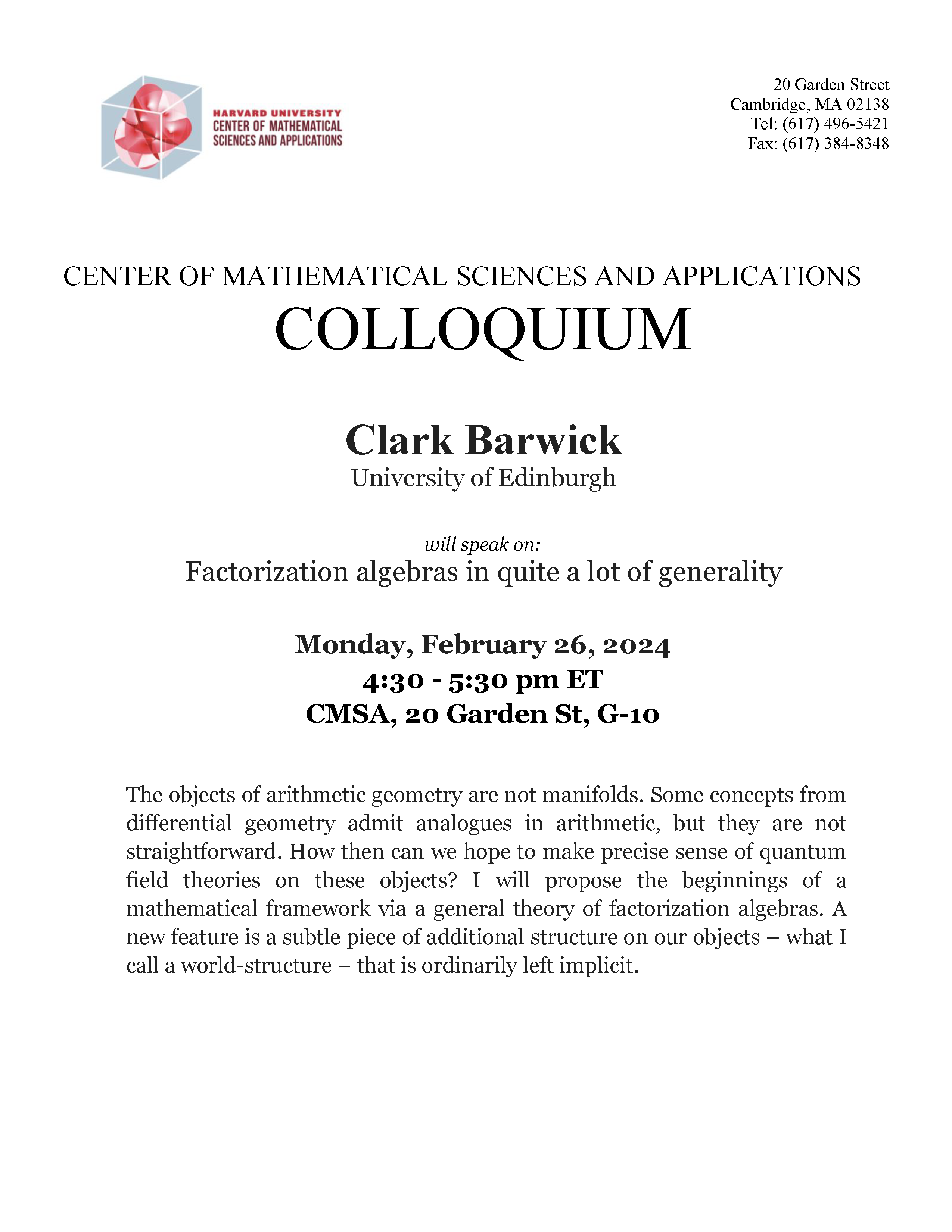
Colloquium Speaker: Clark Barwick, University of Edinburgh Title: Factorization algebras in quite a lot of generality Abstract: The objects of arithmetic geometry are not manifolds. Some concepts from differential geometry admit analogues in arithmetic, but they are not straightforward. How then can we hope to make precise sense of quantum field theories on these objects? […] |
3 events,AQFT Lecture Series Speaker: Wei Zhang (MIT) Title: Shtuka special cycles and their generating series |
0 events,
|
0 events,
|
2 events,AQFT Lecture Series Speaker: Chen Wan, Rutgers Newark Title: Some examples of the relative Langlands duality Abstract: In this talk I will discuss some examples of the relative Langlands duality (introduced by Ben-Zvi—Sakellaridis—Venkatesh) for strongly tempered spherical varieties. In some cases, I will introduce a relative trace formula comparison for the models and prove the […] 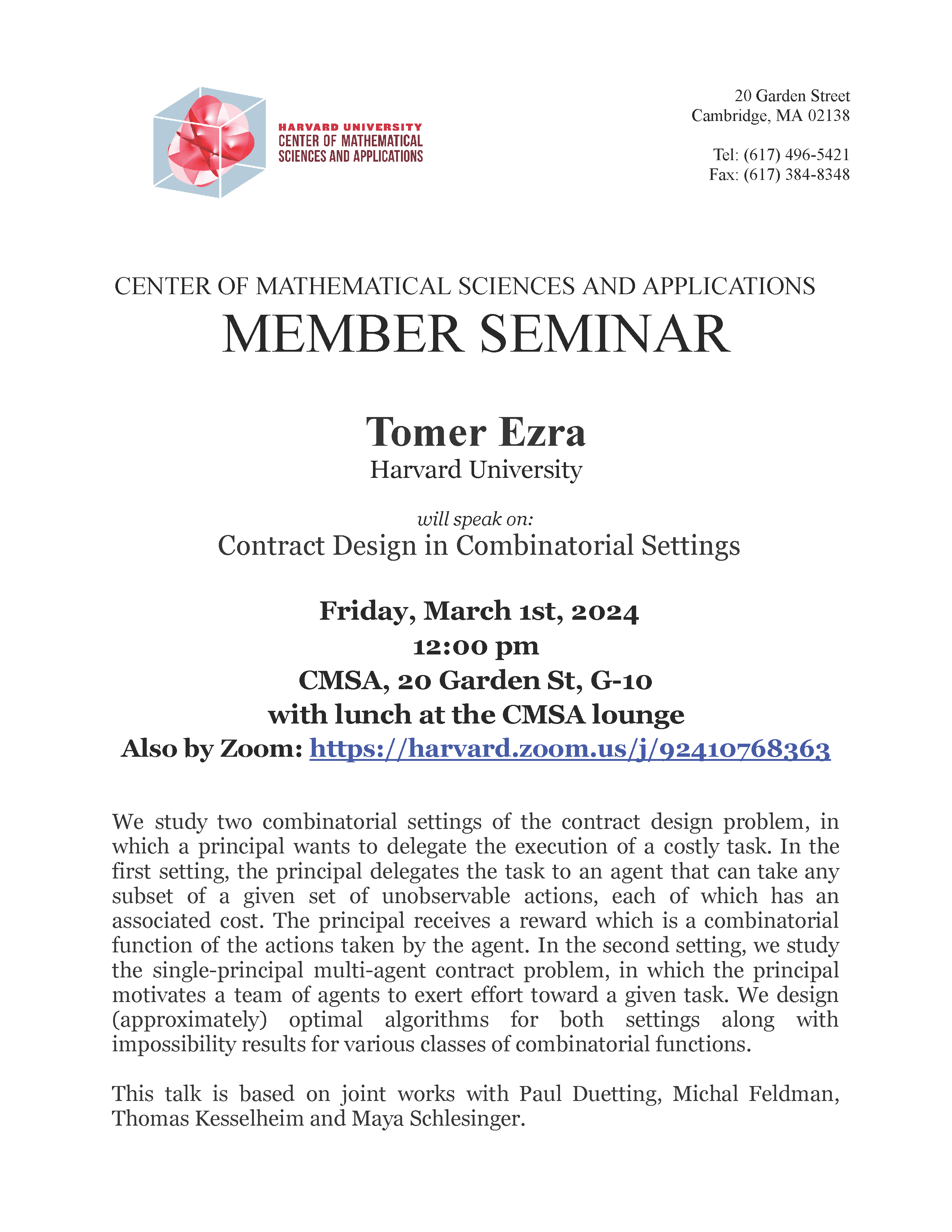
CMSA Member Seminar Speaker: Tomer Ezra (Harvard CMSA) Title: Contract Design in Combinatorial Settings Abstract: We study two combinatorial settings of the contract design problem, in which a principal wants to delegate the execution of a costly task. In the first setting, the principal delegates the task to an agent that can take any subset of a […] |
0 events,
|
0 events,
|
1 event,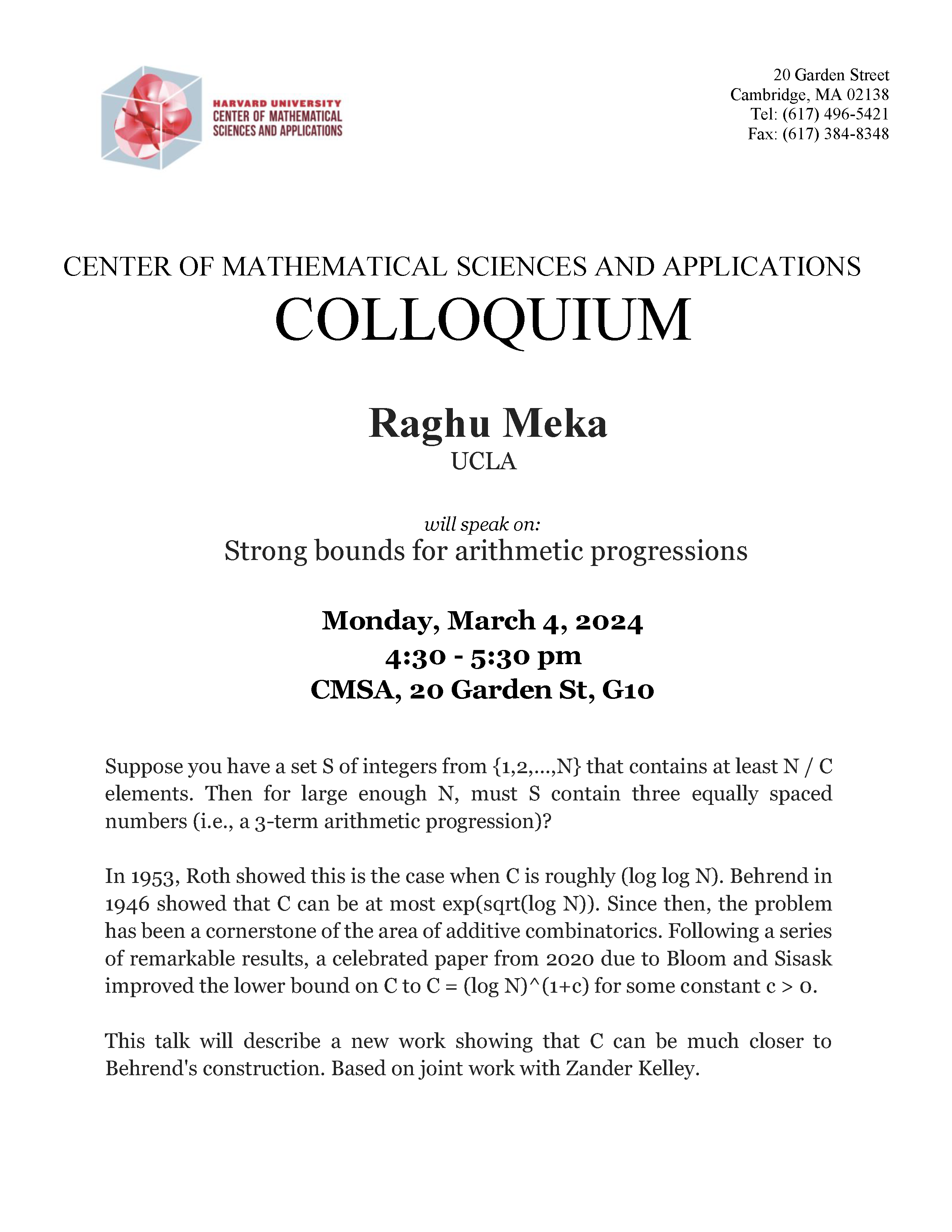
Colloquium Speaker: Raghu Meka (UCLA) Title: Strong bounds for arithmetic progressions Abstract: Suppose you have a set S of integers from {1,2,...,N} that contains at least N / C elements. Then for large enough N, must S contain three equally spaced numbers (i.e., a 3-term arithmetic progression)? In 1953, Roth showed this is the case […] |
2 events,CMSA Q&A Seminar Speaker: Yannai Gonczarowski, Harvard University Question: What do people mean when they say 'the intersection between theoretical computer science and economic theory'? |
1 event,
-
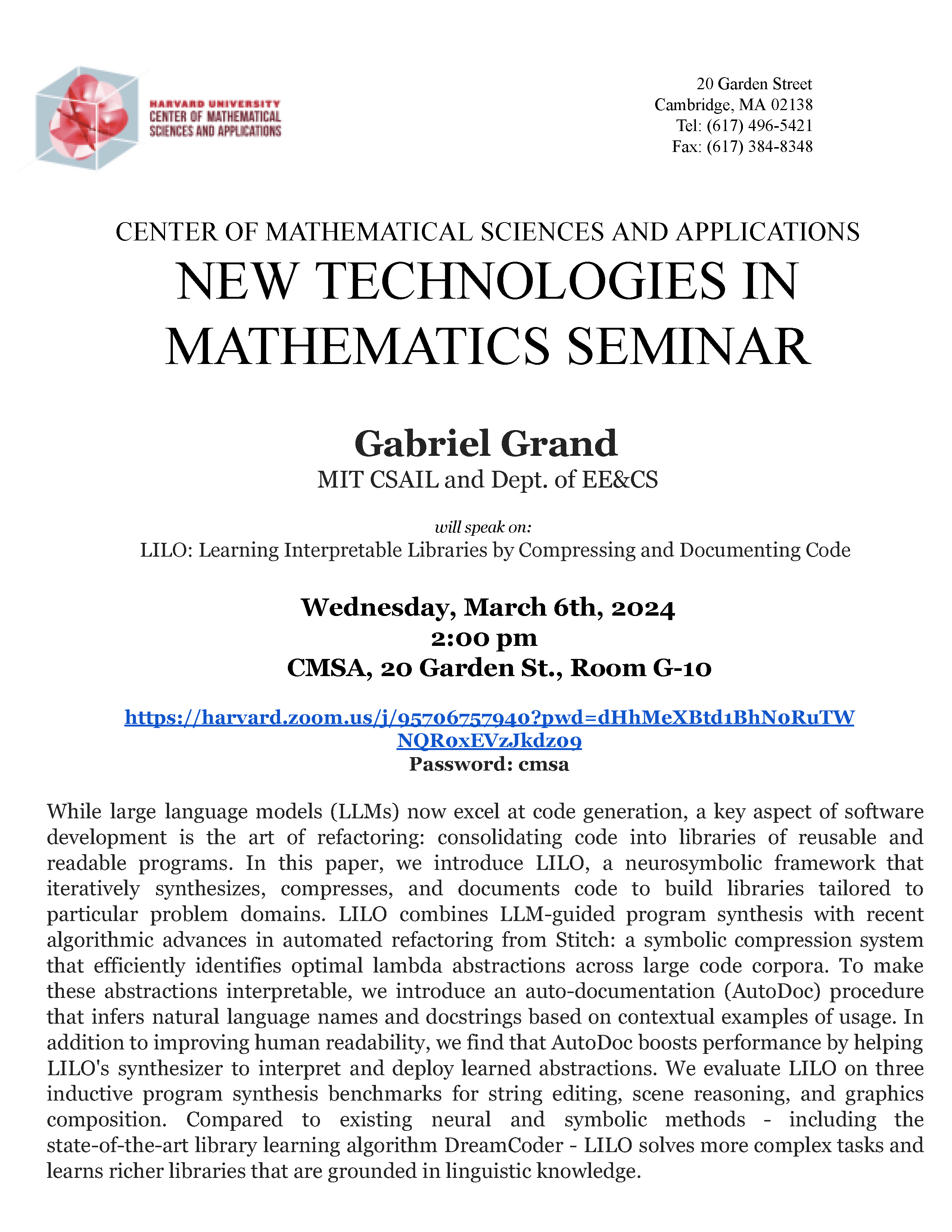
https://youtu.be/ZDMRN0Iyp28 New Technologies in Mathematics Seminar Speaker: Gabe Grand, MIT CSAIL and Dept. of EE&CS Title: LILO: Learning Interpretable Libraries by Compressing and Documenting Code Abstract: While large language models (LLMs) now excel at code generation, a key aspect of software development is the art of refactoring: consolidating code into libraries of reusable and readable programs. […] |
2 events,AQFT Lecture Series Speaker: An Huang (Brandeis) Title: Tate's thesis and p-adic strings Abstract: I shall explain the relation between a family of deformations of genus zero p-adic string worldsheet action and Tate's thesis, which in particular, gives rise to an attempt of physically deriving quadratic reciprocity. I shall then propose a genus one p-adic […] AQFT Lecture Series Speaker: John Francis (Northwestern) Title: Integrating braided categories over 3-manifolds Abstract: I’ll describe a form of factorization homology, which gives an invariant of framed 3-manifolds given as input a rigid braided-monoidal category with duals. More generally, the construction gives an invariant of framed n-manifolds from an E_{n-1}-monoidal category with duals. This construction relies […] |
2 events,
CMSA Member Seminar Speaker: Dan Freed (Harvard Mathematics and CMSA) Title: Symmetry in quantum field theory Abstract: In joint work with Greg Moore and Constantin Teleman we show how ideas and techniques in topological field theory apply to the study of symmetry in quantum field theory. I will discuss how this came about, beginning with […] AQFT Lecture Series Speaker: Dihua Jiang (U Minnesota) Title: Shalika Periods: Functoriality and Arithmetic Abstract: Shalika periods of automorphic forms were first used by H. Jacquet and J. Shalika (1990) in their construction of global zeta integrals for exterior square L-functions of GL(2n). They were also used by S. Friedberg and H. Jacquet (1993) in […] |
0 events,
|
0 events,
|
|
0 events,
|
0 events,
|
0 events,
|
0 events,
|
2 events,AQFT Lecture Series Speaker: Baiying Liu (Purdue) Title: Recent progress on certain problems related to local Arthur packets of classical groups Abstract: In this talk, I will introduce recent progress on certain problems related to local Arthur packets of classical groups. First, I will introduce a joint work with Freydoon Shahidi towards Jiang's conjecture on the wave […] AQFT Lecture Series Speaker: Tasho Kaletha (University of Michigan) Title: Covers of reductive groups and functoriality Abstract: When studying problems arising from Langlands' functoriality principle, one often encounters groups that are extensions of complex reductive groups by Galois groups, but that do not necessarily satisfy all properties to be L-groups of reductive groups. We will show, […] |
0 events,
|
0 events,
|
2 events,AQFT Lecture Series Speaker: Xinwen Zhu (Stanford) Title: The tame categorical local Langlands correspondence. Abstract: I will discuss a conjectural categorical form of the local Langlands correspondence for p-adic groups and establish the tame part of such correspondence (currently for unramified groups with connected center, and for Q_l-coefficients). I will also explain how to extract a […] 
Colloquium Speaker: Natalie Paquette, University of Washington Title: Koszul duality & twisted holography for asymptotically flat spacetimes Abstract: Koszul duality has been understood in recent years to characterize order-type defects in twists of supersymmetric field theories. This notion has been generalized, from a physical point of view, by studying couplings between D-branes and closed string […] |
1 event,CMSA Q and A Seminar Speaker: Arthur Jaffe, Harvard University Question: What is mathematical picture language? |
2 events,AQFT Lecture Series Speaker: Stephen D. Miller (Rutgers University) Title: What 4-graviton scattering amplitudes had to say about the unitary dual Abstract: I'll give an update on the problem of describing all unitary representations of a Lie group, including joint work with Michael Green and Pierre Vanhove that used intuition from string theory to show […]
-
https://youtu.be/eZbYSOpga2U New Technologies in Mathematics Seminar Speaker: Trieu H. Trinh, Google Deepmind and NYU Dept. of Computer Science Title: Solving olympiad geometry without human demonstrations Abstract: Proving mathematical theorems at the olympiad level represents a notable milestone in human-level automated reasoning, owing to their reputed difficulty among the world’s best talents in pre-university mathematics. Current […] |
1 event,AQFT Lecture Series Speaker: Ezra Getzler (Northwestern) Title: Flat connections on derived stacks and the Gauss-Manin connection in derived algebraic geometry |
2 events,
CMSA Member Seminar Speaker: Chuck Doran (Harvard CMSA) Title: Modularity and Fibrations in Mirror Symmetry Abstract: We will introduce appearances of modularity in the study both of families of Calabi-Yau threefolds and of their enumerative invariants. An important role is played by the structure of fibrations and the DHT fibration-degeneration mirror correspondence, which clarifies how these notions […] AQFT Lecture Series Speaker: Jayce Getz (Duke University) Title: The Poisson summation conjecture and the fiber bundle method Abstract: The Poisson summation conjecture of Braverman-Kazhdan, L. Lafforgue, Ngo, and Sakellaridis predicts that spherical varieties over a global field admit Schwartz spaces, Fourier transforms, and a generalized Poisson summation formula. In this talk I will state a rough form […] |
0 events,
|
0 events,
|
|
0 events,
|
0 events,
|
0 events,
|
0 events,
|
0 events,
|
0 events,
|
0 events,
|