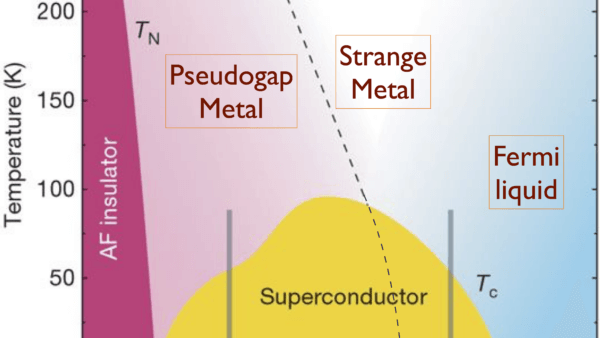
In the 2020-2021 academic year, the CMSA will be hosting a lecture series on Strongly Correlated Materials and High Tc Superconductor. All talks will take place from 10:30-12:00pm ET virtually on Zoom. Cuprate high-temperature superconductors are a classic quantum material system to demonstrate the beauty of “Emergence and Entanglement” in the quantum phases of matter. Merely by […]
During the 2021–2022 academic year, the CMSA will host a program on the so-called “Swampland.” The Swampland program aims to determine which low-energy effective field theories are consistent with nonperturbative quantum gravity considerations. Not everything is possible in String Theory, and finding out what is and what is not strongly constrains the low energy physics. These constraints are naturally […]
During the 2021–22 academic year, the CMSA will be hosting a Colloquium, organized by Du Pei, Changji Xu, and Michael Simkin. It will take place on Wednesdays at 9:30am – 10:30am (Boston time). The meetings will take place virtually on Zoom. All CMSA postdocs/members are required to attend the weekly CMSA Members’ Seminars, as well as the weekly CMSA […]
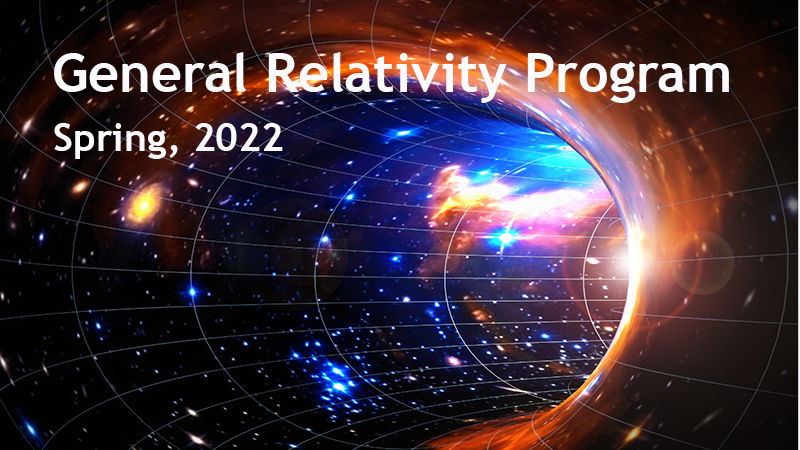
During the Spring 2022 semester, the CMSA hosted a program on General Relativity. This semester-long program included four minicourses, a conference, and a workshop. General Relativity Mincourses: March–May, 2022 General Relativity Conference: April 4–8, 2022 General Relativity Workshop: May 2–5, 2022 Program Visitors Dan Lee, CMSA/CUNY, 1/24/22 – 5/20/22 Stefan Czimek, Brown, 2/27/22 – […]
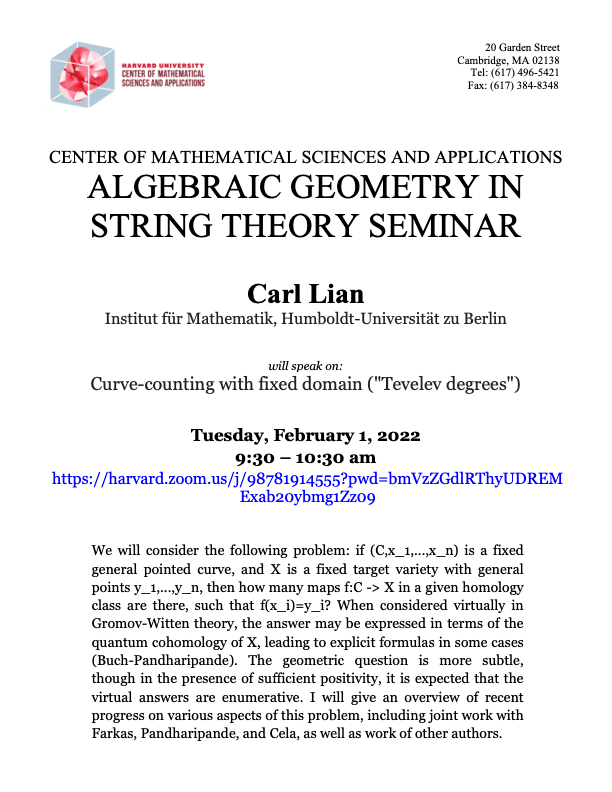
Abstract: We will consider the following problem: if (C,x_1,…,x_n) is a fixed general pointed curve, and X is a fixed target variety with general points y_1,…,y_n, then how many maps f:C -> X in a given homology class are there, such that f(x_i)=y_i? When considered virtually in Gromov-Witten theory, the answer may be expressed in terms of […]
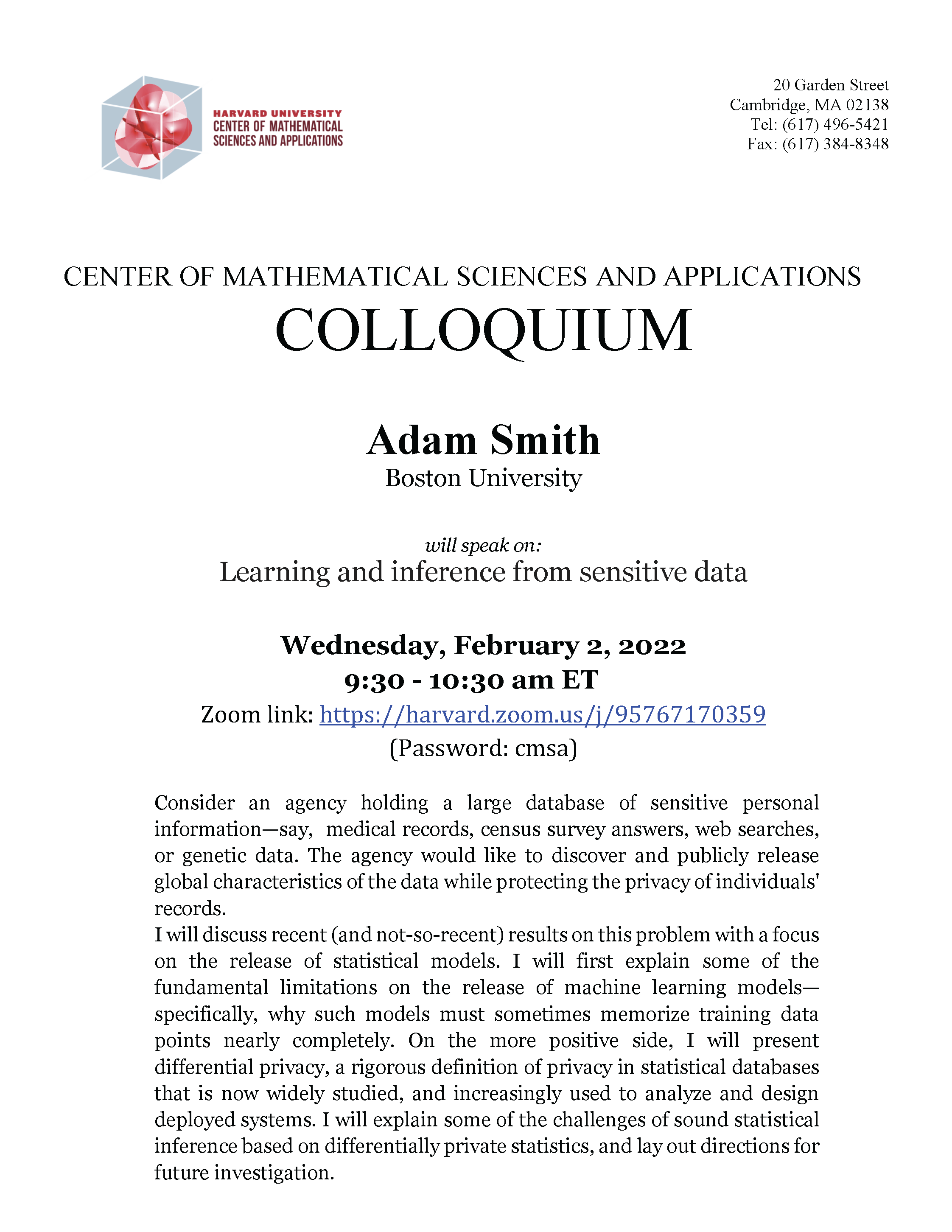
Speaker: Adam Smith (Boston University) Title: Learning and inference from sensitive data Abstract: Consider an agency holding a large database of sensitive personal information—say, medical records, census survey answers, web searches, or genetic data. The agency would like to discover and publicly release global characteristics of the data while protecting the privacy of individuals’ records. I will discuss recent (and not-so-recent) results on this problem with […]
https://youtu.be/7KMcXHwQzZs Speaker: Michael Bronstein, University of Oxford and Twitter Title: Neural diffusion PDEs, differential geometry, and graph neural networks Abstract: In this talk, I will make connections between Graph Neural Networks (GNNs) and non-Euclidean diffusion equations. I will show that drawing on methods from the domain of differential geometry, it is possible to provide a […]
Title: Kramers-Wannier-like duality defects in higher dimensions Abstract: I will introduce a class of non-invertible topological defects in (3 + 1)d gauge theories whose fusion rules are the higher-dimensional analogs of those of the Kramers-Wannier defect in the (1 + 1)d critical Ising model. As in the lower-dimensional case, the presence of such non-invertible defects implies self-duality […]
Abstract: The (tree) amplituhedron was introduced in 2013 by Arkani-Hamed and Trnka in their study of N=4 SYM scattering amplitudes. A central conjecture in the field was to prove that the m=4 amplituhedron is triangulated by the images of certain positroid cells, called the BCFW cells. In this talk I will describe a resolution of this conjecture. The […]
Abstract: In metals, orbital motions of conduction electrons are quantized in magnetic fields, which is manifested by quantum oscillations in electrical resistivity. This Landau quantization is generally absent in insulators, in which all the electrons are localized. Here we report a notable exception in an insulator — ytterbium dodecaboride (YbB12). The resistivity of YbB12, despite much […]
Speaker: Lu Li (U Michigan) Title: Quantum Oscillations of Electrical Resistivity in an Insulator Abstract: In metals, orbital motions of conduction electrons are quantized in magnetic fields, which is manifested by quantum oscillations in electrical resistivity. This Landau quantization is generally absent in insulators, in which all the electrons are localized. Here we report a notable exception […]
Member Seminar Speaker: Dan Lee Title: Survey on stability of the positive mass theorem Abstract: The Riemannian positive mass theorem states that a complete asymptotically flat manifold with nonnegative scalar curvature must have nonnegative ADM mass. This inequality comes with a rigidity statement that says that if the mass is zero, then the manifold must be Euclidean […]
Abstract: The theory of topological modular forms leads to many interesting constraints and predictions for two-dimensional quantum field theories, and some of them might have interesting implications for the swampland program. In this talk, I will show that a conjecture by Segal, Stolz and Teichner requires the constant term of the partition function of a bosonic holomorphic […]
Abstract: I will talk about work to uncover connections between invariant theory and maximum likelihood estimation. I will describe how norm minimization over a torus orbit is equivalent to maximum likelihood estimation in log-linear models. We will see the role played by polytopes and discuss connections to scaling algorithms. Based on joint work with Carlos […]
Abstract: Strominger-Yau-Zaslow conjecture is one of the guiding principles in mirror symmetry, which not only predicts the geometric structures of Calabi-Yau manifolds but also provides a recipe for mirror construction. Besides mirror symmetry, the SYZ conjecture itself is the holy grail in geometrical analysis and closely related to the behavior of the Ricci-flat metrics. In this talk, […]
During the 2021–22 academic year, the CMSA will be hosting a Colloquium, organized by Du Pei, Changji Xu, and Michael Simkin. It will take place on Wednesdays at 9:30am – 10:30am (Boston time). The meetings will take place virtually on Zoom. All CMSA postdocs/members are required to attend the weekly CMSA Members’ Seminars, as well as the weekly CMSA […]
Abstract: There are several properties of closed geodesics which are proven using its Hamiltonian formulation, which has no analogue for minimal surfaces. I will talk about some recent progress in proving some of these properties for minimal surfaces.
https://youtu.be/MSw8HV0eHo8 Speaker: Ben Edelman, Harvard Computer Science Title: Toward Demystifying Transformers and Attention Abstract: Over the past several years, attention mechanisms (primarily in the form of the Transformer architecture) have revolutionized deep learning, leading to advances in natural language processing, computer vision, code synthesis, protein structure prediction, and beyond. Attention has a remarkable ability to enable the […]
Speaker: Yuji Tachikawa (Kavli IPMU, U Tokyo) Title: On the absence of global anomalies of heterotic string theories Abstract: Superstring theory as we know it started from the discovery by Green and Schwarz in 1984 that the perturbative anomalies of heterotic strings miraculously cancel. But the cancellation of global anomalies of heterotic strings remained an open […]
Speaker: Mohamed Anber (Durham University) Title: The global structure of the Standard Model and new nonperturbative processes Abstract: It is well-established that the Standard Model (SM) of particle physics is based on su(3)Xsu(2)Xu(1) Lie-algebra. What is less appreciated, however, is that SM accommodates a Z_6 1-form global symmetry. Gauging this symmetry, or a subgroup of it, changes […]
Abstract: To characterise scalar curvature, Gromov proposed the dihedral rigidity conjecture which states that a positively curved polyhedron having dihedral angles less than those of a corresponding flat polyhedron should be isometric to a flat one. In this talk, we will discuss some recent progress on this conjecture and its connection with general relativity (ADM mass […]
Abstract: My lab is interested in the active and adaptive materials that underlie control of cell shape. This has centered around understanding force transmission and sensing within the actin cytoskeleton. I will first review our current understanding of the types of active matter that can be constructed by actin polymers. I will then turn to our […]
Member Seminar Speaker: Matteo Parisi Title: Amplituhedra, Scattering Amplitudes and Triangulations Abstract: In this talk I will discuss about Amplituhedra – generalizations of polytopes inside the Grassmannian – recently introduced by physicists as new geometric constructions encoding interactions of elementary particles in certain Quantum Field Theories. In particular, I will explain how the problem of finding […]
Abstract: In 1973, Lemmens and Seidel asked to determine N_alpha(r), the maximum number of equiangular lines in R^r with common angle arccos(alpha). Recently, this problem has been almost completely settled when r is exponentially large relative to 1/alpha, with the approach both relying on Ramsey’s theorem, as well as being limited by it. In this talk, […]
Abstract: In this talk, I will introduce a virtual variant of the quantized Coulomb branch constructed by Braverman-Finkelberg-Nakajima, where the convolution product is modified by a virtual intersection. The resulting virtual Coulomb branch acts on the moduli space of quasimaps into the holomorphic symplectic quotient T^*N//G. When G is abelian, over the torus fixed points, this […]
Speaker: Takuro Mochizuki (Kyoto University) Title: Kobayashi-Hitchin correspondences for harmonic bundles and monopoles Abstract: In 1960's, Narasimhan and Seshadri discovered the equivalence between irreducible unitary flat bundles and stable bundles of degree $0$ on compact Riemann surfaces. In 1980's, Donaldson, Uhlenbeck and Yau generalized it to the equivalence between irreducible Hermitian-Einstein bundles and stable bundles on smooth […]
Speaker: Petr Hořava (UC Berkeley) Title: Topological Quantum Gravity and the Ricci Flow – Part I Abstract: In this sequence of talks, I will describe our work with Alexander Frenkel and Stephen Randall, in which we presented a novel topological quantum gravity, relating three previously unrelated fields: Topological quantum field theories (of the cohomological type), the […]
https://youtu.be/updzX0XPYU4 Speaker: James Bonifacio, Cambridge DAMTP Title: Bootstrapping hyperbolic manifolds Abstract: Hyperbolic manifolds are a class of Riemannian manifolds that are important in mathematics and physics, playing a prominent role in topology, number theory, and string theory. Associated with a given hyperbolic metric is a sequence of numbers corresponding to the discrete eigenvalues of the […]
This is the Fall 2020 - Spring 2022 Quantum Matter in Mathematics and Physics Archive page. To view current seminars, please visit the Fall 2022-Spring 2023 Quantum Matter Seminar Page As part of the program on Quantum Matter in Mathematics and Physics, the CMSA hosted two weekly seminars. The Quantum Matter/Quantum Field Theory seminar took place […]
Speaker: Andrea Grigoletto (SISSA & INFN) Title: Spin-cobordisms, surgeries and fermionic modular bootstrap Abstract: ‘tHooft anomalies of anomalous systems can be described via anomaly inflow by invertible theories living in one dimension higher. Thanks to this it is possible to provide a general method to determine modular transformations of anomalous 2d fermionic CFTs with general discrete symmetry […]
Abstract: I demonstrate that black hole dynamics simplifies – without trivializing – in the limit in which the number of spacetime dimensions D in which the black holes live is taken to infinity. In the strict large D limit and under certain conditions I show the equations that govern black hole dynamics reduce to the equations describing the dynamics of a non gravitational membrane propagating in an unperturbed spacetime (e.g. flat space). In the stationary […]
Member Seminar Speaker:An Huang Title: Quadratic reciprocity from a family of adelic conformal field theories Abstract: This talk aims to provide a physics framework to understand quadratic reciprocity. Specifically, we consider a deformation of the two-dimensional free scalar field theory by raising the Laplacian to a positive real power. It turns out that the resulting non-local […]
Abstract: We construct a certain type of Gauged Linear Sigma Model quasimap invariants that generalize the original ones and are easier to compute. Higgs-Coulomb correspondence provides identification of generating functions of our invariants with certain analytic functions that can be represented as generalized inverse Mellin transforms. Analytic continuation of these functions provides wall-crossing results for GLSM […]
Speaker: Bartek Czech, Tsinghua University Title: Holographic Cone of Average Entropies and Universality of Black Holes Abstract: In the AdS/CFT correspondence, the holographic entropy cone, which identifies von Neumann entropies of CFT regions that are consistent with a semiclassical bulk dual, is currently known only up to n=5 regions. I explain that average entropies of p-partite subsystems can […]
Abstract: In this sequence of talks, I will describe our work with Alexander Frenkel and Stephen Randall, in which we presented a novel topological quantum gravity, relating three previously unrelated fields: Topological quantum field theories (of the cohomological type), the theory of Ricci flows on Riemannian manifolds, and nonrelativistic quantum gravity. The remarkable richness of […]
Abstract: I will report on a project which aims to encode the DT invariants of a CY3 triangulated category in a geometric structure on its stability space. I will focus on a class of categories whose stability spaces were studied in previous joint work with Ivan Smith, and which correspond in physics to theories of class […]
Abstract: The spontaneous emergence of collective flows is a generic property of active fluids and often leads to chaotic flow patterns characterized by swirls, jets, and topological disclinations in their orientation field. I will first discuss two examples of these collective features helping us understand biological processes: (i) to explain the tortoise & hare story in bacterial competition: […]
https://youtu.be/USKZjJ8_LI0 Speaker: Achilleas Porfyriadis, Harvard Black Hole Initiative Title: Extreme Black Holes: Anabasis and Accidental Symmetry Abstract: The near-horizon region of black holes near extremality is universally AdS_2-like. In this talk I will concentrate on the simplest example of AdS_2 x S^2 as the near-horizon of (near-)extreme Reissner-Nordstrom. I will first explain the SL(2)transformation properties of the spherically […]
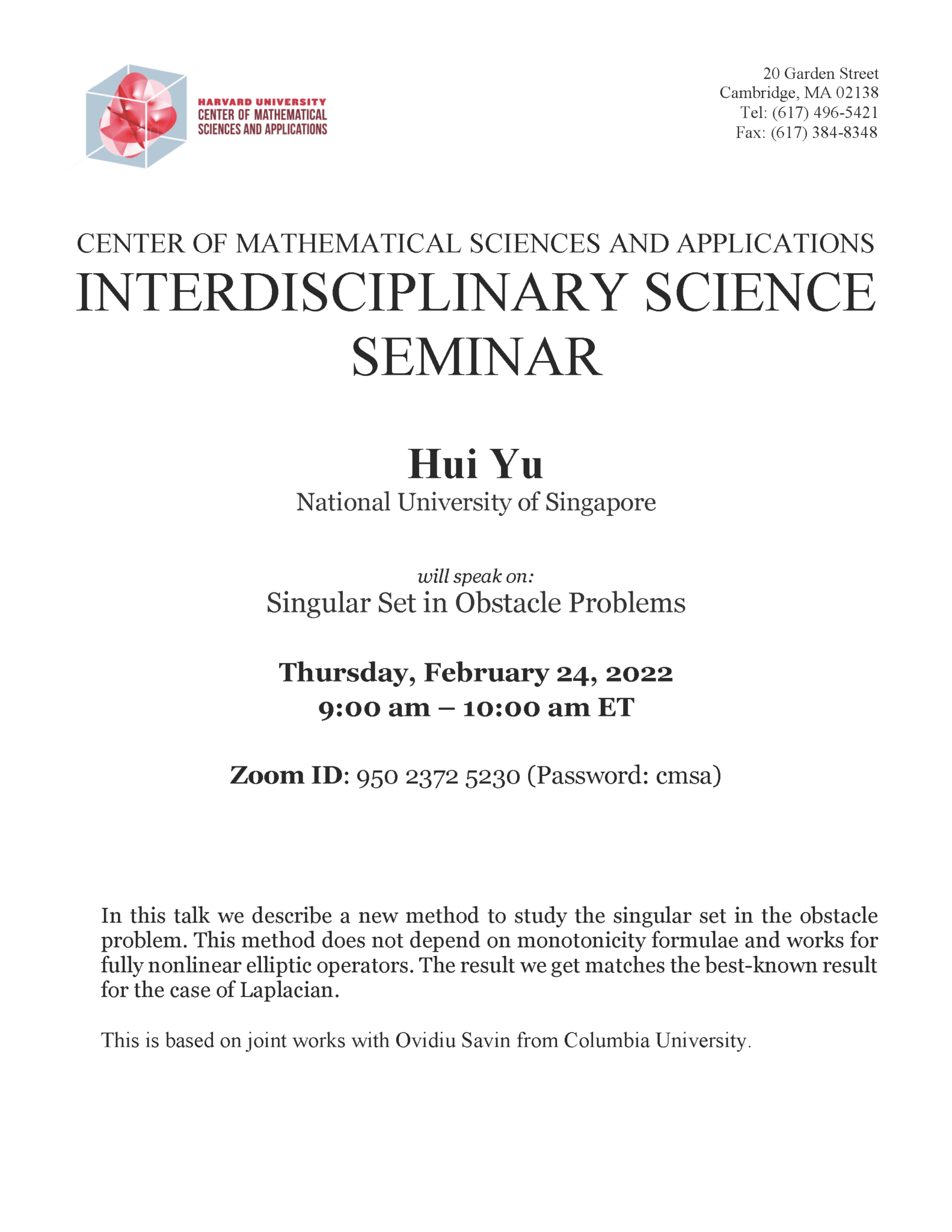
Abstract: In this talk we describe a new method to study the singular set in the obstacle problem. This method does not depend on monotonicity formulae and works for fully nonlinear elliptic operators. The result we get matches the best-known result for the case of Laplacian.
Minicourses General Relativity Program Minicourses During the Spring 2022 semester, the CMSA hosted a program on General Relativity. This semester-long program included four minicourses running in March, April, and May; a conference April 4–8, 2022; and a workshop from May 2–5, 2022. Schedule Speaker Title Abstract March 1 – 3, 2022 10:00 am – […]
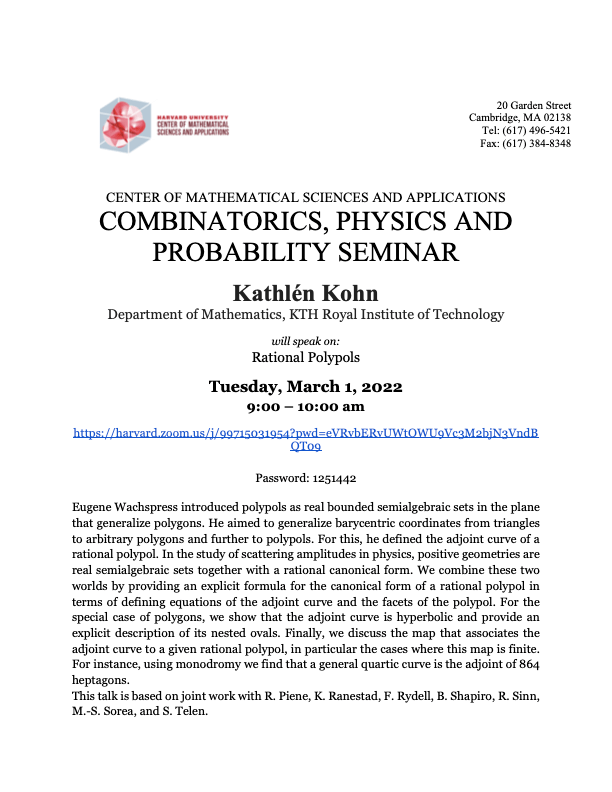
Abstract: Eugene Wachspress introduced polypols as real bounded semialgebraic sets in the plane that generalize polygons. He aimed to generalize barycentric coordinates from triangles to arbitrary polygons and further to polypols. For this, he defined the adjoint curve of a rational polypol. In the study of scattering amplitudes in physics, positive geometries are real semialgebraic […]
Abstract: This is a report about work in progress with: Adeel Khan, Aloysha Latyntsev, Hyeonjun Park and Charanya Ravi. We will describe a virtual Atiyah-Bott formula for Artin stacks. In the Deligne-Mumford case our methods allow us to remove the global resolution hypothesis for the virtual normal bundle.
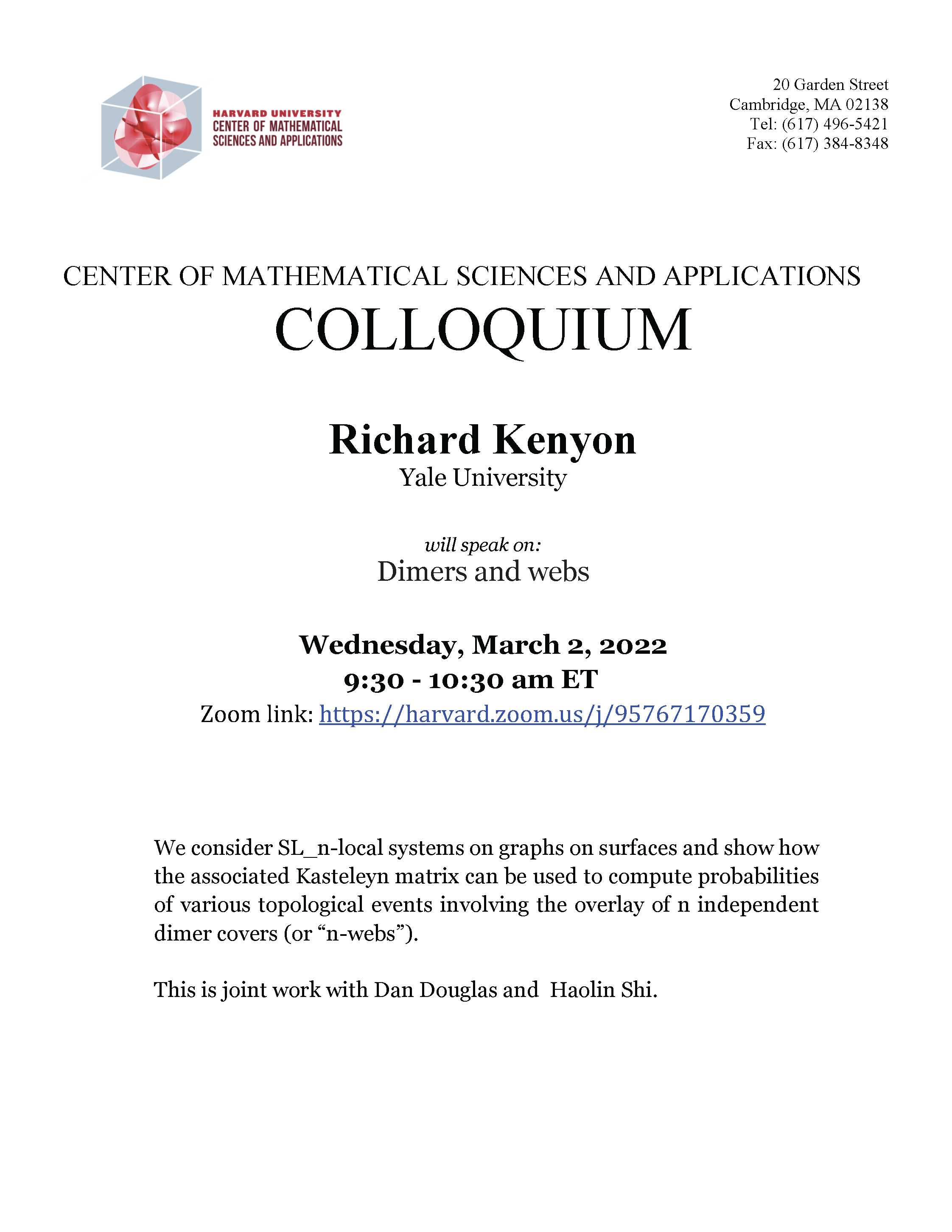
Speaker: Richard Kenyon (Yale) Title: Dimers and webs Abstract: We consider SL_n-local systems on graphs on surfaces and show how the associated Kasteleyn matrix can be used to compute probabilities of various topological events involving the overlay of n independent dimer covers (or “n-webs”). This is joint work with Dan Douglas and Haolin Shi.
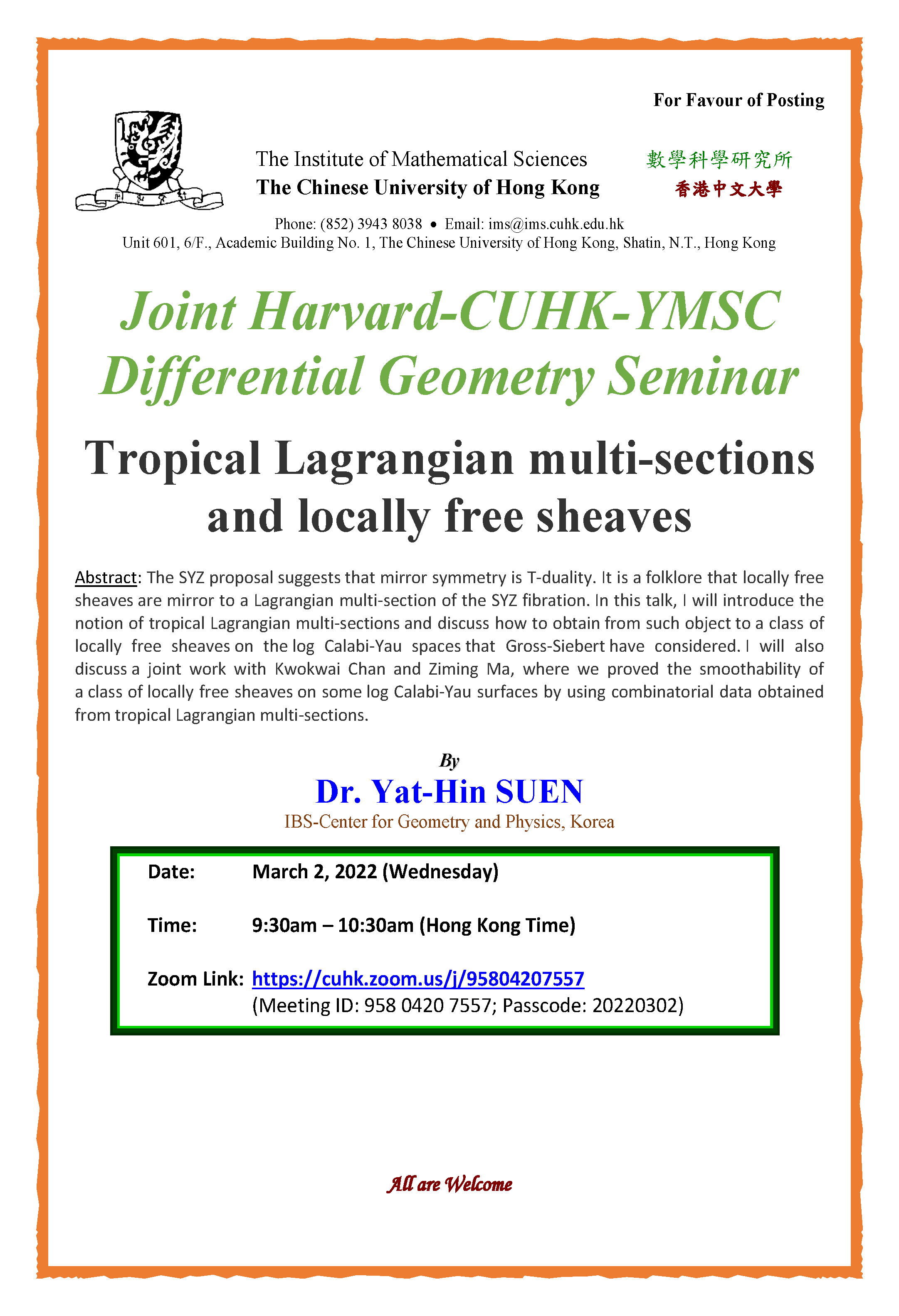
Abstract: The SYZ proposal suggests that mirror symmetry is T-duality. It is a folklore that locally free sheaves are mirror to a Lagrangian multi-section of the SYZ fibration. In this talk, I will introduce the notion of tropical Lagrangian multi-sections and discuss how to obtain from such object to a class of locally free sheaves on the log Calabi-Yau spaces that Gross-Siebert have considered. I will also discuss a joint work […]
Abstract: We construct infinitely many new exactly solvable local commuting projector lattice Hamiltonian models for general bosonic beyond group cohomology invertible topological phases of order two and four in any spacetime dimensions, whose boundaries are characterized by gravitational anomalies. Examples include the beyond group cohomology invertible phase “w2w3” in (4+1)D that has an anomalous boundary topological […]
Abstract: In this talk we will discuss the interaction between magnetic monopoles and massless fermions. In the 1980’s Callan and Rubakov showed that in the simplest example and that fermion-monopole interactions catalyze proton decay in GUT completions of the standard model. Here we will explain how fermions in general representations interact with general spherically symmetric monopoles […]
Abstract: While over-parameterization is widely believed to be crucial for the success of optimization for the neural networks, most existing theories on over-parameterization do not fully explain the reason — they either work in the Neural Tangent Kernel regime where neurons don’t move much, or require an enormous number of neurons. In this talk I will […]
Member Seminar Speaker: Martin Lesourd Title: Positive Mass, Density, and Scalar Curvature on Noncompact Manifolds Abstract: I’ll describe some recent work spanning a couple of different papers on the topics mentioned in the title: Positive Mass, Density, and Scalar Curvature on Noncompact Manifolds. Two of these are with R. Unger, Prof. S-T. Yau, and two others are with R. Unger, […]