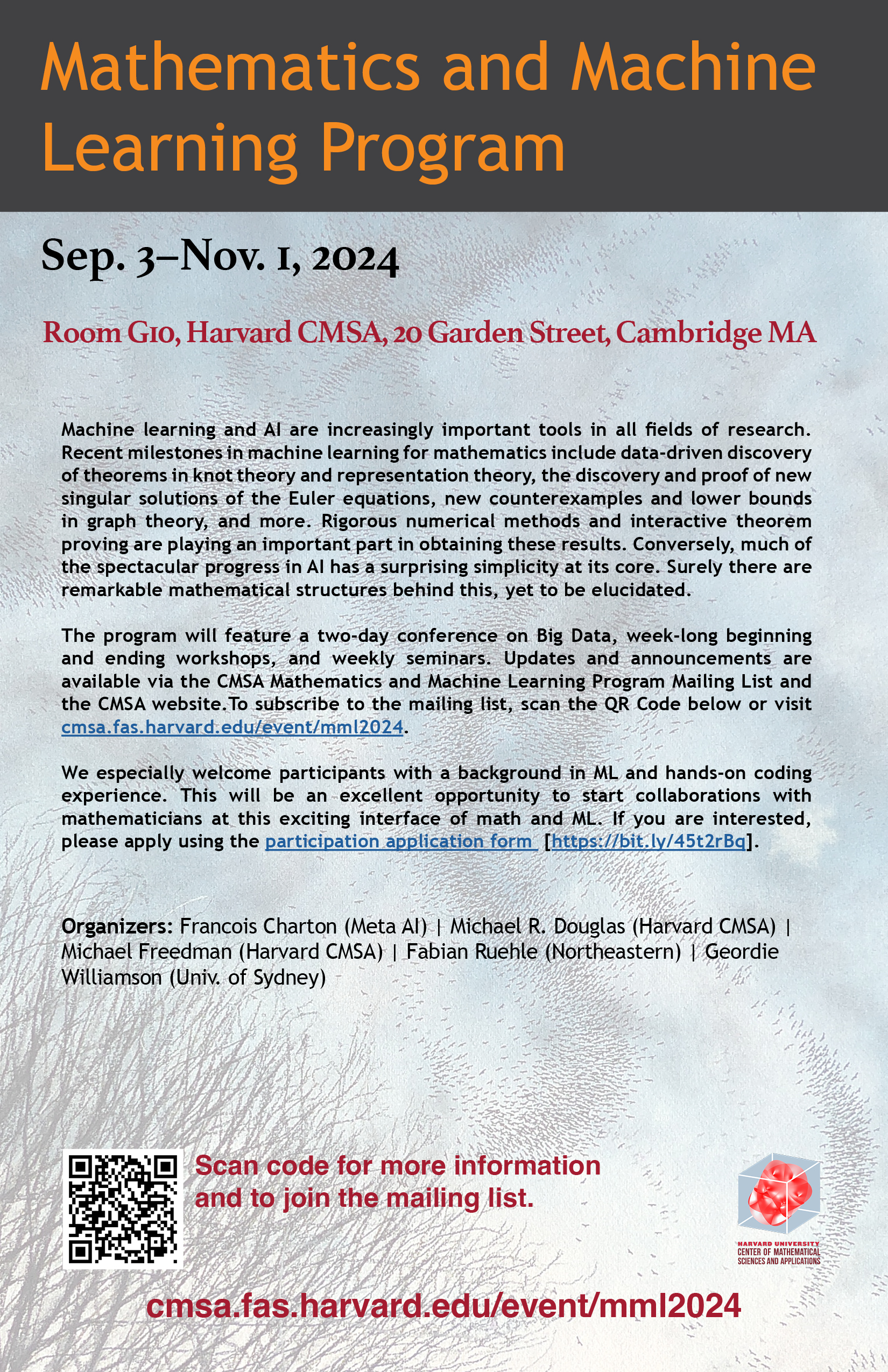
Mathematics and Machine Learning Program Dates: September 3 - November 1, 2024 Location: Harvard CMSA, 20 Garden Street, Cambridge, MA 0213 Machine learning and AI are increasingly important tools in all fields of research. Recent milestones in machine learning for mathematics include data-driven discovery of theorems in knot theory and representation theory, the discovery and […]
https://youtu.be/Pht8aXE5IsU Machine Learning in Science Education Panel Discussion Monday, Sep. 30, 2024 3:30-5:30 pm ET Machine Learning is rapidly influencing many spheres of human activity. As part of the CMSA Mathematics and Machine Learning Program, this panel discussion will explore current and future uses of Machine Learning in science education. Panelists will make brief presentations, […]
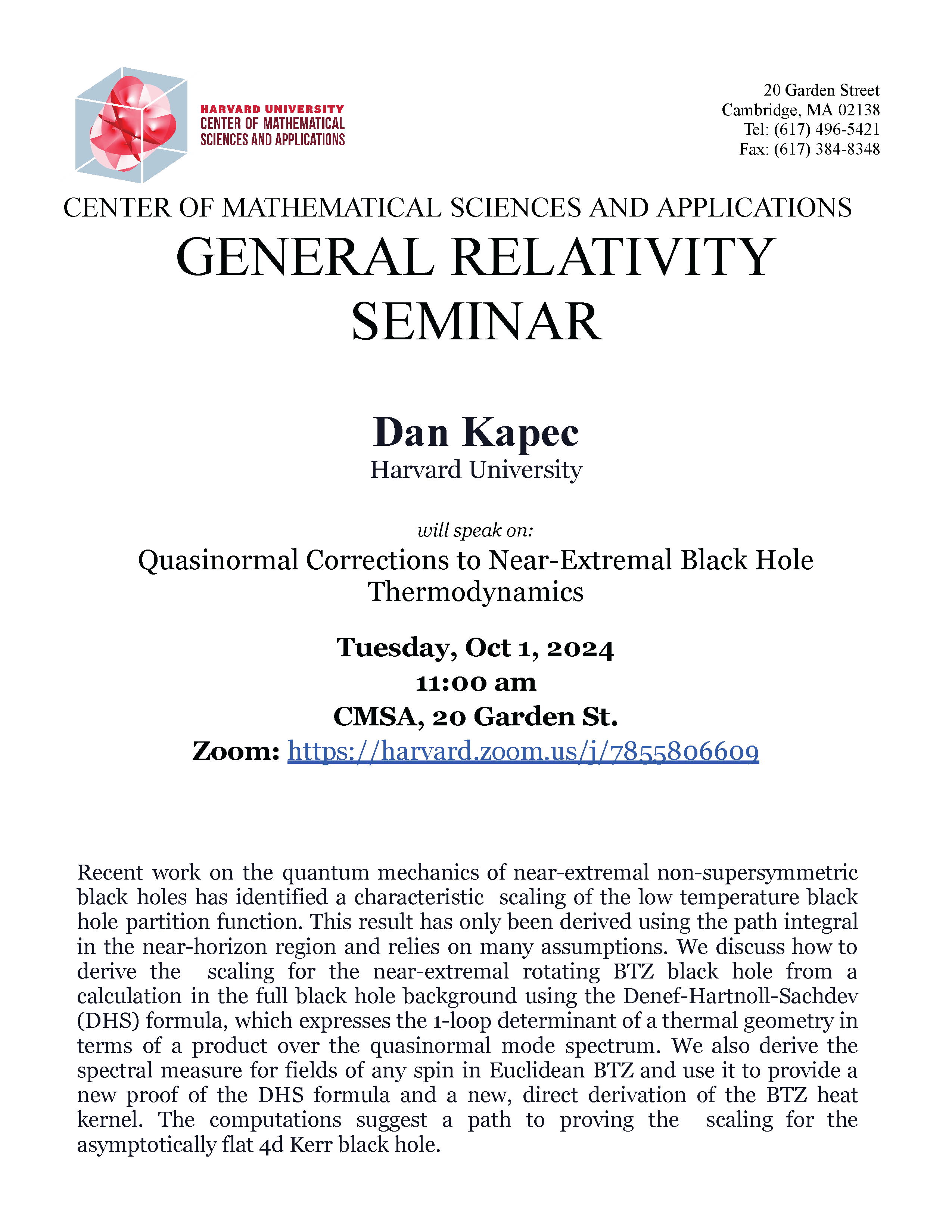
General Relativity Seminar Speaker: Daniel Kapec, Harvard Title: Quasinormal Corrections to Near-Extremal Black Hole Thermodynamics Abstract: Recent work on the quantum mechanics of near-extremal non-supersymmetric black holes has identified a characteristic scaling of the low temperature black hole partition function. This result has only been derived using the path integral in the near-horizon region and relies […]
https://youtu.be/x7LPDDYZn94 New Technologies in Mathematics Seminar Speaker: Antonio Sclocchi, EPFL Title: Hierarchical data structures through the lenses of diffusion models Abstract: The success of deep learning with high-dimensional data relies on the fact that natural data are highly structured. A key aspect of this structure is hierarchical compositionality, yet quantifying it remains a challenge. In […]
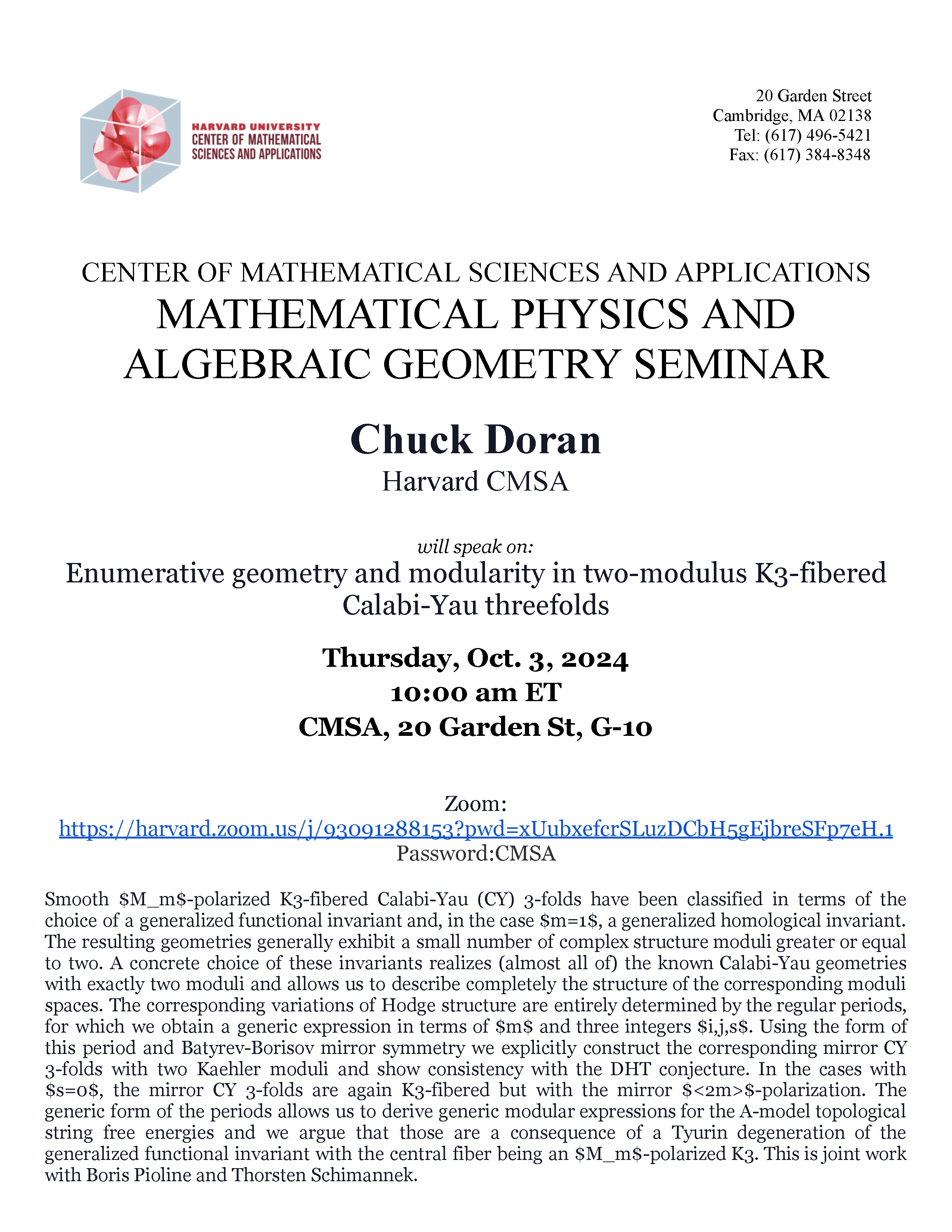
Mathematical Physics and Algebraic Geometry Seminar Speaker: Chuck Doran, Harvard CMSA Title: Enumerative geometry and modularity in two-modulus K3-fibered Calabi-Yau threefolds Abstract: Smooth $M_m$-polarized K3-fibered Calabi-Yau (CY) 3-folds have been classified in terms of the choice of a generalized functional invariant and, in the case $m=1$, a generalized homological invariant. The resulting geometries generally exhibit […]
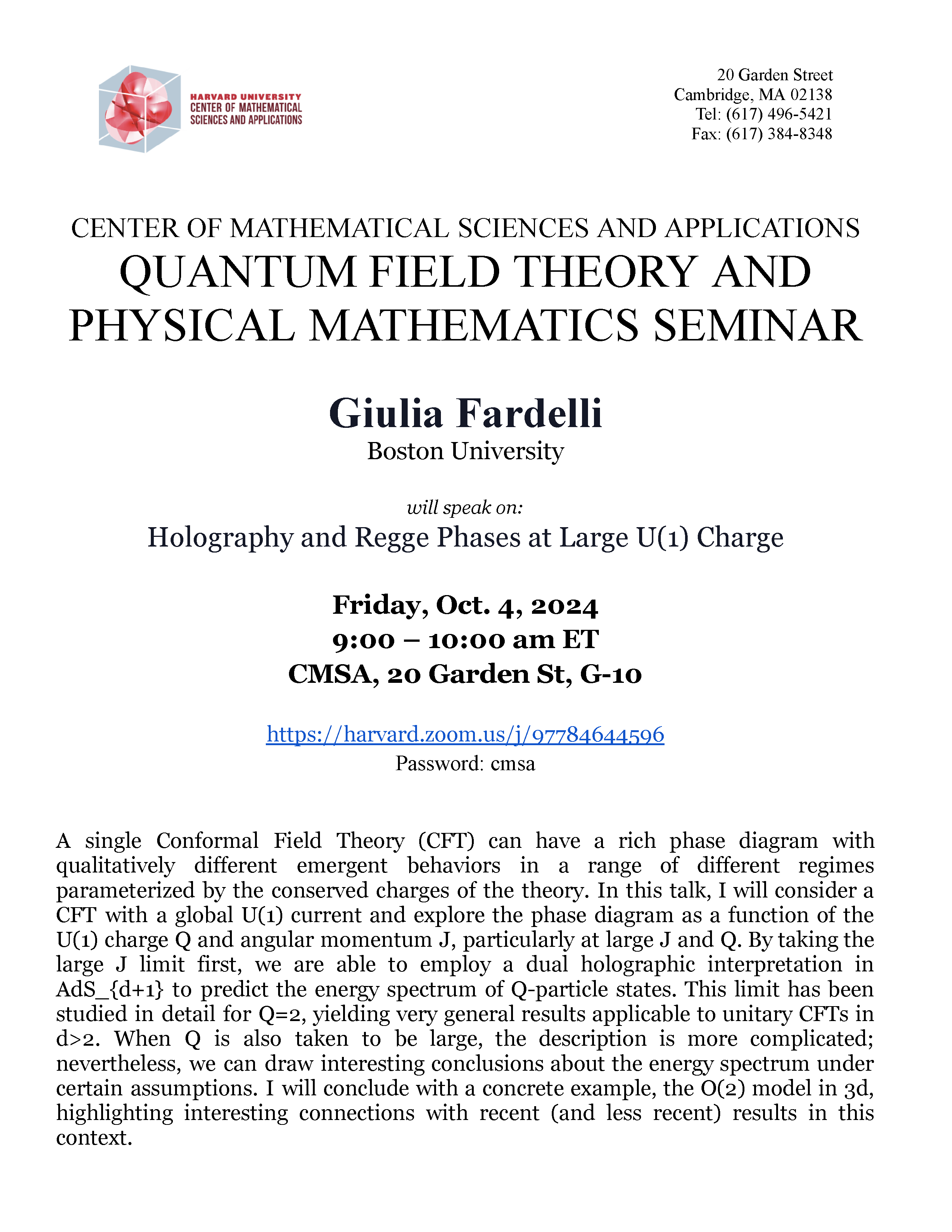
Quantum Field Theory and Physical Mathematics Seminar Speaker: Giulia Fardelli, Boston University Title: Holography and Regge Phases at Large U(1) Charge Abstract: A single Conformal Field Theory (CFT) can have a rich phase diagram with qualitatively different emergent behaviors in a range of different regimes parameterized by the conserved charges of the theory. In this […]
Member Seminar Speaker: Hugo Cui, CMSA Title: High-dimensional learning of narrow neural networks Abstract: This talk explores the interplay between neural network architectures and data structure through the lens of high-dimensional asymptotics. We focus on a class of narrow neural networks, namely networks possessing a finite number of hidden units, while operating in high dimensions. In the […]
Colloquium Speaker: Elisenda Grigsby, Boston College Title: Local complexity measures in modern parameterized function classes for supervised learning Abstract: The parameter space for any fixed architecture of neural networks serves as a proxy during training for the associated class of functions - but how faithful is this representation? For any fixed feedforward ReLU network architecture, it […]
General Relativity Seminar Speaker: Oswaldo Vazquez, Northeastern University Title: Continuation of solutions of Einstein's equations Abstract: Klainerman-Rodnianski improved the continuation criterion for the solutions of Einstein's equations proved by Michael Anderson using Kirchoff-Sobolev type parametrix and geometric Littlewood-Paley theory. Using their technique but a new parametrix we prove a continuation condition in the context of […]
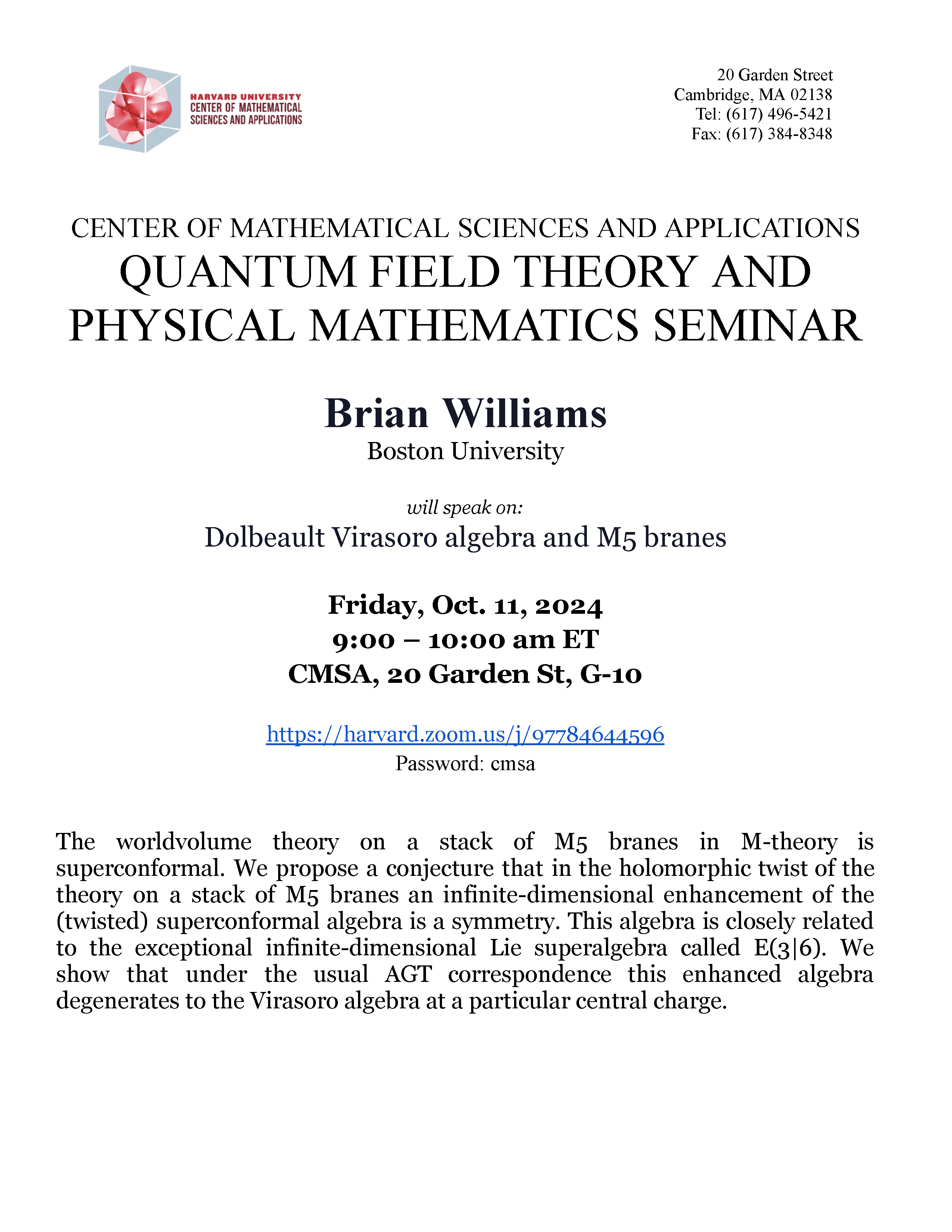
Quantum Field Theory and Physical Mathematics Seminar Speaker: Brian Williams, Boston University Title: Dolbeault Virasoro algebra and M5 branes Abstract: The worldvolume theory on a stack of M5 branes in M-theory is superconformal. We propose a conjecture that in the holomorphic twist of the theory on a stack of M5 branes an infinite-dimensional enhancement of […]
Member Seminar Speaker: Keyou Zeng Title: Scattering Amplitude from a Twistor Point of View Abstract: Scattering amplitude is a key quantity in quantum field theory. Although challenging to compute at higher loops and for large particle numbers, physicists have developed various tools to gain a deeper understanding of amplitudes. In this seminar, I will introduce […]
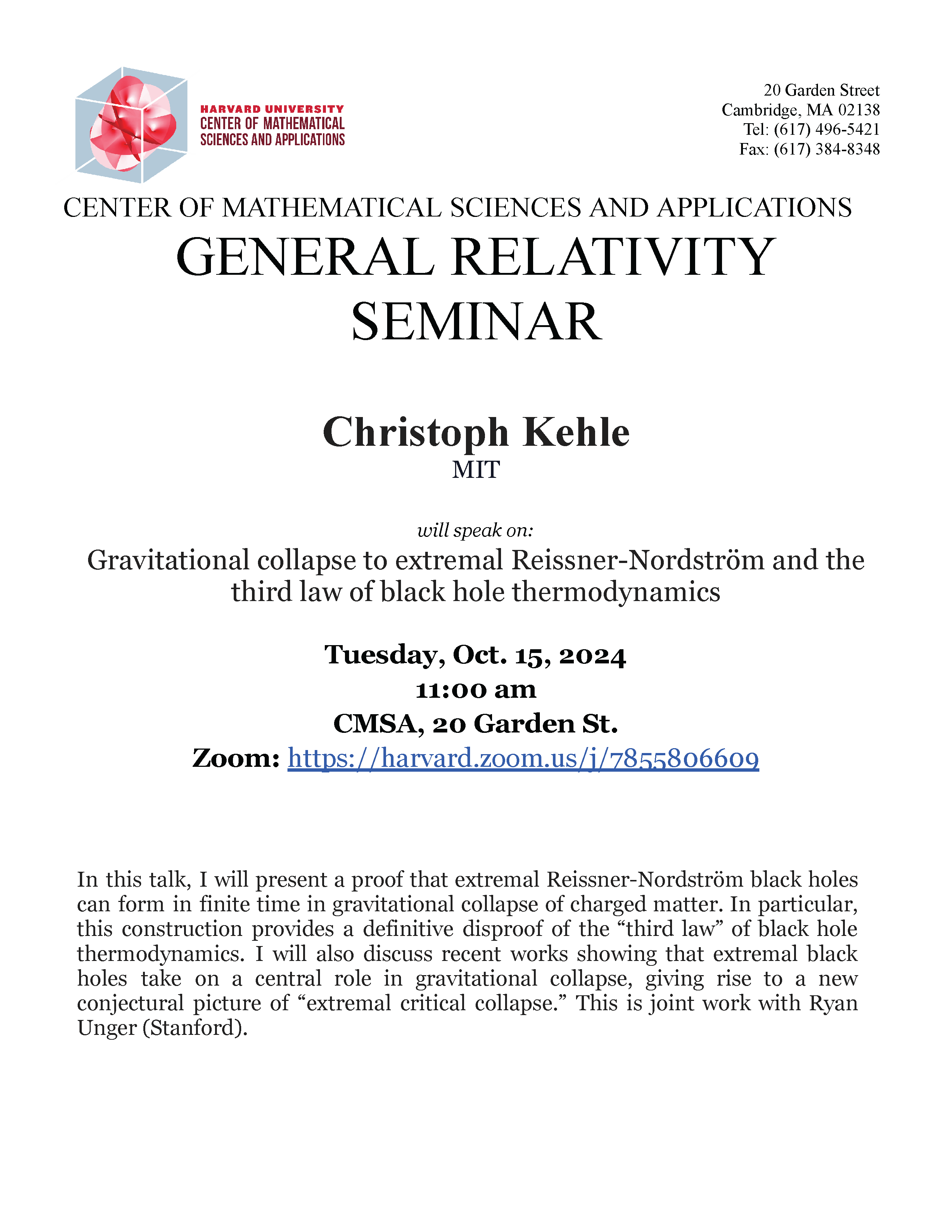
General Relativity Seminar Speaker: Christoph Kehle, MIT Title: Gravitational collapse to extremal Reissner-Nordström and the third law of black hole thermodynamics Abstract: In this talk, I will present a proof that extremal Reissner-Nordström black holes can form in finite time in gravitational collapse of charged matter. In particular, this construction provides a definitive disproof of […]
Geometry and Quantum Theory Seminar Speaker: Mayuko Yamashita, Kyoto University Title: Topological Modular Forms, its equivariant refinements and relation with supersymmetric quantum field theories Abstract: This talk is about the Segal-Stolz-Teichner program, which is one of the most deep and interesting topics relating homotopy theory and physics. Mathematically, they propose a geometric model of TMF, […]
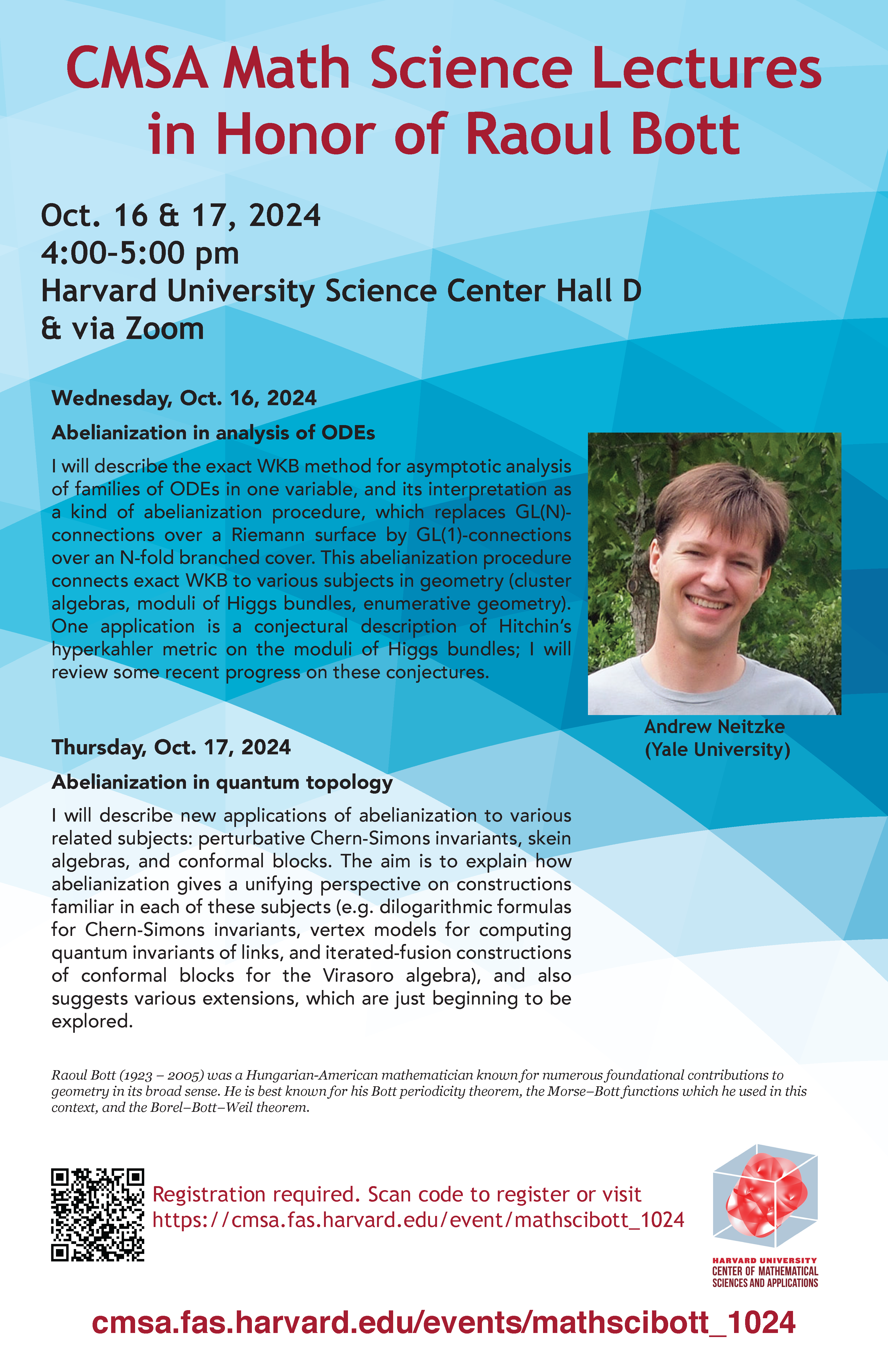
Speaker: Andrew Neitzke, Yale University Location: Harvard University Science Center Hall D & via Zoom webinar Dates: October 16 & 17, 2024 Time: 4:00 pm https://youtu.be/1SyGyeMmWoM Wednesday, Oct. 16, 2024 Title: Abelianization in analysis of ODEs Abstract: I will describe the exact WKB method for asymptotic analysis of families of ODEs in one […]
Speaker: Andrew Neitzke, Yale University Location: Harvard University Science Center Hall D & via Zoom webinar Dates: October 16 & 17, 2024 Time: 4:00 pm https://youtu.be/1SyGyeMmWoM Wednesday, Oct. 16, 2024 Title: Abelianization in analysis of ODEs Abstract: I will describe the exact WKB method for asymptotic analysis of families of ODEs in one variable, […]
Quantum Field Theory and Physical Mathematics Seminar *via Zoom only* Speaker: Rajath Radhakrishnan (ICTP, Trieste) Title: Bosonic and fermionic 1-form symmetries and anomaly matching Abstract: In this talk, I will consider bosonic and fermionic (non-invertible) 1-form symmetries in 2+1d QFTs. These are 1-form symmetries implemented by topological line operators with real spins. I will present a classification […]
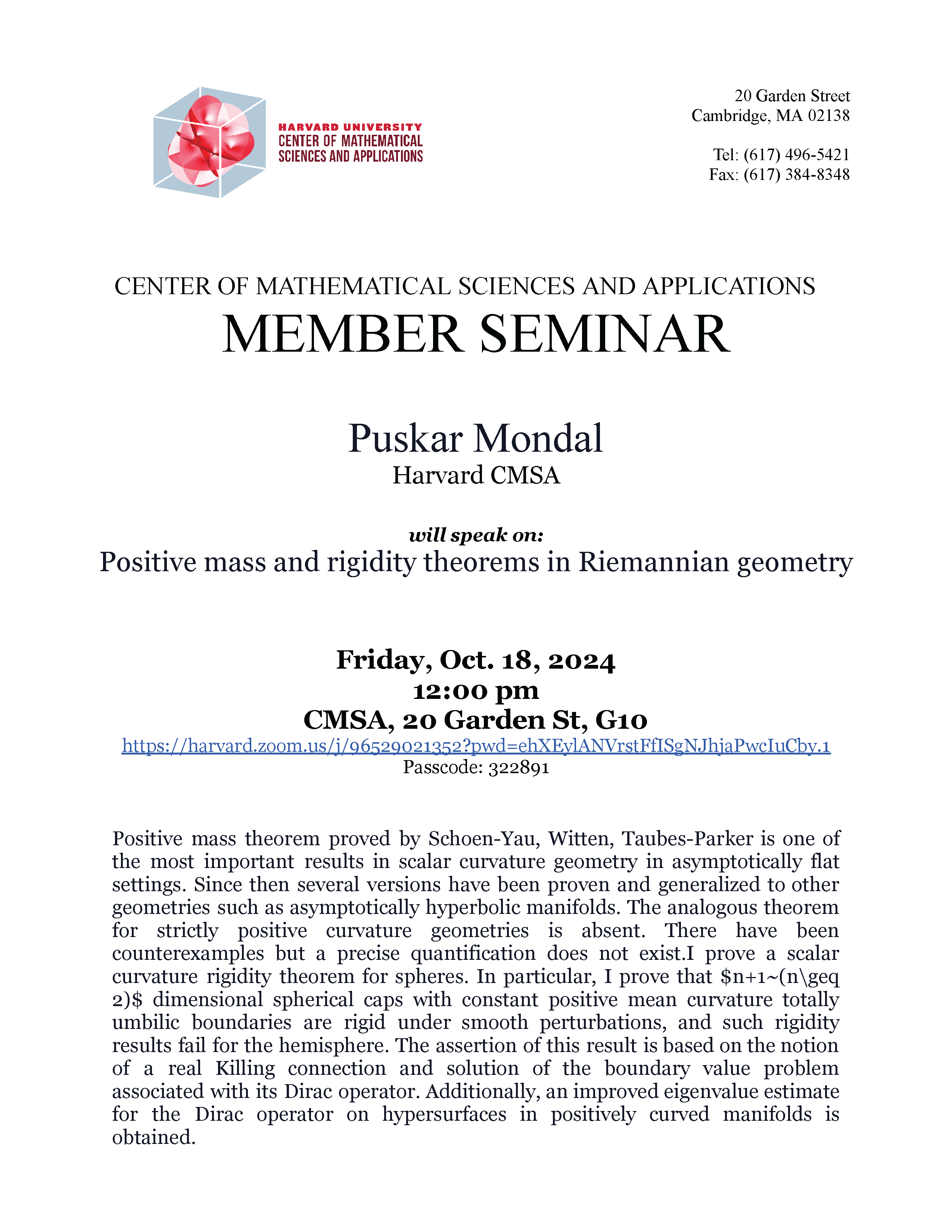
Member Seminar Speaker: Puskar Mondal Title: Positive mass and rigidity theorems in Riemannian geometry Abstract: Positive mass theorem proved by Schoen-Yau, Witten, Taubes-Parker is one of the most important results in scalar curvature geometry in asymptotically flat settings. Since then several versions have been proven and generalized to other geometries such as asymptotically hyperbolic manifolds. The analogous […]
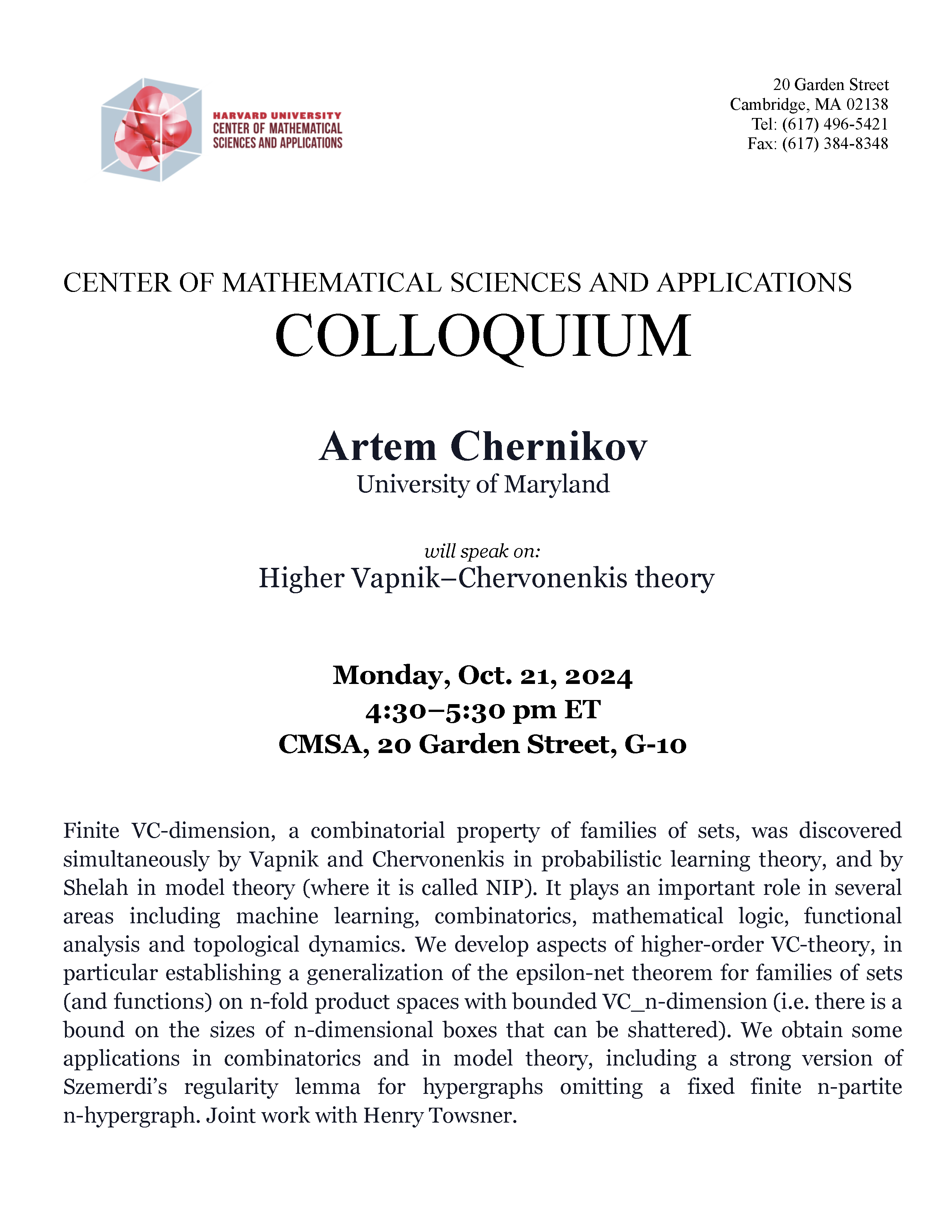
Colloquium Speaker: Artem Chernikov, University of Maryland Title: Higher Vapnik–Chervonenkis theory Abstract: Finite VC-dimension, a combinatorial property of families of sets, was discovered simultaneously by Vapnik and Chervonenkis in probabilistic learning theory, and by Shelah in model theory (where it is called NIP). It plays an important role in several areas including machine learning, combinatorics, mathematical […]
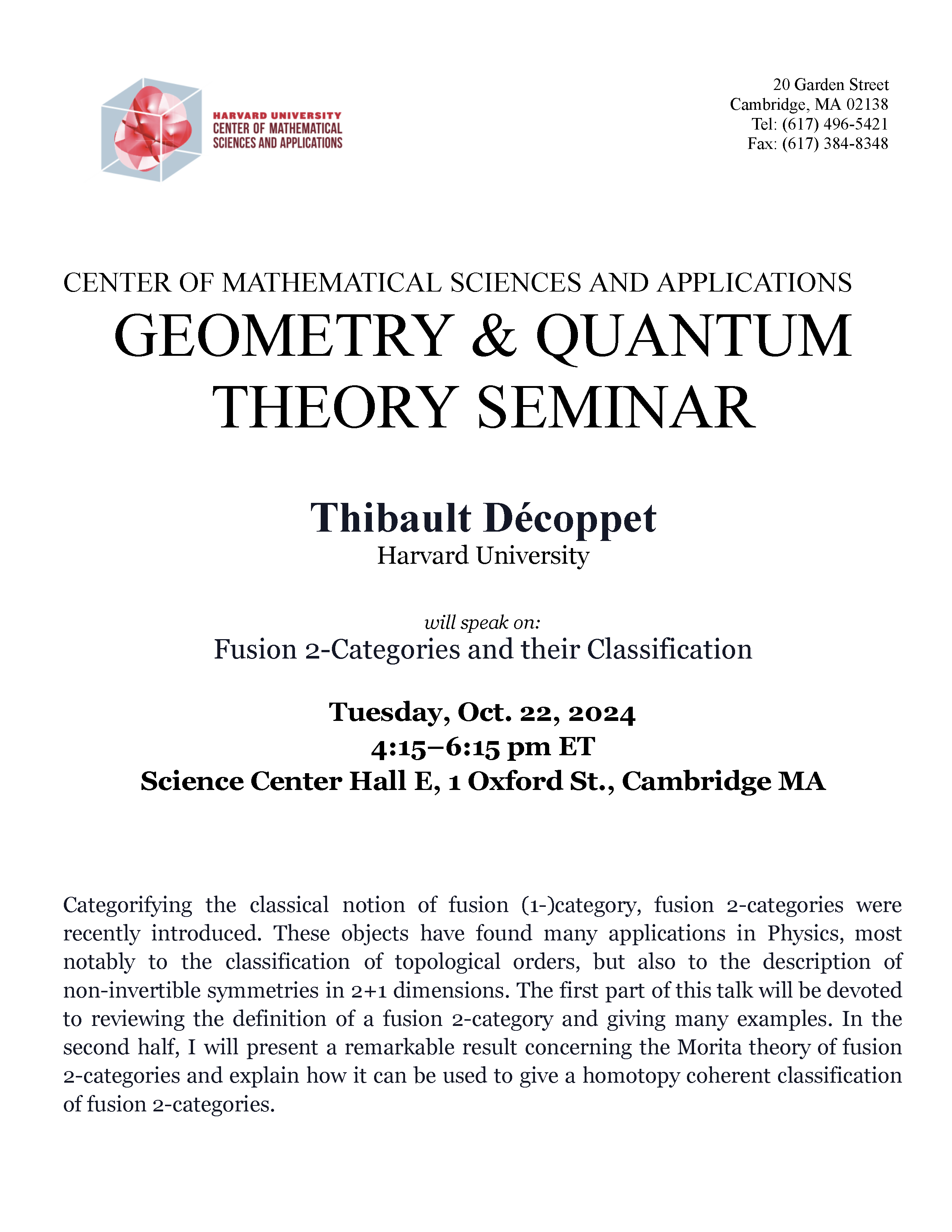
Geometry and Quantum Theory Seminar Speaker: Thibault Décoppet, Harvard University Title: Fusion 2-Categories and their Classification Abstract: Categorifying the classical notion of fusion (1-)category, fusion 2-categories were recently introduced. These objects have found many applications in Physics, most notably to the classification of topological orders, but also to the description of non-invertible symmetries in 2+1 dimensions. […]
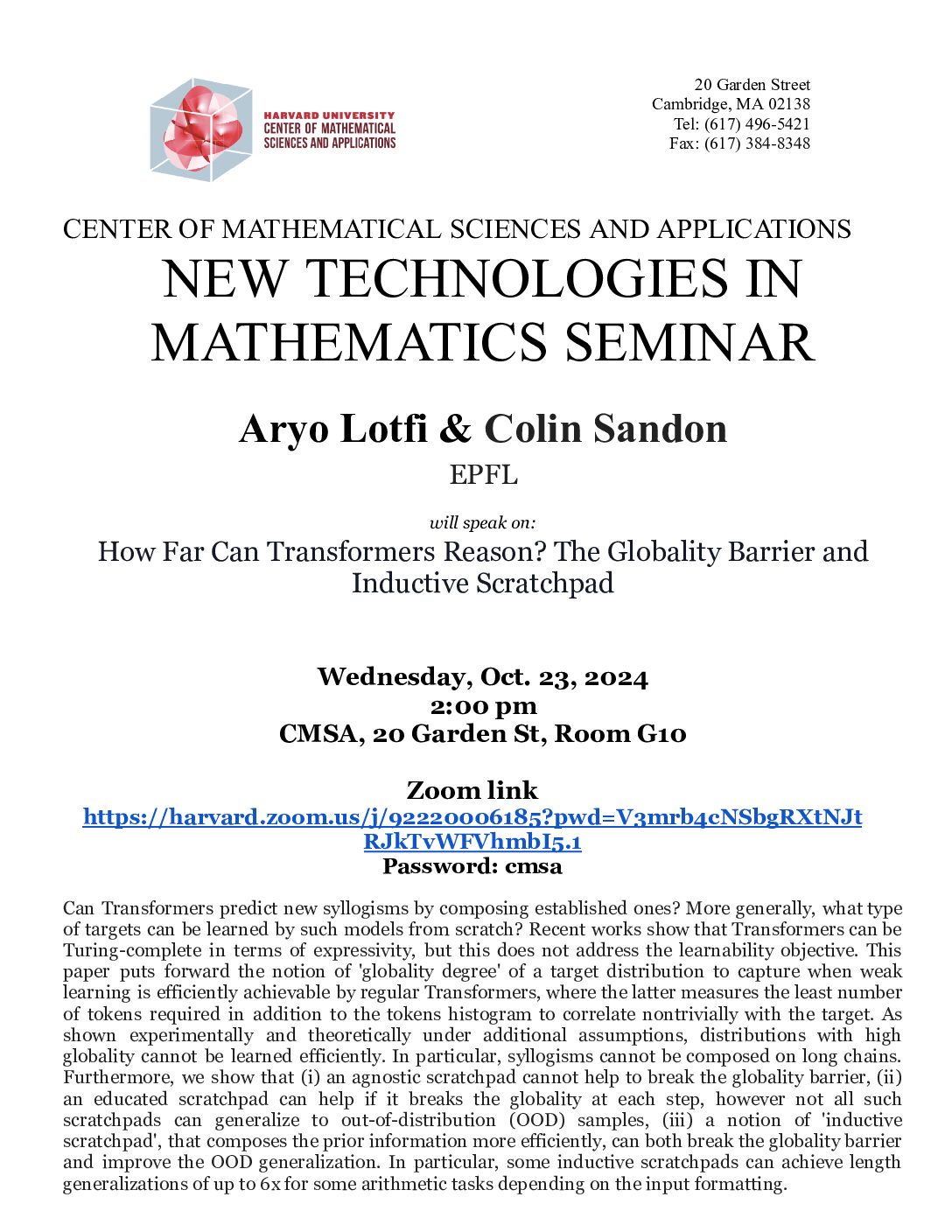
https://youtu.be/C6NDdnSaluU New Technologies in Mathematics Seminar Speaker: Aryo Lotfi (EPFL) Title: How Far Can Transformers Reason? The Globality Barrier and Inductive Scratchpad Abstract: Can Transformers predict new syllogisms by composing established ones? More generally, what type of targets can be learned by such models from scratch? Recent works show that Transformers can be Turing-complete in terms of […]
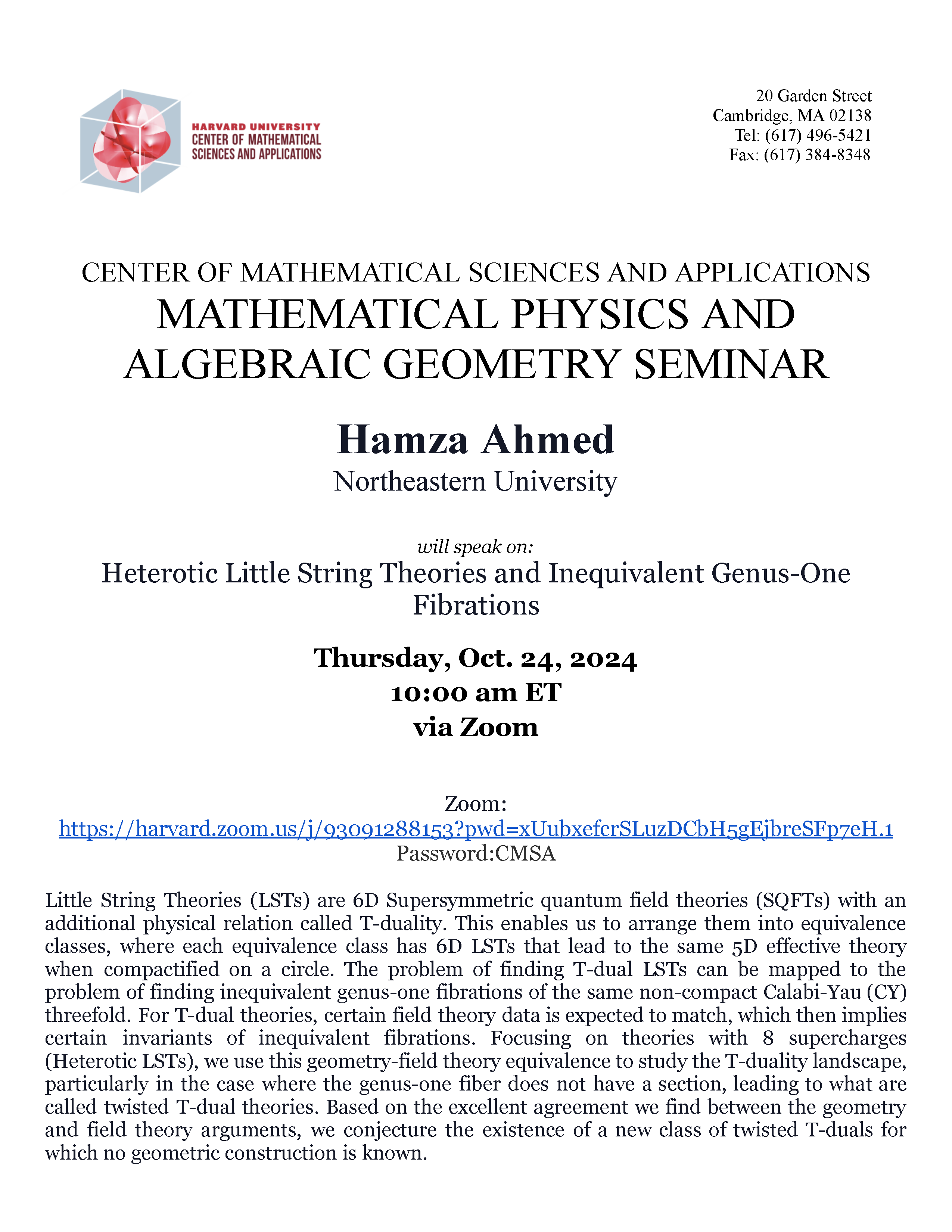
Mathematical Physics and Algebraic Geometry Seminar Speaker: Hamza Ahmed, Northeastern University Title: Heterotic Little String Theories and Inequivalent Genus-One Fibrations Abstract: Little String Theories (LSTs) are 6D Supersymmetric quantum field theories (SQFTs) with an additional physical relation called T-duality. This enables us to arrange them into equivalence classes, where each equivalence class has 6D LSTs that lead […]
Quantum Field Theory and Physical Mathematics Seminar Speaker: Luuk Stehouwer, Dalhousie University Title: The spin-statistics theorem for TFTs Abstract: In quantum field theory (QFT) the spin-statistics theorem says that in a unitary QFT, a particle has half-integer spin if and only if it is a fermion. I show how to phrase this statement in the […]
Member Seminar Speaker: Ahsan Khan Title: Formality Theorem and Webs Abstract: The “formality theorem” of Kontsevich was a key result that implies that every Poisson manifold admits a deformation quantization. I will review the ideas behind the formality theorem and discuss a potentially novel viewpoint on it involving webs and twisted masses.
Mathematics and Machine Learning Closing Workshop Dates: October 28 - Oct. 30, 2024 Location: Room G10, CMSA, 20 Garden Street, Cambridge MA The closing workshop will provide a forum for discussing the most current research in these areas, including work in progress and recent results from program participants. We will devote one day to frontier […]
General Relativity Seminar Speaker: Xuantao Chen, Johns Hopkins University Title: Formation of Trapped Surfaces in Geodesic Foliation Abstract: We reprove the formation of trapped surfaces for the Einstein vacuum equation using the incoming geodesic foliation. All previous results, starting with the seminal work of Christodoulou, make use of the double null foliation. In the new […]
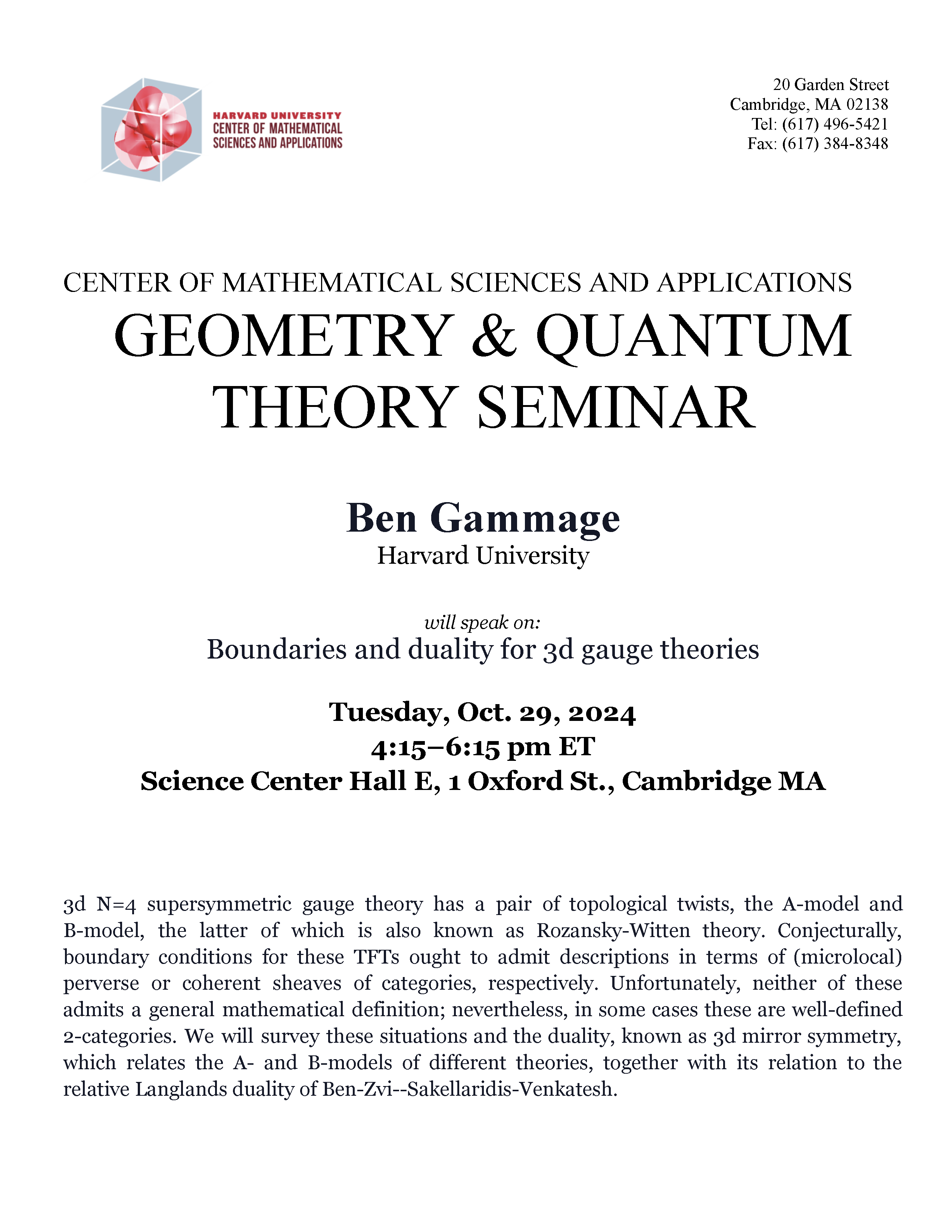
Geometry and Quantum Theory Seminar Speaker: Ben Gammage, Harvard University Title: Boundaries and duality for 3d gauge theories Abstract: 3d N=4 supersymmetric gauge theory has a pair of topological twists, the A-model and B-model, the latter of which is also known as Rozansky-Witten theory. Conjecturally, boundary conditions for these TFTs ought to admit descriptions in […]
CMSA Q&A Seminar Speaker: Michael Freedman, Harvard CMSA Topic: Broad perspective on manifolds: all dimensions, all structures, classification and dynamics
Mathematical Physics and Algebraic Geometry Seminar Speaker: Ju Tan (Boston University) Title: Mirror Construction for Nakajima Quiver Varieties Abstract: Quiver possesses a rich representation theory. On the one hand, it exhibits a deep connection with instantons and coherent sheaves as illuminated by the ADHM construction and the works of many others. On the other hand, […]
CMSA, 20 Garden Street Cambridge,
MA
02138United States+ Google Map
Phone 6174967132
Geometry and Quantum Theory Seminar Event Title: Topological Modular Forms, its equivariant refinements and relation with supersymmetric quantum field theories