During the 2021–2022 academic year, the CMSA will host a program on the so-called “Swampland.” The Swampland program aims to determine which low-energy effective field theories are consistent with nonperturbative quantum gravity considerations. Not everything is possible in String Theory, and finding out what is and what is not strongly constrains the low energy physics. These constraints are naturally […]

35 events found.
Events
Calendar of Events
|
Monday
|
Tuesday
|
Wednesday
|
Thursday
|
Friday
|
Saturday
|
Sunday
|
|---|---|---|---|---|---|---|
6 events,During the 2021–22 academic year, the CMSA will be hosting a Colloquium, organized by Du Pei, Changji Xu, and Michael Simkin. It will take place on Wednesdays at 9:30am – 10:30am (Boston time). The meetings will take place virtually on Zoom. All CMSA postdocs/members are required to attend the weekly CMSA Members’ Seminars, as well as the weekly CMSA […] 
During the Spring 2022 semester, the CMSA hosted a program on General Relativity. This semester-long program included four minicourses, a conference, and a workshop. General Relativity Mincourses: March–May, 2022 General Relativity Conference: April 4–8, 2022 General Relativity Workshop: May 2–5, 2022 Program Visitors Dan Lee, CMSA/CUNY, 1/24/22 – 5/20/22 Stefan Czimek, Brown, 2/27/22 – […] Minicourses General Relativity Program Minicourses During the Spring 2022 semester, the CMSA hosted a program on General Relativity. This semester-long program included four minicourses running in March, April, and May; a conference April 4–8, 2022; and a workshop from May 2–5, 2022. Schedule Speaker Title Abstract March 1 – 3, 2022 10:00 am – […]
-
Abstract: A proposal to use the renormalisation group to address moduli stabilisation in IIB string perturbation theory will be described. We revisit brane-antibrane inflation combining this proposal with non-linearly realised supersymmetry.
-
Abstract: According to general relativity, the remnant of a binary black hole merger should be a perturbed Kerr black hole. Perturbed Kerr black holes emit “ringdown” radiation which is well described by a superposition of quasinormal modes, with frequencies and damping times that depend only on the mass and spin of the remnant. Therefore the observation […] |
5 events,
-
During the 2021–22 academic year, the CMSA will be hosting a seminar on Combinatorics, Physics and Probability, organized by Matteo Parisi and Michael Simkin. This seminar will take place on Tuesdays at 9:00 am – 10:00 am (Boston time). The meetings will take place virtually on Zoom. To learn how to attend, please fill out this form, or contact […] |
8 events,
-
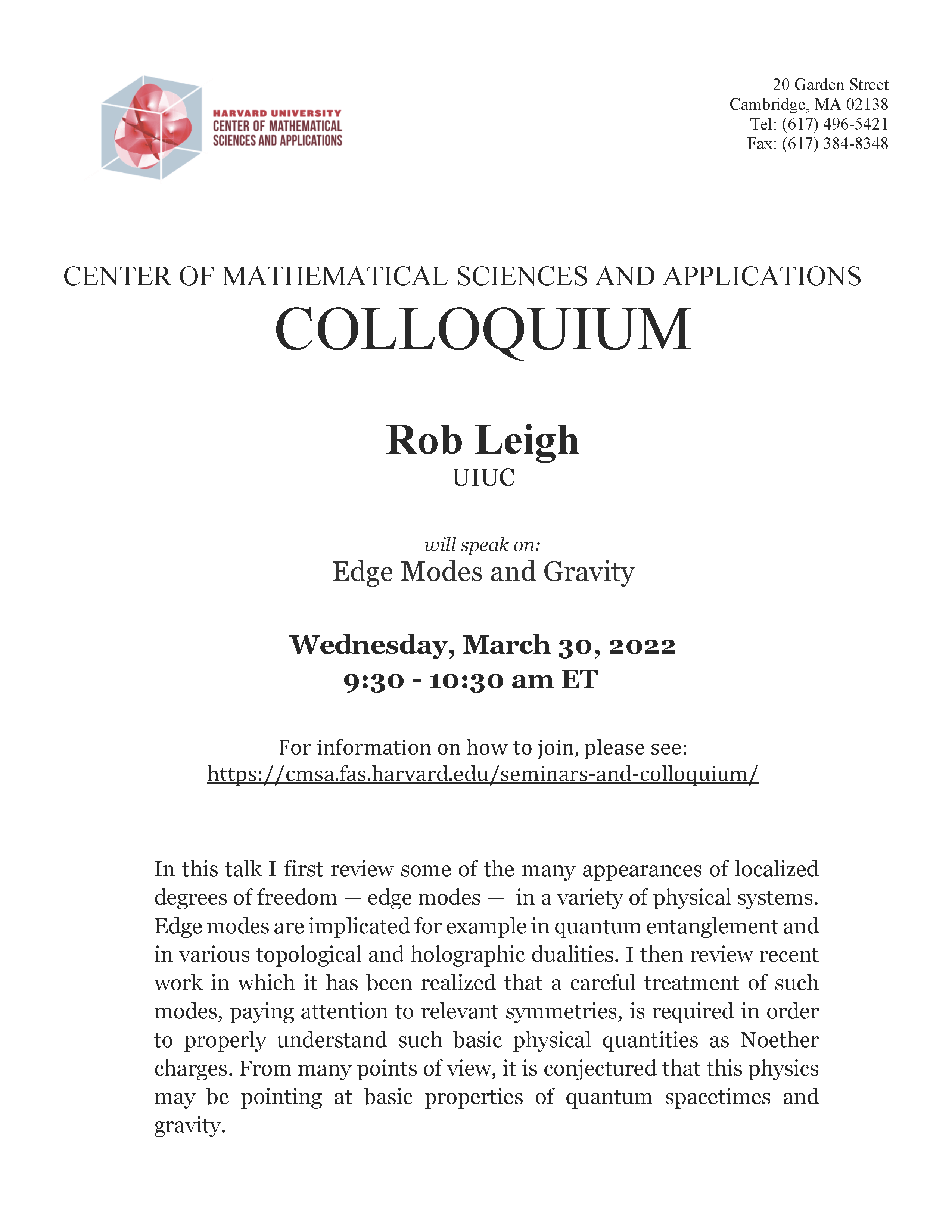
Speaker: Rob Leigh, UIUC Title: Edge Modes and Gravity Abstract: In this talk I first review some of the many appearances of localized degrees of freedom — edge modes — in a variety of physical systems. Edge modes are implicated for example in quantum entanglement and in various topological and holographic dualities. I then review recent […]
-
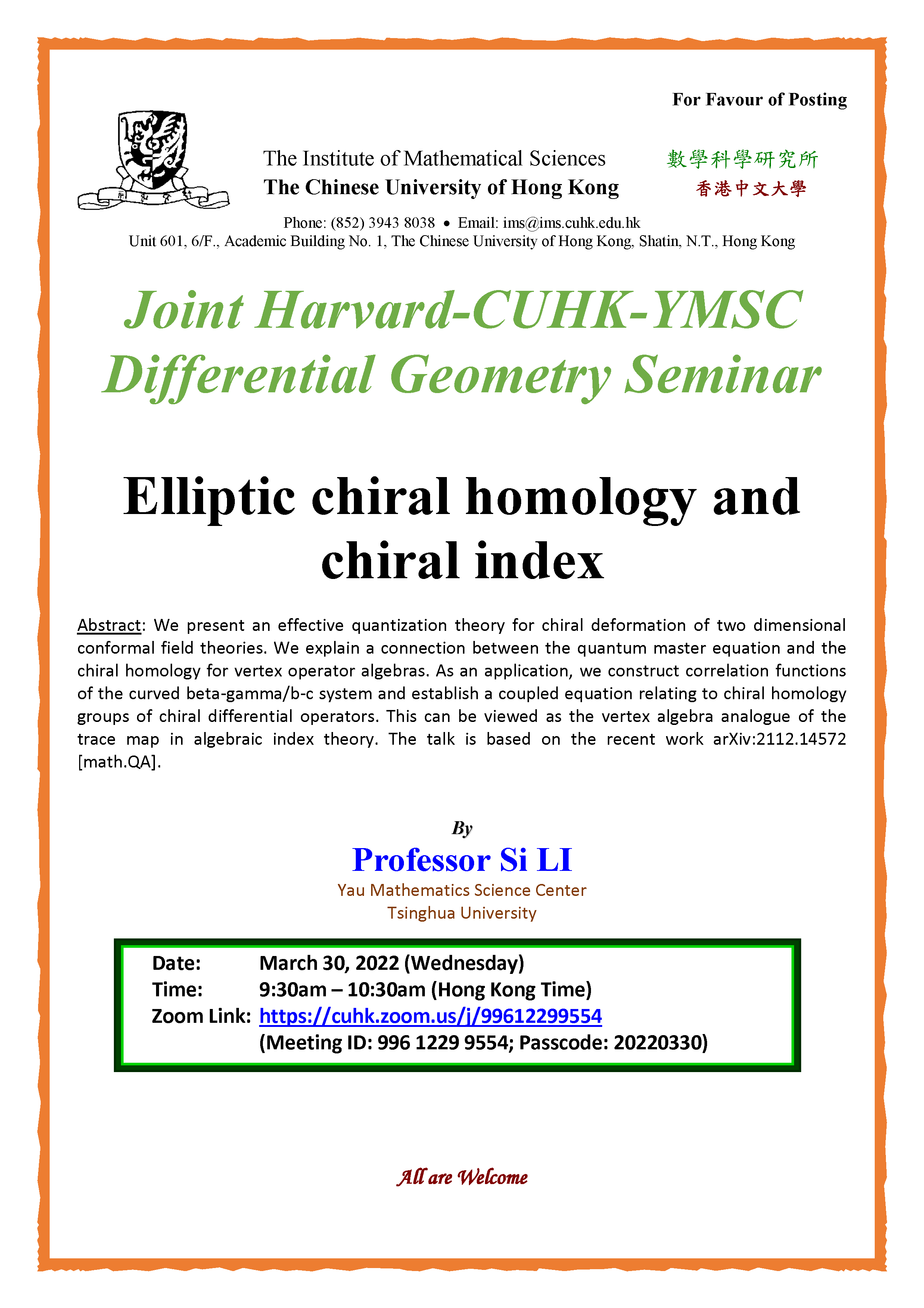
Abstract: We present an effective quantization theory for chiral deformation of two-dimensional conformal field theories. We explain a connection between the quantum master equation and the chiral homology for vertex operator algebras. As an application, we construct correlation functions of the curved beta-gamma/b-c system and establish a coupled equation relating to chiral homology groups of chiral […]
-
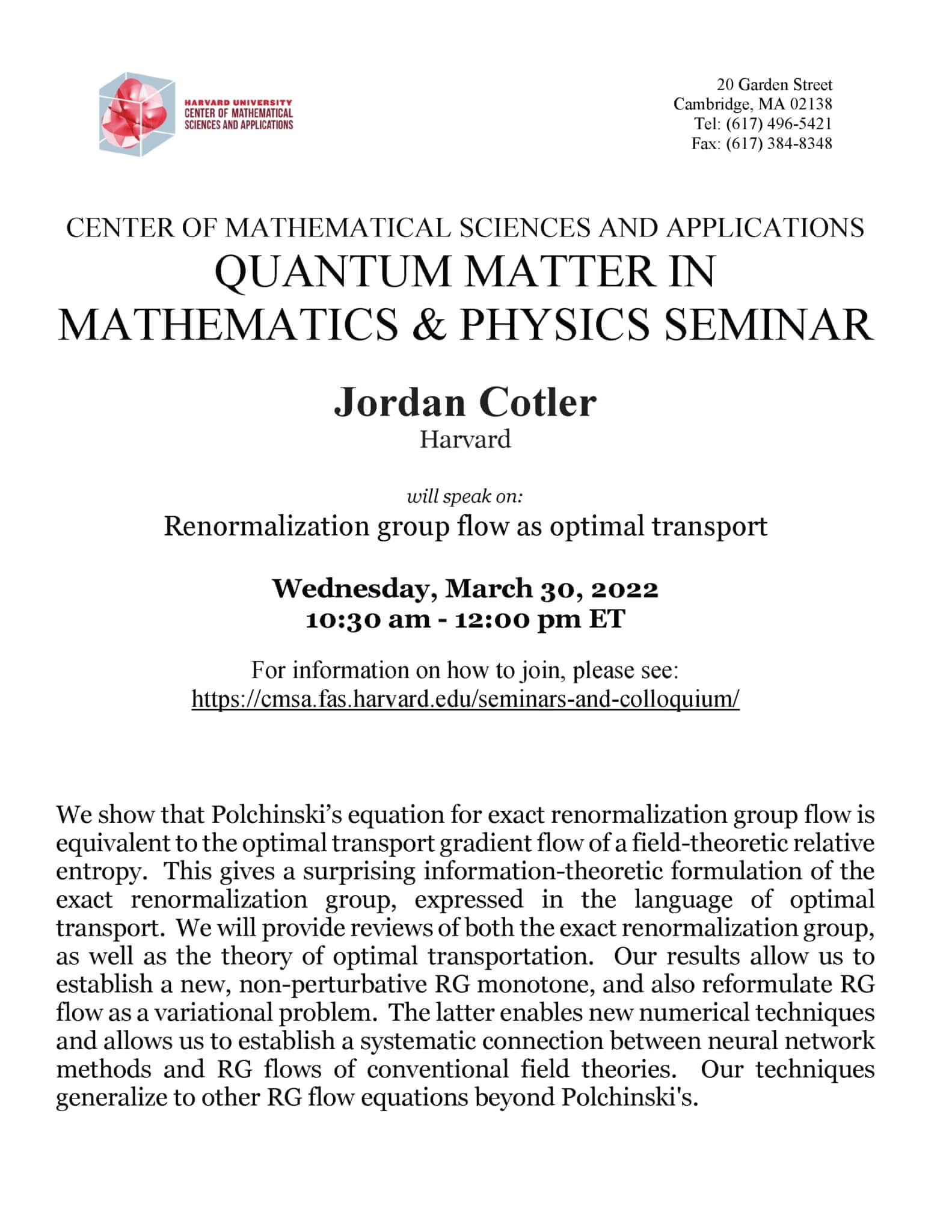
Youtube Video Abstract: We show that Polchinski’s equation for exact renormalization group flow is equivalent to the optimal transport gradient flow of a field-theoretic relative entropy. This gives a surprising information-theoretic formulation of the exact renormalization group, expressed in the language of optimal transport. We will provide reviews of both the exact renormalization group, as well as the theory of optimal transportation. Our […] |
5 events,
-
Abstract: Matroids are combinatorial abstractions of vector spaces embedded in a coordinate space. Many fundamental questions have been open for these classical objects. We highlight some recent progress that arise from the interaction between matroid theory and algebraic geometry. Key objects involve compactifications of embedded vector spaces, and an exceptional Hirzebruch-Riemann-Roch isomorphism between the K-ring of vector […] |
5 events,
-
Member Seminar Speaker: Farzan Vafa Title: Diffusive growth sourced by topological defects Abstract: In this talk, we develop a minimal model of morphogenesis of a surface where the dynamics of the intrinsic geometry is diffusive growth sourced by topological defects. We show that a positive (negative) defect can dynamically generate a cone (hyperbolic cone). We […] |
||
7 events,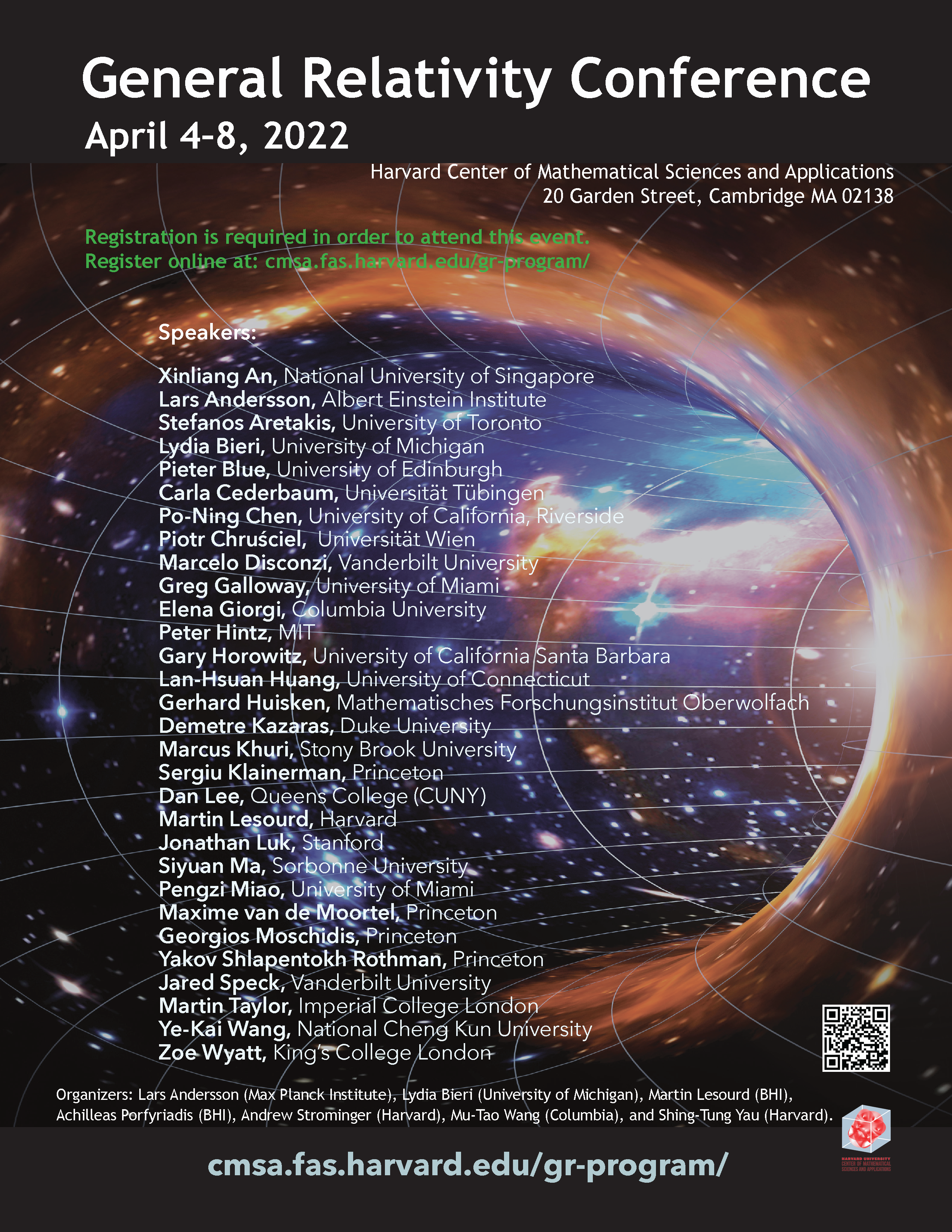
https://www.youtube.com/playlist?list=PL0NRmB0fnLJTTVV5eLYJbJUHxi-3BipfS Schedule | April 4–8, 2022 Monday, April 4, 2022 Time (ET) Speaker Title/Abstract 9:30 am–10:30 am Pieter Blue, University of Edinburgh, UK (virtual) Title: Linear stability of the Kerr spacetime in the outgoing radiation gauge Abstract: This talk will discuss a new gauge condition (i.e. coordinate condition) for the Einstein equation, the linearisation of […]
-
Swampland Seminar Speakers: Simon Caron-Huot (McGill University) and Julio Parra (Caltech) Title: Causality constraints on corrections to Einstein gravity Abstract: We study constraints from causality and unitarity on 2→2 graviton scattering in four-dimensional weakly-coupled effective field theories. Together, causality and unitarity imply dispersion relations that connect low-energy observables to high-energy data. Using such dispersion relations, we derive two-sided bounds on gravitational Wilson coefficients […]
-
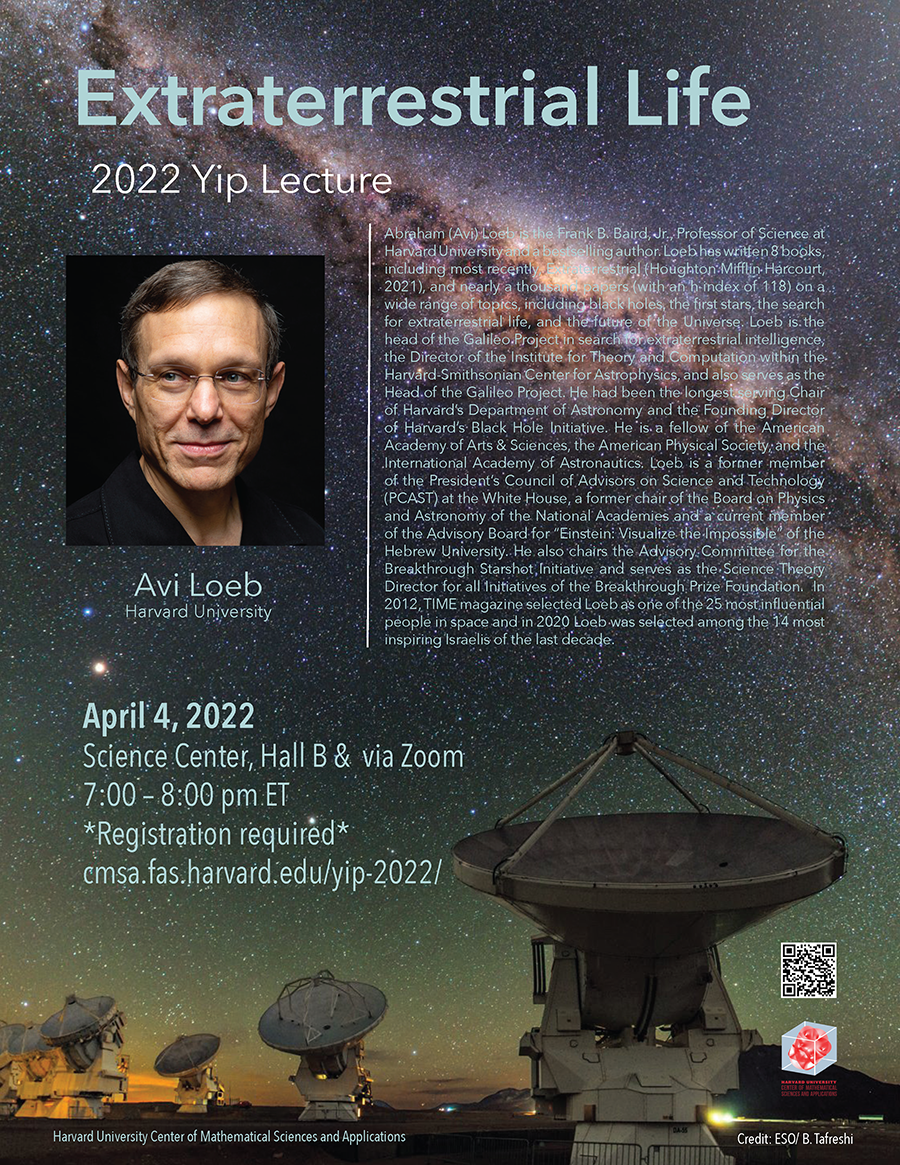
Harvard CMSA hosted the second annual Yip Lecture on April 4, 2022. The Yip Lecture takes place thanks to the support of Dr. Shing-Yiu Yip. This year’s speaker was Avi Loeb (Harvard). https://youtu.be/YV4Ki7x_yRc Extraterrestrial Life Abstract: Are we alone? It would be arrogant to think that we are, given that a quarter of all […] |
6 events,
-
Abstract: I will report a recent approach of regularizing divergent integrals on configuration spaces of Riemann surfaces, introduced by Si Li and myself in arXiv:2008.07503, with an emphasis on genus one cases where modular forms arise naturally. I will then talk about some applications in studying correlation functions in 2d chiral CFTs, holomorphic anomaly equations, […] |
9 events,
-
Speaker: Johannes Kleiner, LMU München Title: What is Mathematical Consciousness Science? Abstract: In the last three decades, the problem of consciousness – how and why physical systems such as the brain have conscious experiences – has received increasing attention among neuroscientists, psychologists, and philosophers. Recently, a decidedly mathematical perspective has emerged as well, which is now […]
-
Youtube Video Abstract: Characterizing many-body entanglement is one of the most important problems in quantum physics. We present our studies on the steady state von Neumann entropy and its transition in Brownian SYK models. For unitary evolution, we show that the correlations between different replicas account for the Page curve at late time, and a […]
-
Random Matrix & Probability Theory Seminar Speaker: Minh-Binh TRAN (SMU & MIT) Location: CMSA, Room G02 Title: On the wave turbulence theory for a stochastic KdV type equation Abstract: We report recent progress, in collaboration with Gigliola Staffilani (MIT), on the problem of deriving kinetic equations from dispersive equations. To be more precise, starting from the stochastic […] |
8 events,
-
Youtube Video Abstract: Exactly solvable spin models such as toric codes and X-cube model have heightened our understanding of spin liquids and topological matter in two and three dimensions. Their exact solvability, it turns out, is rooted in the existence of commuting generators in their parent lattice gauge theory (LGT). We can understand the toric […]
-
Abstract: The morphogenesis of branched tissues has been a subject of long-standing debate. Although much is known about the molecular pathways that control cell fate decisions, it remains unclear how macroscopic features of branched organs, including their size, network topology and spatial pattern are encoded. Based on large-scale reconstructions of the mouse mammary gland and […]
-
Abstract: Bott periodicity relates vector bundles on a topological space X to vector bundles on X “times a sphere”. I’m not a topologist, so I will try to explain an algebraic or geometric incarnation, in terms of vector bundles on the Riemann sphere. I will attempt to make the talk introductory, and (for the most part) […] |
6 events,
-
Speaker: Jörn Boehnke Title: Synthetic Regression Discontinuity: Estimating Treatment Effects using Machine Learning Abstract: In the standard regression discontinuity setting, treatment assignment is based on whether a unit’s observable score (running variable) crosses a known threshold. We propose a two-stage method to estimate the treatment effect when the score is unobservable to the econometrician while the […] |
||
5 events,
-
Abstract: We revisit type IIB flux compactification that are mirror dual to type IIA on rigid Calabi-Yau manifolds. We find a variety of interesting new solutions, like fully stabilized Minkowski vacua and infinite families of AdS$_4$ solutions with arbitrarily large numbers of spacetime filling D3 branes. We discuss how these solutions fit into the web of […] |
6 events,
-

Abstract: There is a close connection between the scattering amplitudes in planar N=4 SYM theory and the cells in the positive Grassmannian. In the context of BCFW recursion relations the tree-level S-matrix is represented as a sum of planar on-shell diagrams (aka plabic graphs) and associated with logarithmic forms on the Grassmannian cells of certain dimensionality. […]
-
Abstract: In this talk I will explain the construction of a determinant map for Tate objects and two applications: (i) to construct central extensions of iterated loop groups and (ii) to produce a determinant theory on certain ind-schemes. For that I will introduce some aspects of the theory of Tate objects in a couple of contexts. |
6 events,
-
Abstract: The standard definition of symmetries of a structure given on a set S (in the sense of Bourbaki) is the group of bijective maps S to S, compatible with this structure. But in fact, symmetries of various structures related to storing and transmitting information (such as information spaces) are naturally embodied in various classes of loops […]
-
Youtube Video Abstract: It has been known that the four-dimensional abelian chiral gauge theories of an anomaly-free set of Wely fermions can be formulated on the lattice preserving the exact gauge invariance and the required locality property in the framework of the Ginsparg- Wilson relation. This holds true in two dimensions. However, in the related formulation […] |
7 events,
-
Abstract: A main challenge in analyzing single-cell RNA sequencing (scRNA-seq) data is to reduce technical variations yet retain cell heterogeneity. Due to low mRNAs content per cell and molecule losses during the experiment (called ‘dropout’), the gene expression matrix has a substantial amount of zero read counts. Existing imputation methods treat either each cell or each […]
-
Abstract: In this talk, we briefly introduce our recent work on establishing the global existence and stability to the future of non-linear perturbation of de Sitter-like solutions to the Einstein-Yang-Mills system in n≥4 spacetime dimension. This generalizes Friedrich’s (1991) Einstein-Yang-Mills stability results in dimension n=4 to all higher dimensions. This is a joint work with […]
-
Youtube video Abstract: I will explain a mechanism to cancel the vacuum energy and both terms in the Weyl anomaly in the standard model of particle physics, using conformally-coupled dimension-zero scalar fields. Remarkably, given the standard model gauge group SU(3)xSU(2)xU(1), the cancellation requires precisely 48 Weyl spinors — i.e. three generations of standard model fermions, […] |
5 events,
-
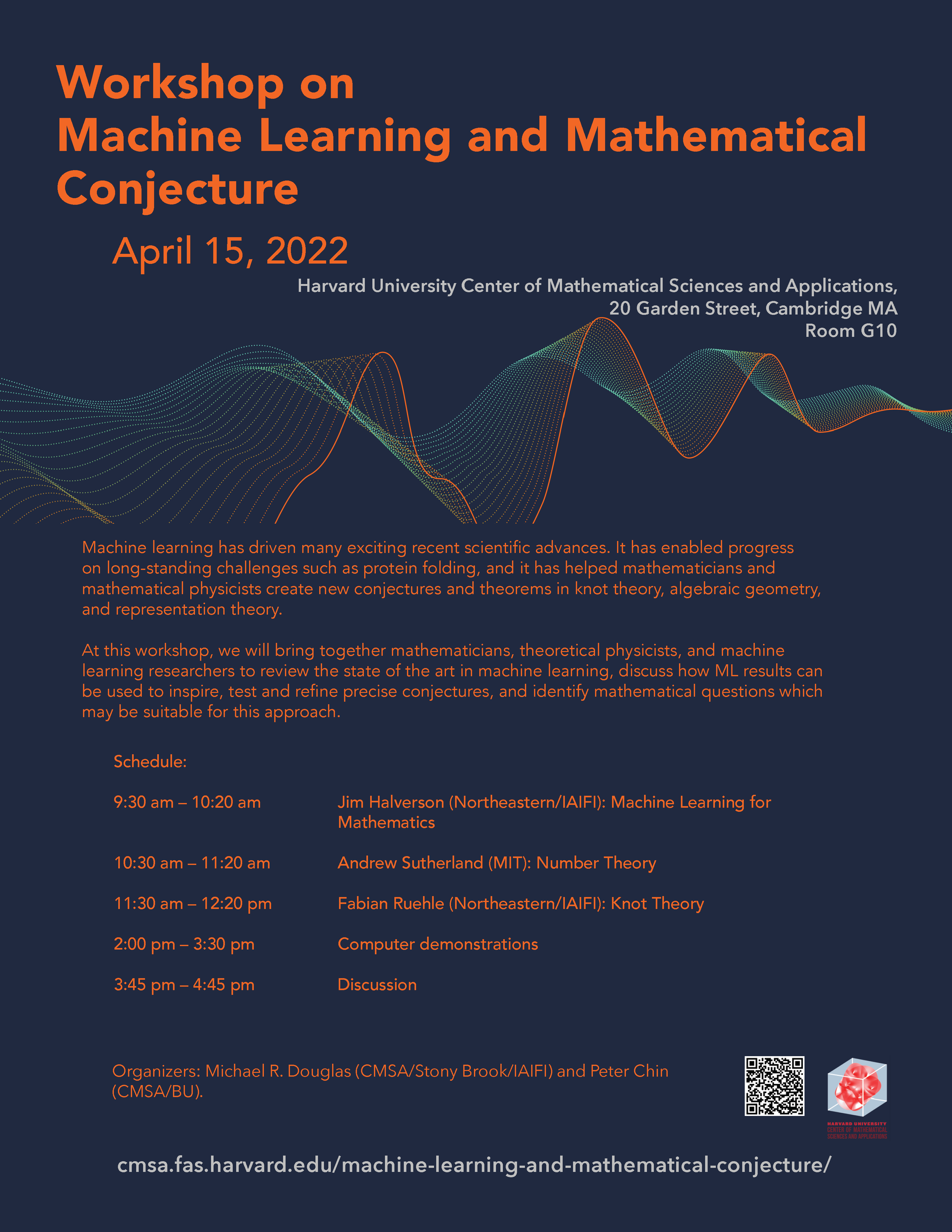
On April 15, 2022, the CMSA will hold a one-day workshop, Machine Learning and Mathematical Conjecture, related to the New Technologies in Mathematics Seminar Series. Location: Room G10, 20 Garden Street, Cambridge, MA 02138. Organizers: Michael R. Douglas (CMSA/Stony Brook/IAIFI) and Peter Chin (CMSA/BU). Machine learning has driven many exciting recent scientific advances. It has enabled […] |
||
6 events,
-
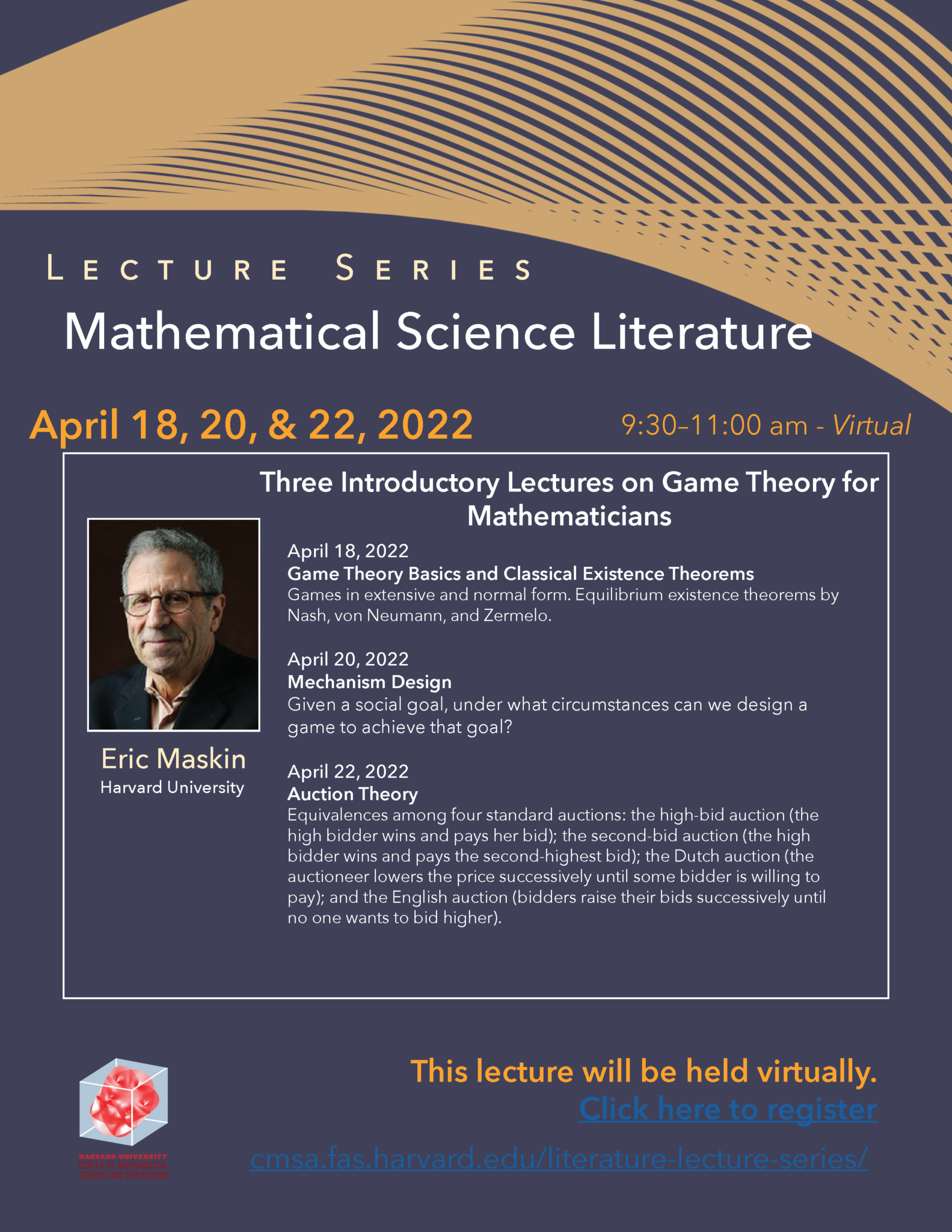
Eric Maskin (Harvard University) Three Introductory Lectures on Game Theory for Mathematicians April 18, 2022 | 9:30 – 11:00 am ET Title: Game Theory Basics and Classical Existence Theorems Abstract: Games in extensive and normal form. Equilibrium existence theorems by Nash, von Neumann, and Zermelo Talk chairs: Scott Kominers, Sergiy Verstyuk SLIDES | VIDEO
-
|
6 events,
-
Abstract: In studying complex Chern-Simons theory on a Seifert manifold, Gukov-Pei proposed an equivariant Verlinde formula, a one-parameter deformation of the celebrated Verlinde formula. It computes, among many things, the graded dimension of the space of holomorphic sections of (powers of) a natural determinant line bundle over the Hitchin moduli space. Gukov-Pei conjectured that the equivariant Verlinde numbers are equal to the equivariant quantum K-invariants […]
-
Abstract: Wilson loop diagrams can be used to study amplitudes in N=4 SYM. I will set them up and talk about some of their combinatorial aspects, such as how many Wilson loop diagrams give the same positroid and how to combinatorially read off the dimension and the denominators for the integrands. **This talk will be […] |
6 events,
-
Eric Maskin (Harvard University) Three Introductory Lectures on Game Theory for Mathematicians April 20, 2022 | 9:30 – 11:00 am ET Title: Mechanism Design Abstract: Given a social goal, under what circumstances can we design a game to achieve that goal? Talk chairs: Scott Kominers, Sergiy Verstyuk SLIDES | VIDEO
-
Abstract: Since its discovery, unconventional superconductivity in cuprates has motivated the search for materials with analogous electronic or atomic structure. We have used soft chemistry approaches to synthesize superconducting infinite layer nickelates from their perovskite precursor phase. We will present the synthesis and transport properties of the nickelates, observation of a doping-dependent superconducting dome, and […] |
6 events,
-
Abstract: Encryption is the backbone of cybersecurity. While encryption can secure data both in transit and at rest, in the new era of ubiquitous computing, modern cryptography also aims to protect data during computation. Secure multi-party computation (MPC) is a powerful technology to tackle this problem, which enables distrustful parties to jointly perform computation over […]
-
Abstract: We study the small perturbations of the $1+3$-dimensional Milne model for the Einstein-Klein-Gordon (EKG) system. We prove the nonlinear future stability, and show that the perturbed spacetimes are future causally geodesically complete. For the proof, we work within the constant mean curvature (CMC) gauge and focus on the $1+3$ splitting of the Bianchi-Klein-Gordon equations. […] |
6 events,
-
Eric Maskin (Harvard University) Three Introductory Lectures on Game Theory for Mathematicians April 22, 2022 | 9:30 – 11:00 am ET Title: Auction Theory Abstract: Equivalences among four standard auctions: the high-bid auction (the high bidder wins and pays her bid); the second-bid auction (the high bidder wins and pays the second-highest bid); the Dutch […]
-
https://www.youtube.com/watch?v=11vWx0H-PKs&list=PL0NRmB0fnLJQAnYwkpt9PN2PBKx4rvdup&index=14 Speaker: Ruben Verresen Title: Higgs = SPT Abstract: The Higgs phase of a gauge theory is important to both fundamental physics (e.g., electroweak theory) as well as condensed matter systems (superconductors and other emergent phenomena). However, such a charge condensate seems subtle and is sometimes described as the spontaneous breaking of gauge symmetry (or a […] |
||
6 events,
-
Abstract: We discuss the algebraic geometry of maximum likelihood estimation from the perspective of scattering amplitudes in particle physics. A guiding examples the moduli space of n-pointed rational curves. The scattering potential plays the role of the log-likelihood function, and its critical points are solutions to rational function equations. Their number is an Euler characteristic. Soft […]
-
Abstract: In “Mirror symmetry for log Calabi–Yau surfaces I,” given a smooth log Calabi–Yau surface pair (Y,D), Gross–Hacking–Keel constructed its mirror family as the spectrum of an explicit algebra whose structure coefficients are determined by the enumerative geometry of (Y,D). As a follow-up of the work of Gross–Hacking–Keel, when (Y,D) is positive, we prove the […] |
6 events,
On April 27–29, 2022, the CMSA hosted a workshop on Nonlinear Algebra and Combinatorics. Organizers: Bernd Sturmfels (MPI Leipzig) and Lauren Williams (Harvard). In recent years, ideas from integrable systems and scattering amplitudes have led to advances in nonlinear algebra and combinatorics. In this short workshop, aimed at younger participants in the field, we will […]
-
Speaker: Venkatesan Guruswami, UC Berkeley Title: Long common subsequences between bit-strings and the zero-rate threshold of deletion-correcting codes Abstract: Suppose we transmit n bits on a noisy channel that deletes some fraction of the bits arbitrarily. What’s the supremum p* of deletion fractions that can be corrected with a binary code of non-vanishing rate? Evidently p* is at […] |
9 events,
-
https://www.youtube.com/watch?v=c6_RbJS8CoM&list=PL0NRmB0fnLJQAnYwkpt9PN2PBKx4rvdup&index=14&t=2s Abstract: We will overview the program of geometrically engineering four dimensional supersymmetric QFTs as compactifications of six dimensional SCFTs. In particular we will discuss how strong coupling phenomena in four dimensions, such as duality and emergence of symmetry, can be better understood in such geometric constructions.
-
Speaker: Guillaume Duclos (Brandeis) Title: Building active nematic and active polar liquids out of biological machines Abstract: Active matter describes out-of-equilibrium materials composed of motile building blocks that convert free energy into mechanical work. The continuous input of energy at the particle scale liberates these systems from the constraints of thermodynamic equilibrium, leading to emergent collective behaviors not found in passive materials. In this talk, I […]
-
Abstract: Let X be a compact hyperbolic surface. We can see that there is a constant C(X) such that the intersection number of the closed geodesics is \leq C(X) times the product of their lengths. Consider the optimum constant C(X). In this talk, we describe its asymptotic behavior in terms of systole, length of the shortest […] |
6 events,
-
Member Seminar Speaker: Sergiy Verstyuk Title: Machine Learning the Gravity Equation for International Trade Abstract: We will go through modern deep learning methods and existing approaches to their interpretation. Next, I will describe a graph neural network framework. You will also be introduced to an economic analog of gravity. Finally, we will see how these […] |