During the 2021–2022 academic year, the CMSA will host a program on the so-called “Swampland.” The Swampland program aims to determine which low-energy effective field theories are consistent with nonperturbative quantum gravity considerations. Not everything is possible in String Theory, and finding out what is and what is not strongly constrains the low energy physics. These constraints are naturally […]

42 events found.
Events
Calendar of Events
|
Monday
|
Tuesday
|
Wednesday
|
Thursday
|
Friday
|
Saturday
|
Sunday
|
|---|---|---|---|---|---|---|
4 events,During the 2021–22 academic year, the CMSA will be hosting a Colloquium, organized by Du Pei, Changji Xu, and Michael Simkin. It will take place on Wednesdays at 9:30am – 10:30am (Boston time). The meetings will take place virtually on Zoom. All CMSA postdocs/members are required to attend the weekly CMSA Members’ Seminars, as well as the weekly CMSA […] 
During the Spring 2022 semester, the CMSA hosted a program on General Relativity. This semester-long program included four minicourses, a conference, and a workshop. General Relativity Mincourses: March–May, 2022 General Relativity Conference: April 4–8, 2022 General Relativity Workshop: May 2–5, 2022 Program Visitors Dan Lee, CMSA/CUNY, 1/24/22 – 5/20/22 Stefan Czimek, Brown, 2/27/22 – […] Minicourses General Relativity Program Minicourses During the Spring 2022 semester, the CMSA hosted a program on General Relativity. This semester-long program included four minicourses running in March, April, and May; a conference April 4–8, 2022; and a workshop from May 2–5, 2022. Schedule Speaker Title Abstract March 1 – 3, 2022 10:00 am – […] |
6 events,
-
Abstract: We discuss the algebraic geometry of maximum likelihood estimation from the perspective of scattering amplitudes in particle physics. A guiding examples the moduli space of n-pointed rational curves. The scattering potential plays the role of the log-likelihood function, and its critical points are solutions to rational function equations. Their number is an Euler characteristic. Soft […]
-
Abstract: In “Mirror symmetry for log Calabi–Yau surfaces I,” given a smooth log Calabi–Yau surface pair (Y,D), Gross–Hacking–Keel constructed its mirror family as the spectrum of an explicit algebra whose structure coefficients are determined by the enumerative geometry of (Y,D). As a follow-up of the work of Gross–Hacking–Keel, when (Y,D) is positive, we prove the […] |
6 events,
On April 27–29, 2022, the CMSA hosted a workshop on Nonlinear Algebra and Combinatorics. Organizers: Bernd Sturmfels (MPI Leipzig) and Lauren Williams (Harvard). In recent years, ideas from integrable systems and scattering amplitudes have led to advances in nonlinear algebra and combinatorics. In this short workshop, aimed at younger participants in the field, we will […]
-
Speaker: Venkatesan Guruswami, UC Berkeley Title: Long common subsequences between bit-strings and the zero-rate threshold of deletion-correcting codes Abstract: Suppose we transmit n bits on a noisy channel that deletes some fraction of the bits arbitrarily. What’s the supremum p* of deletion fractions that can be corrected with a binary code of non-vanishing rate? Evidently p* is at […] |
9 events,
-
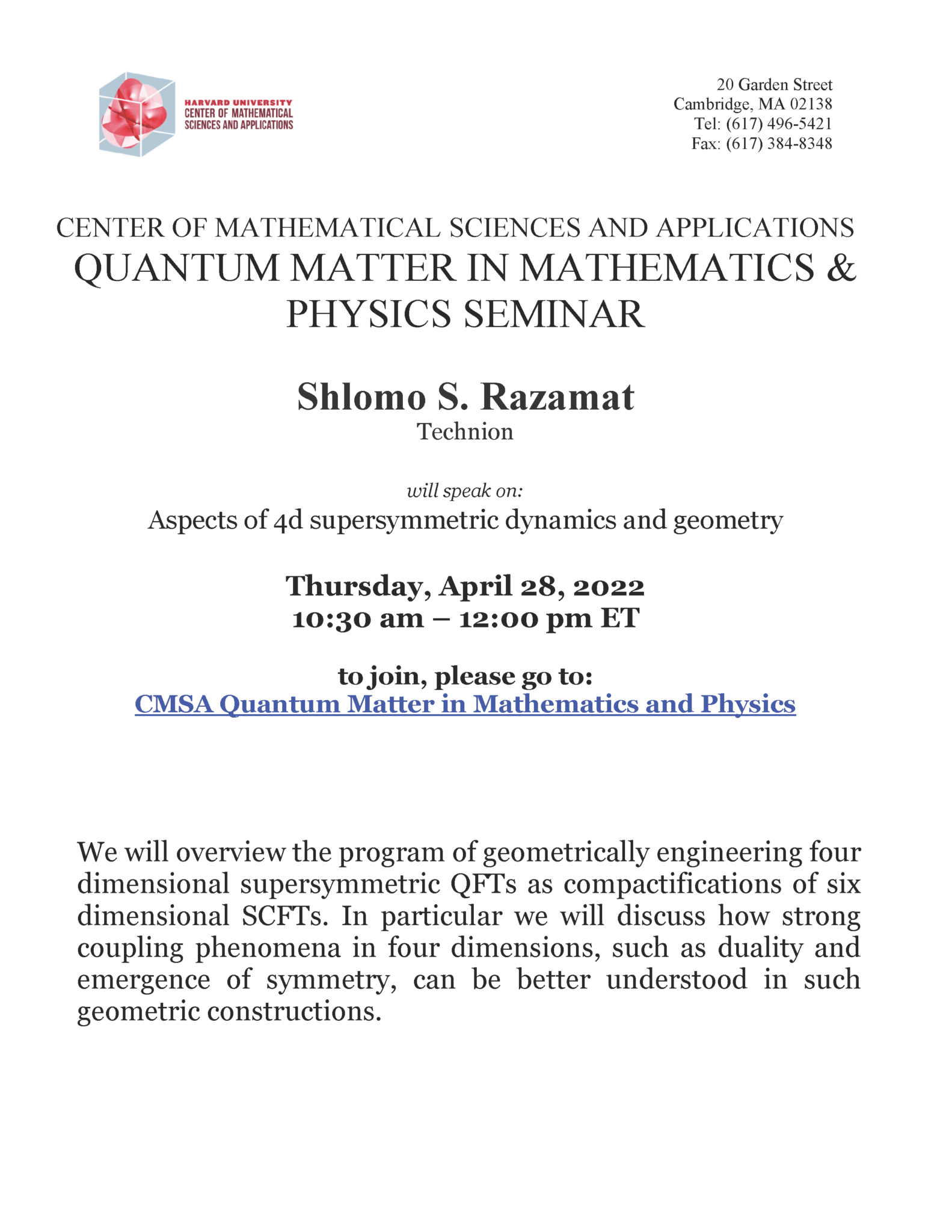
https://www.youtube.com/watch?v=c6_RbJS8CoM&list=PL0NRmB0fnLJQAnYwkpt9PN2PBKx4rvdup&index=14&t=2s Abstract: We will overview the program of geometrically engineering four dimensional supersymmetric QFTs as compactifications of six dimensional SCFTs. In particular we will discuss how strong coupling phenomena in four dimensions, such as duality and emergence of symmetry, can be better understood in such geometric constructions.
-
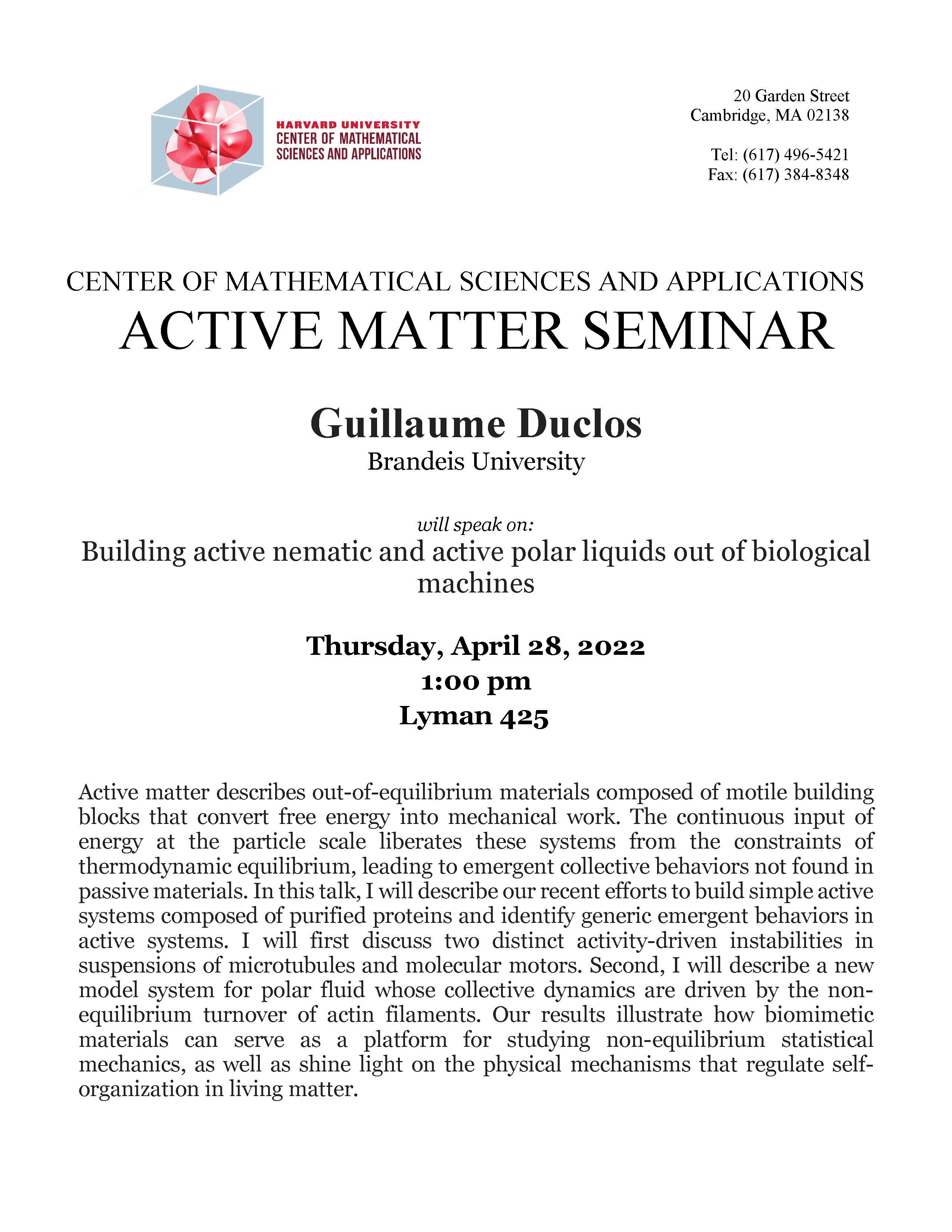
Speaker: Guillaume Duclos (Brandeis) Title: Building active nematic and active polar liquids out of biological machines Abstract: Active matter describes out-of-equilibrium materials composed of motile building blocks that convert free energy into mechanical work. The continuous input of energy at the particle scale liberates these systems from the constraints of thermodynamic equilibrium, leading to emergent collective behaviors not found in passive materials. In this talk, I […]
-
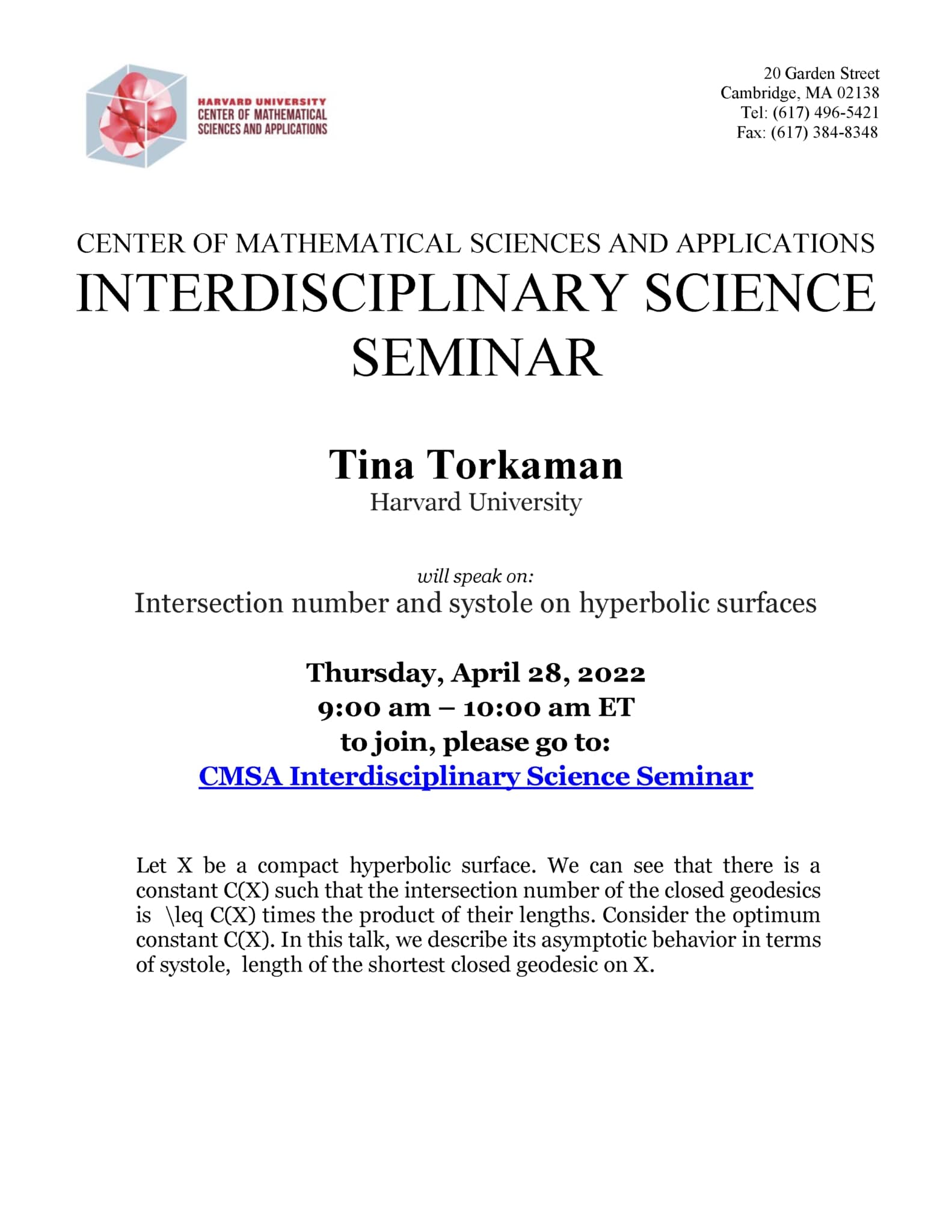
Abstract: Let X be a compact hyperbolic surface. We can see that there is a constant C(X) such that the intersection number of the closed geodesics is \leq C(X) times the product of their lengths. Consider the optimum constant C(X). In this talk, we describe its asymptotic behavior in terms of systole, length of the shortest […] |
6 events,
-
Member Seminar Speaker: Sergiy Verstyuk Title: Machine Learning the Gravity Equation for International Trade Abstract: We will go through modern deep learning methods and existing approaches to their interpretation. Next, I will describe a graph neural network framework. You will also be introduced to an economic analog of gravity. Finally, we will see how these […] |
||
5 events,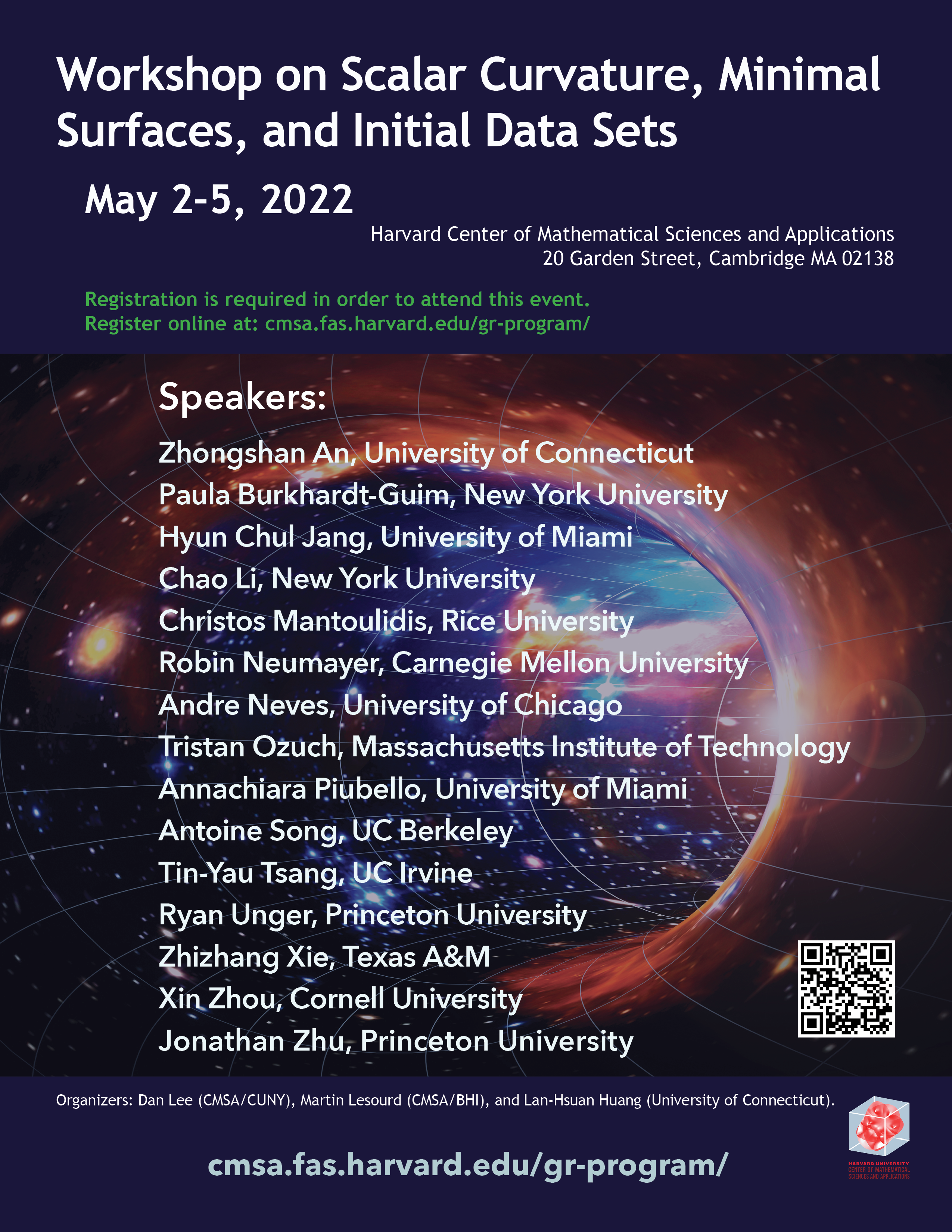
General Relativity Workshop on scalar curvature, minimal surfaces, and initial data sets Dates: May 2–5, 2022 Location: Room G10, CMSA, 20 Garden Street, Cambridge MA 02138 and via Zoom webinar. Advanced registration for in-person components is required. Organizers: Dan Lee (CMSA/CUNY), Martin Lesourd (CMSA/BHI), and Lan-Hsuan Huang (University of Connecticut). Speakers: Zhongshan An, University of Connecticut […] |
6 events,
-
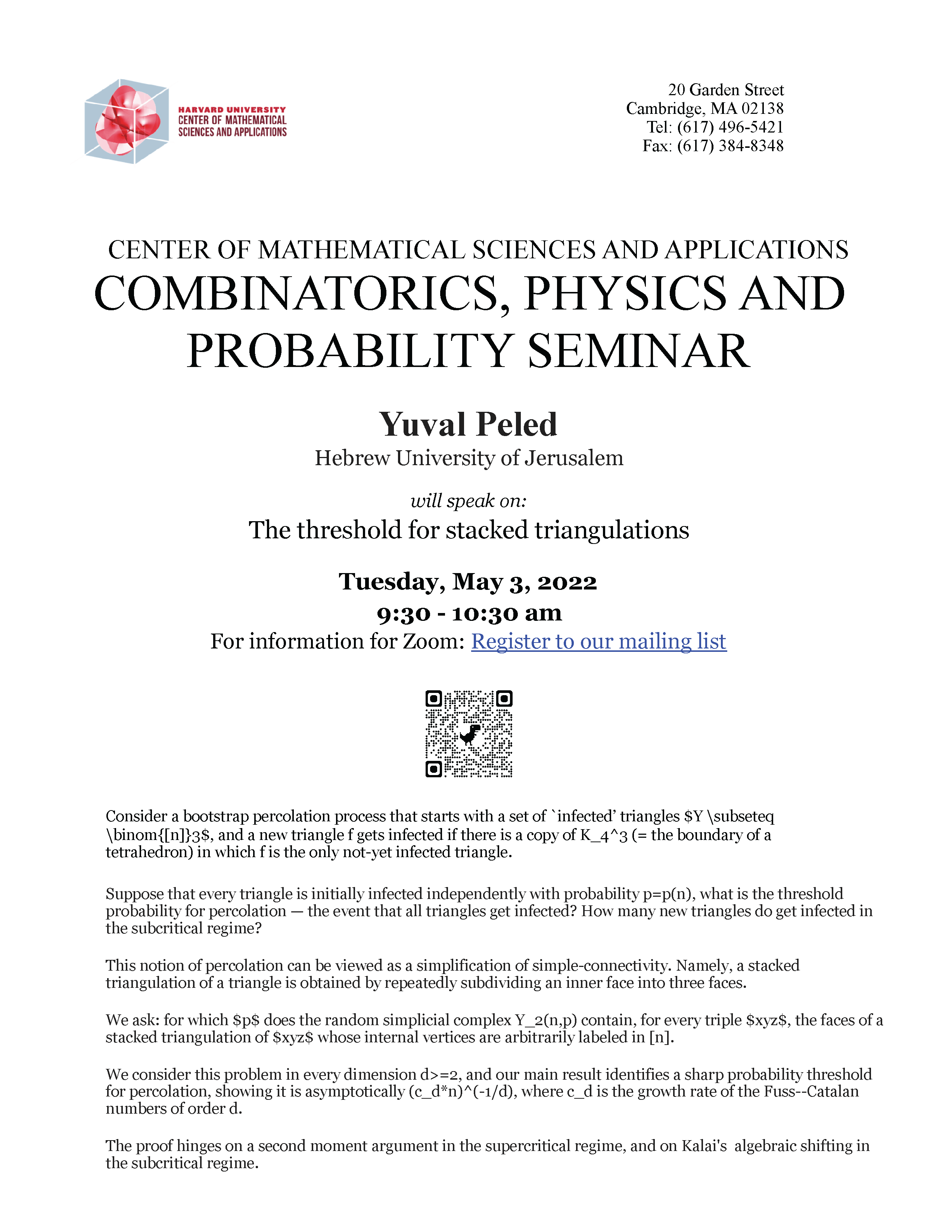
Abstract: Consider a bootstrap percolation process that starts with a set of `infected’ triangles $Y \subseteq \binom{}3$, and a new triangle f gets infected if there is a copy of K_4^3 (= the boundary of a tetrahedron) in which f is the only not-yet infected triangle. Suppose that every triangle is initially infected independently with […] |
6 events,
-
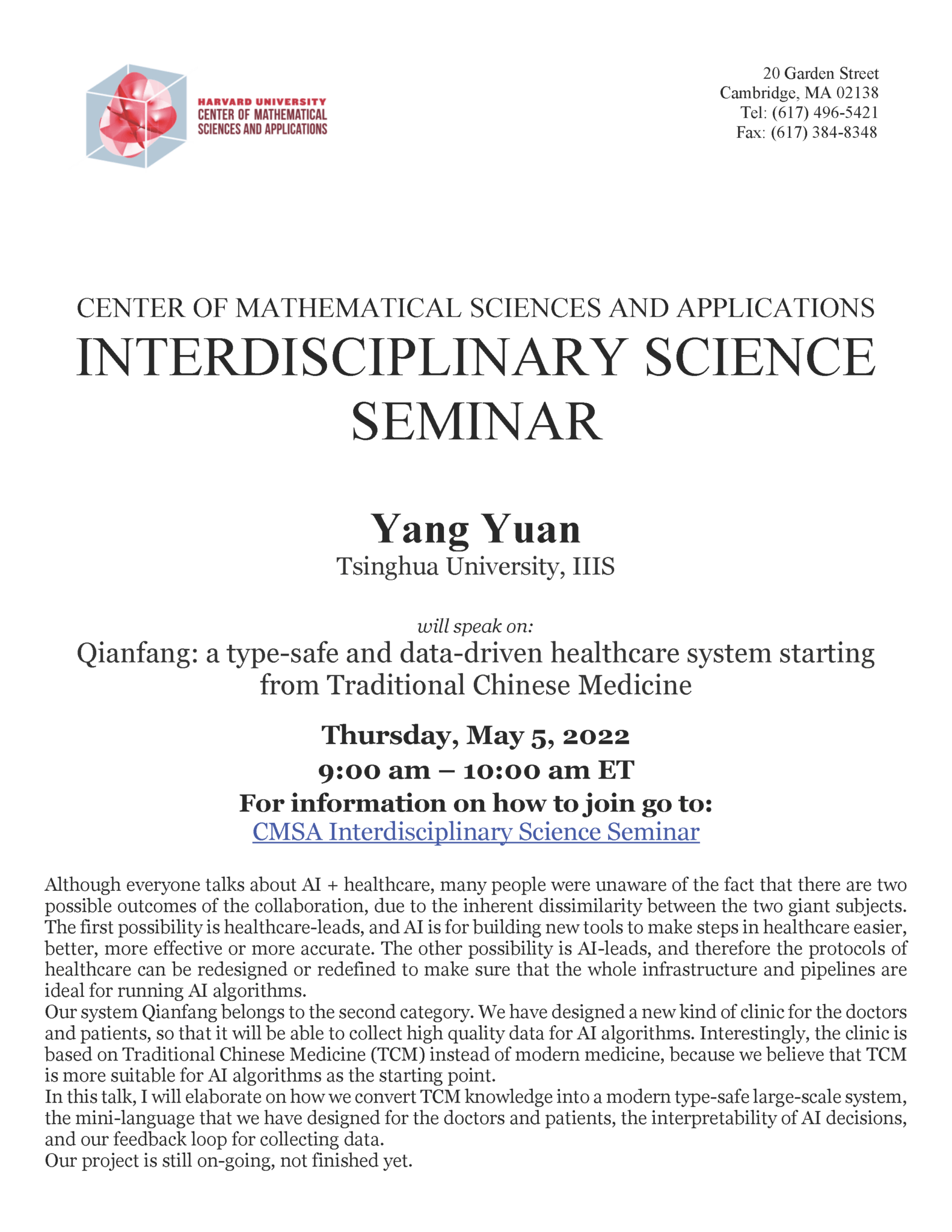
Abstract: Although everyone talks about AI + healthcare, many people were unaware of the fact that there are two possible outcomes of the collaboration, due to the inherent dissimilarity between the two giant subjects. The first possibility is healthcare-leads, and AI is for building new tools to make steps in healthcare easier, better, more effective or […] |
5 events,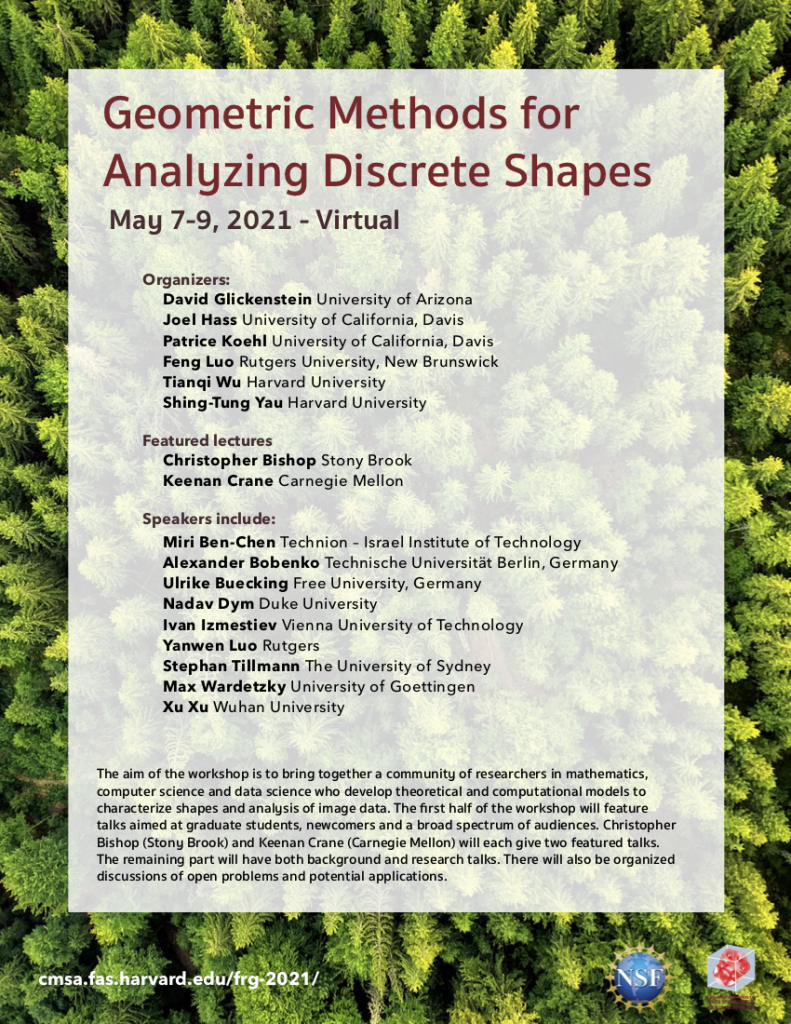
On May 6–8, 2022, the CMSA hosted a second NSF FRG Workshop. This project brings together a community of researchers who develop theoretical and computational models to characterize shapes. Their combined interests span Mathematics (Geometry and Topology), Computer Science (Scientific Computing and Complexity Theory), and domain sciences, from Data Sciences to Computational Biology. Scientific research […] |
|||
6 events,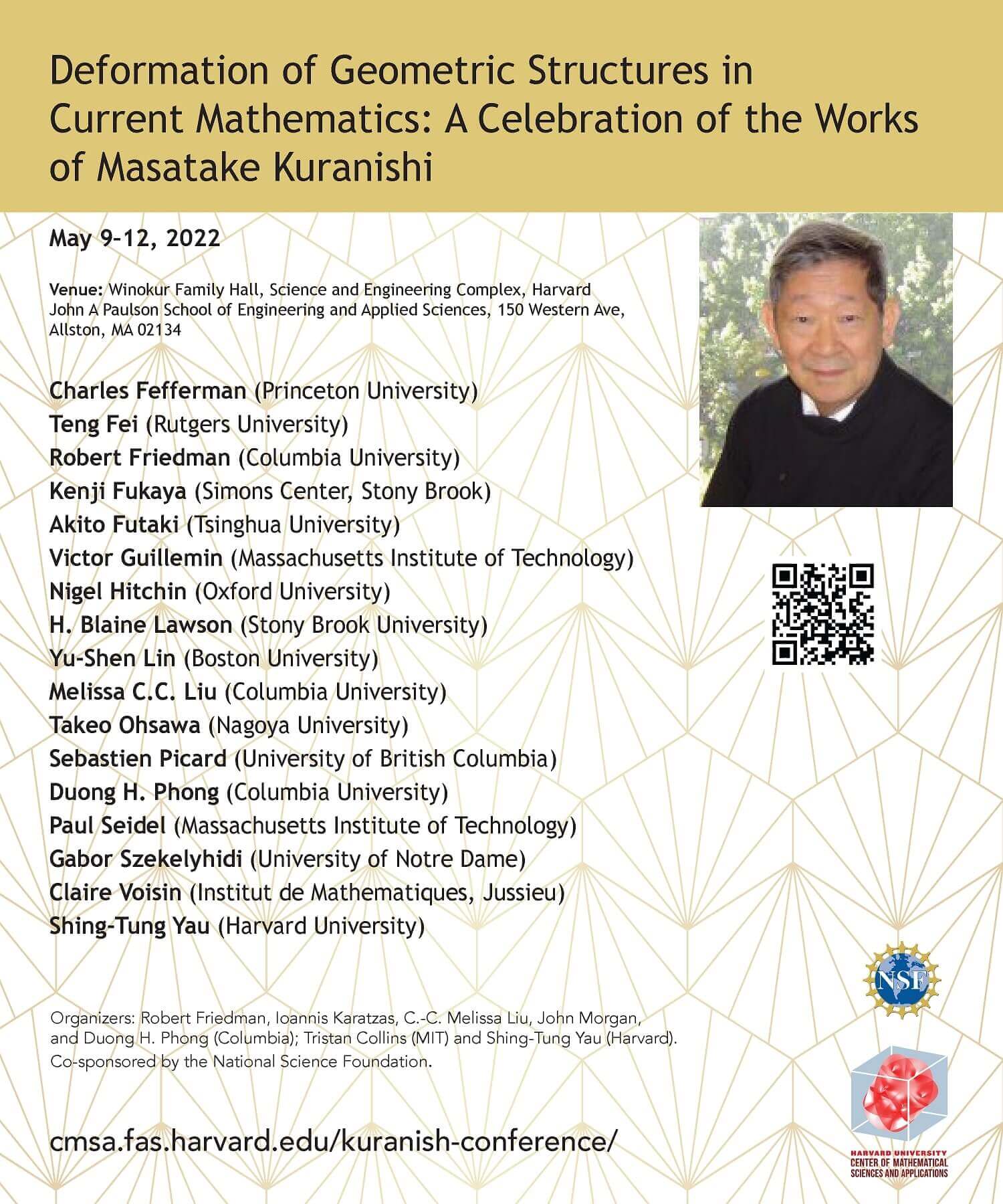
On May 9–12, 2022, the CMSA hosted the conference Deformations of structures and moduli in geometry and analysis: A Memorial in honor of Professor Masatake Kuranishi. Organizers: Tristan Collins (MIT) and Shing-Tung Yau (Harvard and Tsinghua) Videos are available on the conference playlist. Speakers: Charles Fefferman (Princeton University) Teng Fei (Rutgers University) Robert Friedman (Columbia […]
-
Abstract: I will explore the interplay between Swampland conjectures and models of inflation and light Dark Matter. To that end, I will briefly review the weak gravity conjecture (WGC) and the related Festina Lente (FL) bound. These have implications for light darkly and milli-charged particles and can disfavor a large portion of parameter space. The FL bound […] |
6 events,
-
https://www.youtube.com/watch?v=QMbWPWeuJOQ&list=PL0NRmB0fnLJQAnYwkpt9PN2PBKx4rvdup&index=12 Abstract: We are familiar with the idea that quantum gravity in AdS can holographically emerge from complex patterns of entanglement, but can the physics of big bang cosmology emerge from a quantum many-body system? In this talk I will argue that standard tools of holography can be used to describe fully non-perturbative microscopic models of cosmology in which a period […] |
7 events,
-
https://www.youtube.com/watch?v=jnWI9sCfAi0&list=PL0NRmB0fnLJQAnYwkpt9PN2PBKx4rvdup&index=11&t=2s Abstract: The CDF collaboration recently reported a new precise measurement of the W boson mass MW with a central value significantly larger than the SM prediction. We explore the effects of including this new measurement on a fit of the Standard Model (SM) to electroweak precision data. We characterize the tension of this new measurement […]
-
Abstract: Many statistical and computational tasks boil down to comparing probability measures expressed as density functions, clouds of data points, or generative models. In this setting, we often are unable to match individual data points but rather need to deduce relationships between entire weighted and unweighted point sets. In this talk, I will summarize our team’s […] |
5 events,
-
Cobordism and Deformation Class of the Standard Model and Beyond: Proton Stability and Neutrino Mass
Cobordism and Deformation Class of the Standard Model and Beyond: Proton Stability and Neutrino Mass
Member Seminar Speaker: Juven Wang Title: Cobordism and Deformation Class of the Standard Model and Beyond: Proton Stability and Neutrino Mass Abstract: ‘t Hooft anomalies of quantum field theories (QFTs) with an invertible global symmetry G (including spacetime and internal symmetries) in a d-dim spacetime are known to be classified by a d+1-dim cobordism group TPd+1(G), […] |
|||
5 events,
-

SMaSH: Symposium for Mathematical Sciences at Harvard On Tuesday, May 17, 2022, from 9:00 am – 5:30 pm, the Harvard John A Paulson School of Engineering and Applied Sciences (SEAS) and the Harvard Center of Mathematical Sciences and Applications (CMSA) held a Symposium for Mathematical Sciences for the mathematical sciences community at Harvard. Organizing Committee […]
-
Abstract: In 1973, Erdős conjectured the existence of high girth (n,3,2)-Steiner systems. Recently, Glock, Kühn, Lo, and Osthus and independently Bohman and Warnke proved the approximate version of Erdős’ conjecture. Just this year, Kwan, Sah, Sawhney, and Simkin proved Erdős’ conjecture. As for Steiner systems with more general parameters, Glock, Kühn, Lo, and Osthus conjectured the […] |
5 events,
-
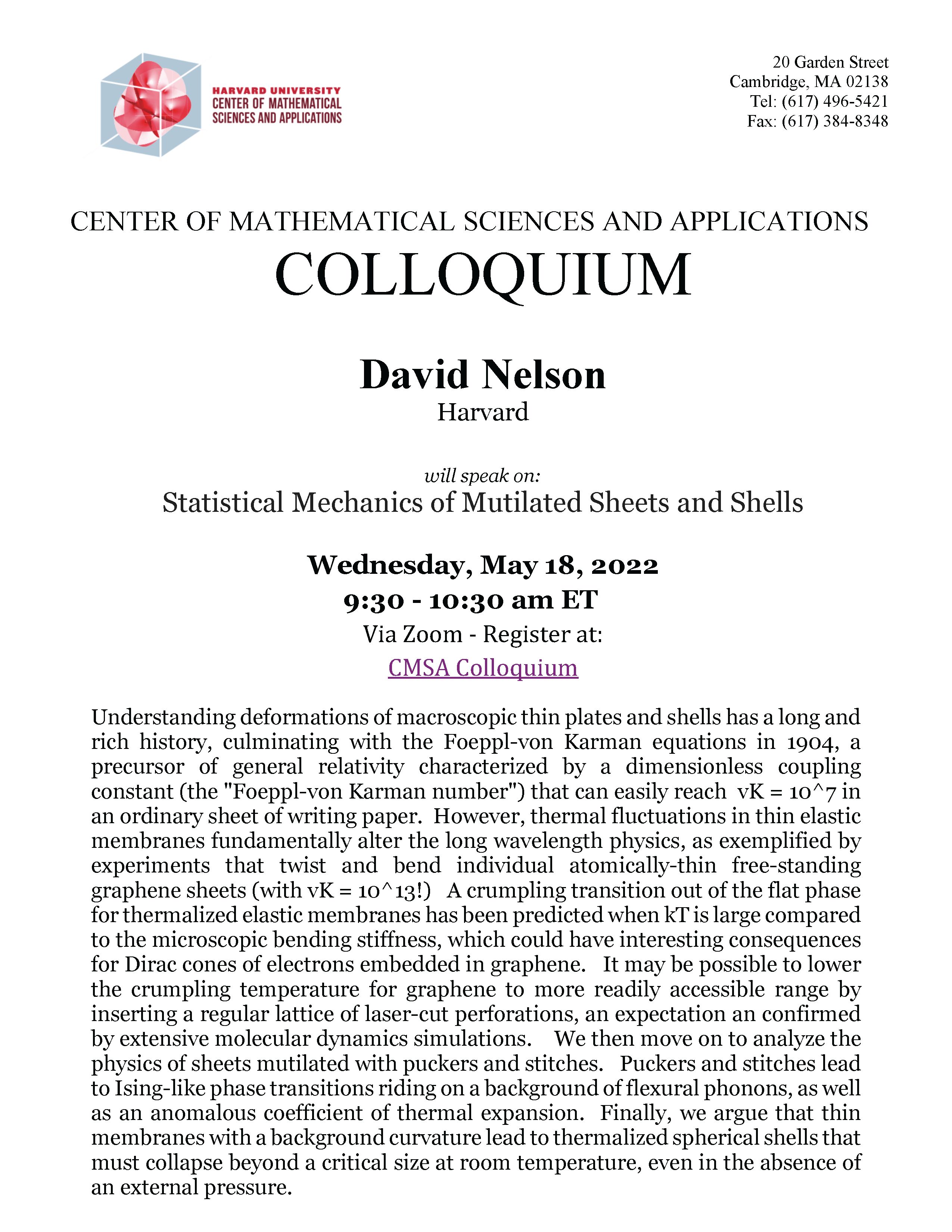
Speaker: David Nelson, Harvard University Title: Statistical Mechanics of Mutilated Sheets and Shells Abstract: Understanding deformations of macroscopic thin plates and shells has a long and rich history, culminating with the Foeppl-von Karman equations in 1904, a precursor of general relativity characterized by a dimensionless coupling constant (the “Foeppl-von Karman number”) that can easily reach vK […]
-
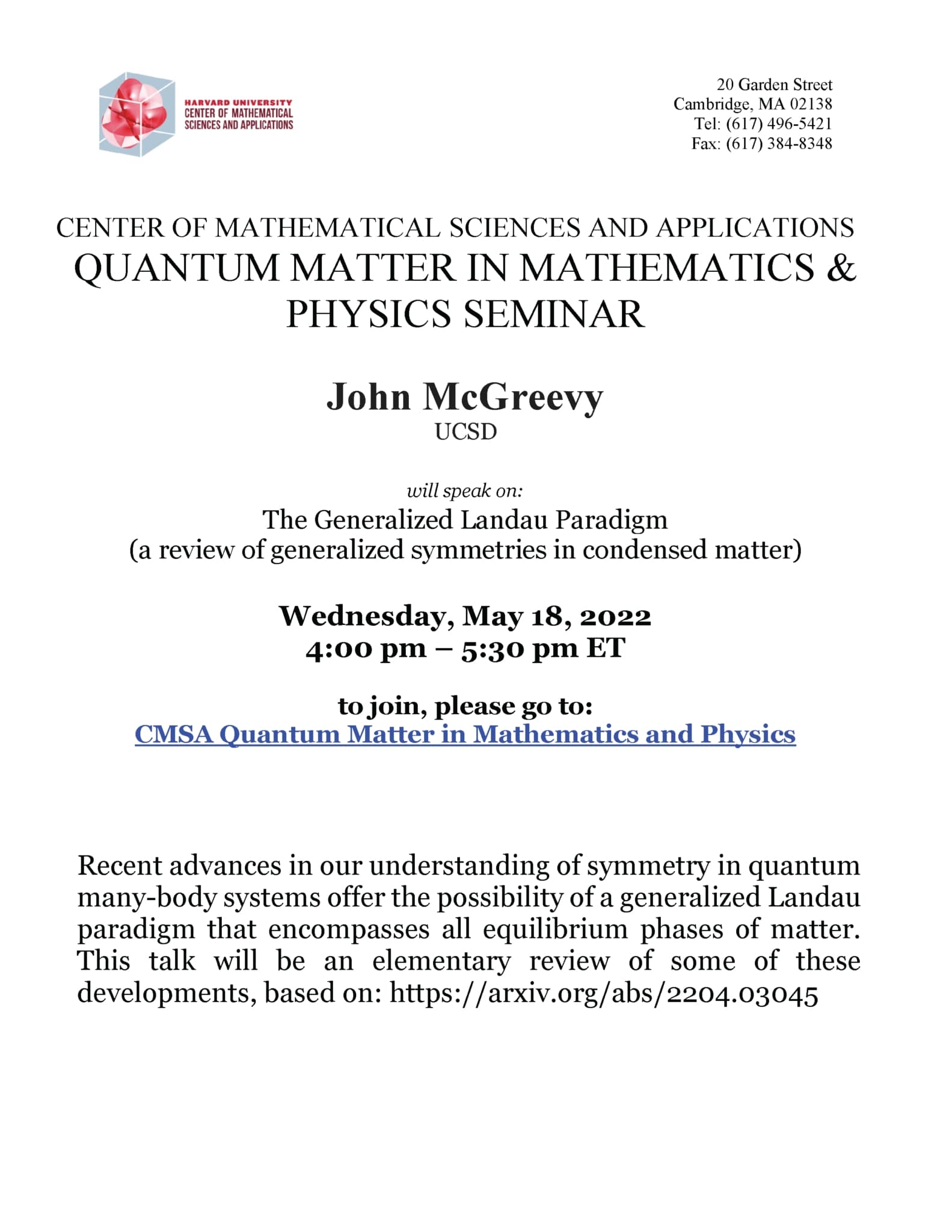
https://www.youtube.com/watch?v=orT7vWJiCeo&list=PL0NRmB0fnLJQAnYwkpt9PN2PBKx4rvdup&index=10&t=15s Abstract: Recent advances in our understanding of symmetry in quantum many-body systems offer the possibility of a generalized Landau paradigm that encompasses all equilibrium phases of matter. This talk will be an elementary review of some of these developments, based on: https://arxiv.org/abs/2204.03045
-
Speaker: Linhao Li (ISSP, U Tokyo) Title: Boundary conditions and LSM anomalies of conformal field theories in 1+1 dimensions Abstract: In this talk, we will study a relationship between conformally invariant boundary conditions and anomalies of conformal field theories (CFTs) in 1+1 dimensions. For a given CFT with a global symmetry, we consider symmetric gapping […] |
3 events,
-
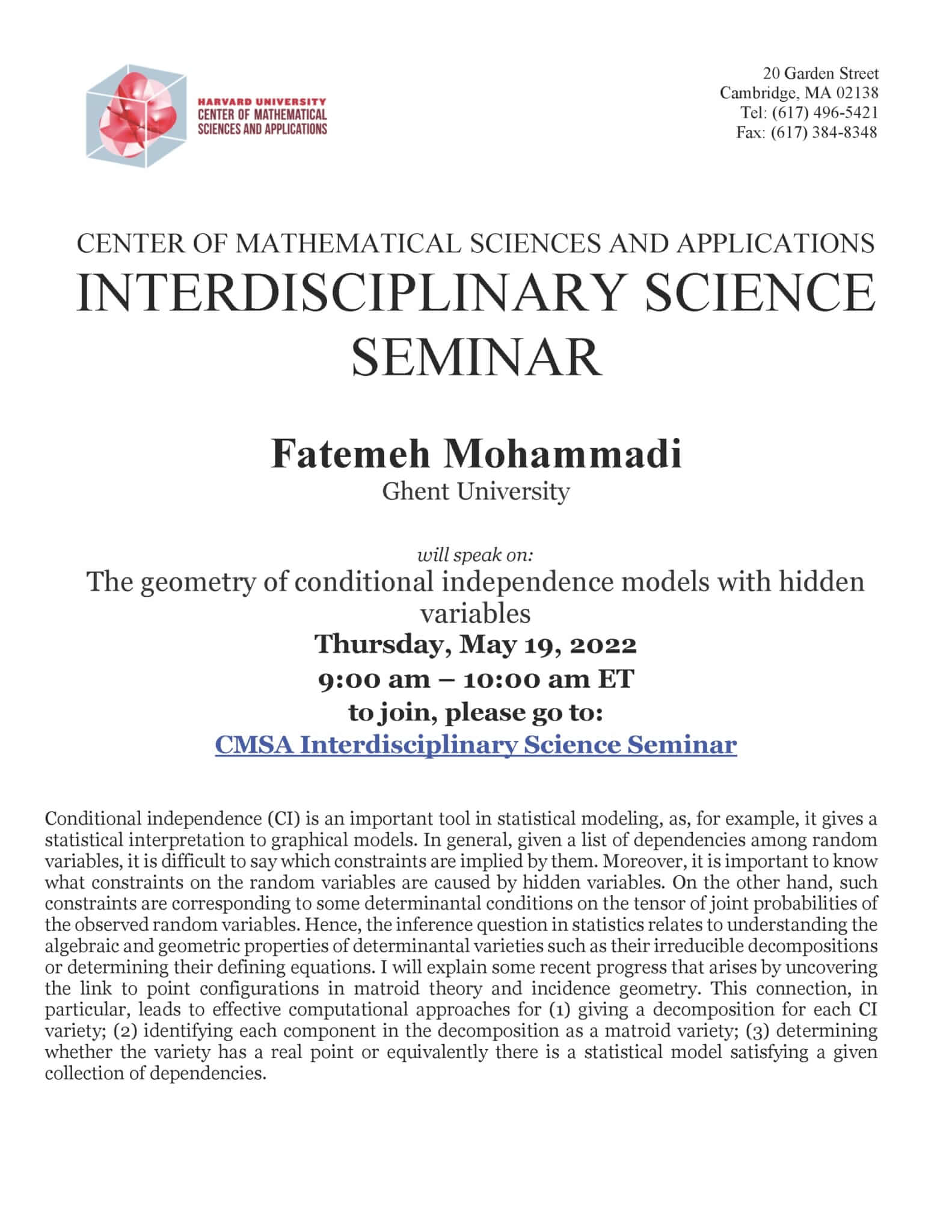
Abstract: Conditional independence (CI) is an important tool instatistical modeling, as, for example, it gives a statistical interpretation to graphical models. In general, given a list of dependencies among random variables, it is difficult to say which constraints are implied by them. Moreover, it is important to know what constraints on the random variables are caused […] |
3 events,
The Math Department and Harvard’s Center of Mathematical Sciences and Applications (CMSA) will be running a math program/course for mathematically minded undergraduates this summer. The course will be run by Dr. Yingying Wu from CMSA. Here is a description: Summer Introduction to Mathematical Research (sponsored by CMSA and the Harvard Math Department) In this course, we will start […] |
|||
3 events,
-
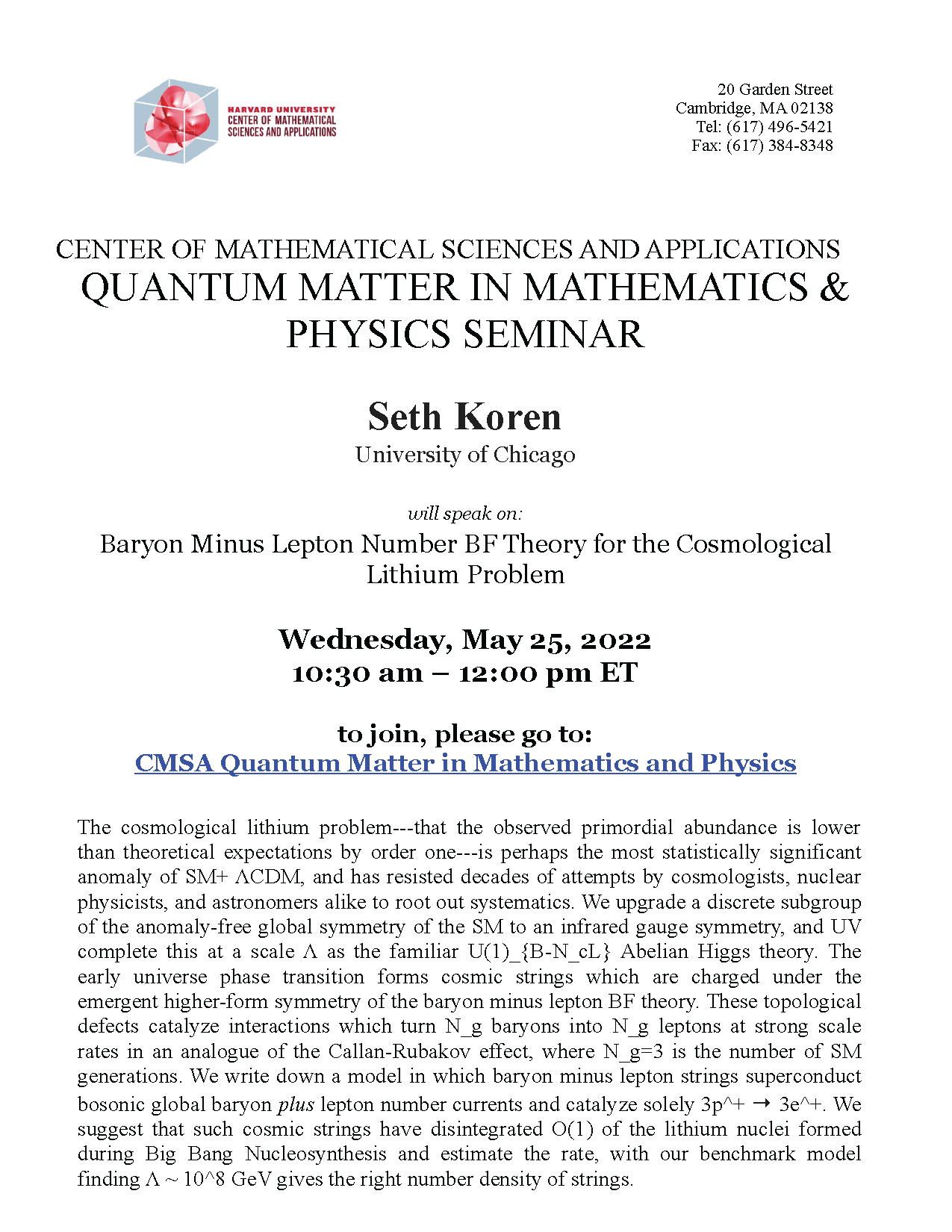
Speaker: Seth Koren (University of Chicago) Title: Baryon Minus Lepton Number BF Theory for the Cosmological Lithium Problem Abstract: The cosmological lithium problem—that the observed primordial abundance is lower than theoretical expectations by order one—is perhaps the most statistically significant anomaly of SM+ ΛCDM, and has resisted decades of attempts by cosmologists, nuclear physicists, and […] |
2 events,
-
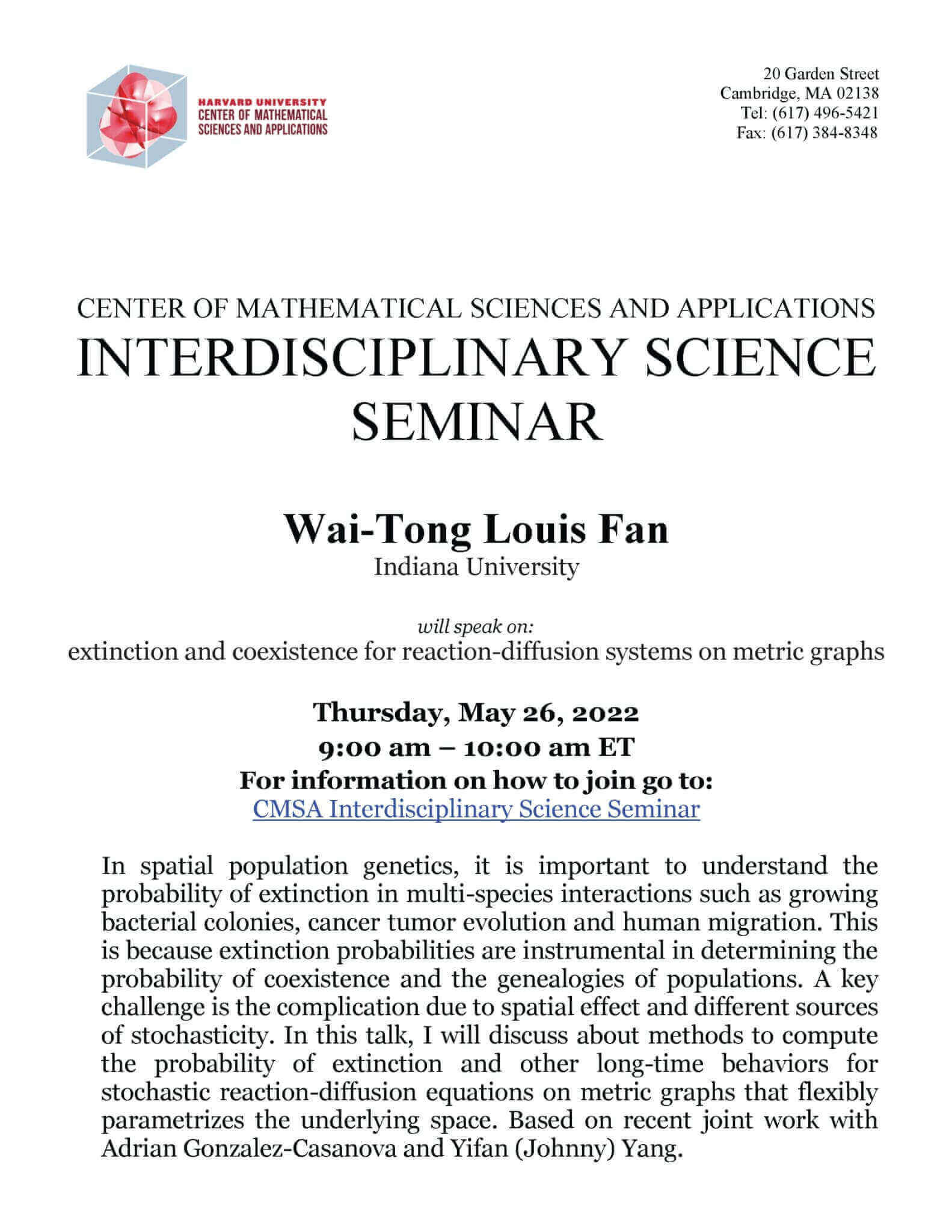
Abstract: In spatial population genetics, it is important to understand the probability of extinction in multi-species interactions such as growing bacterial colonies, cancer tumor evolution and human migration. This is because extinction probabilities are instrumental in determining the probability of coexistence and the genealogies of populations. A key challenge is the complication due to spatial effect […] |
|||||
2 events,
-
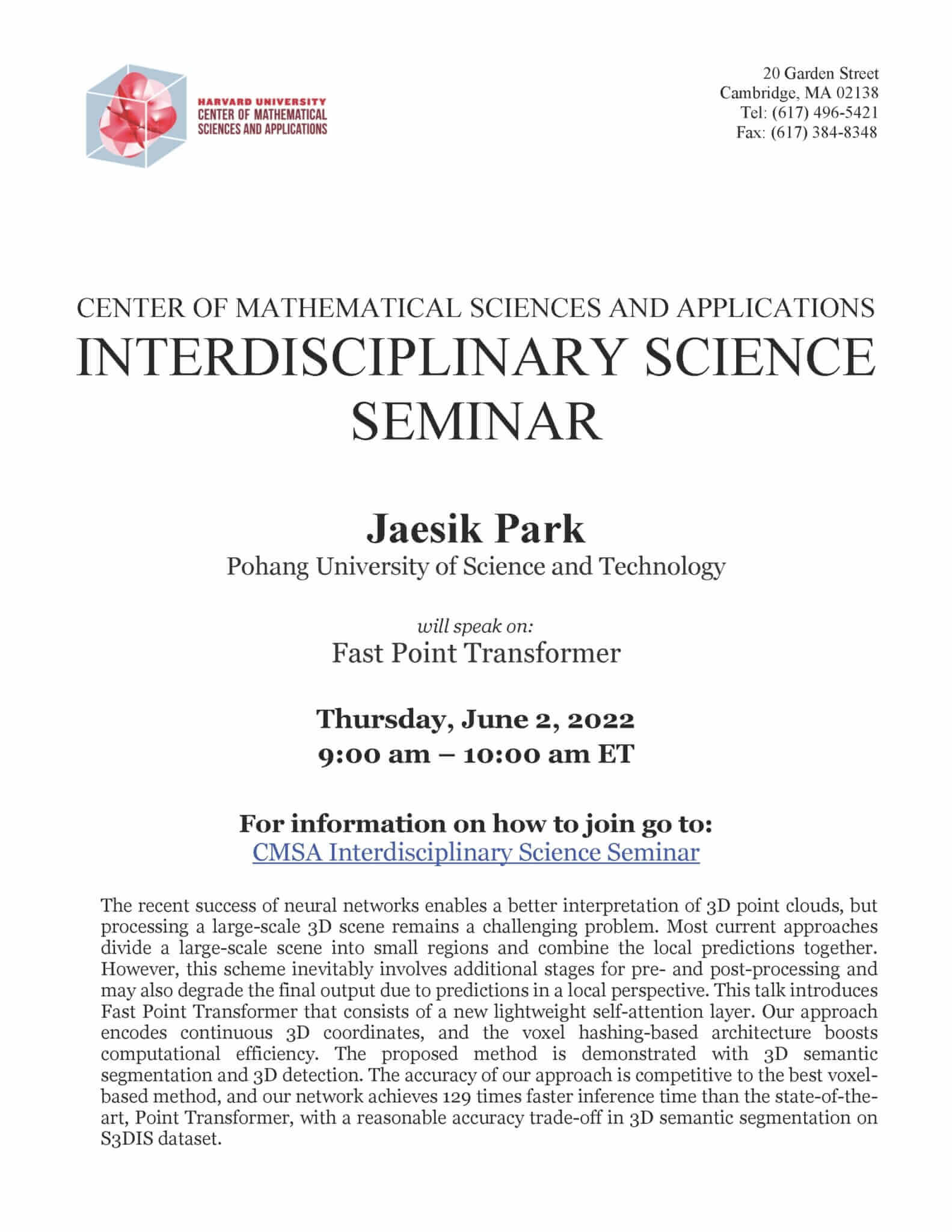
Abstract: The recent success of neural networks enables a better interpretation of 3D point clouds, but processing a large-scale 3D scene remains a challenging problem. Most current approaches divide a large-scale scene into small regions and combine the local predictions together. However, this scheme inevitably involves additional stages for pre- and post-processing and may also degrade […] |